
- New
| Reference: | A54374 |
| Author | Niccolò ROSSIGLIANI detto "Il Vicentino" |
| Year: | 1540 ca. |
| Measures: | 405 x 290 mm |
| Reference: | A54374 |
| Author | Niccolò ROSSIGLIANI detto "Il Vicentino" |
| Year: | 1540 ca. |
| Measures: | 405 x 290 mm |
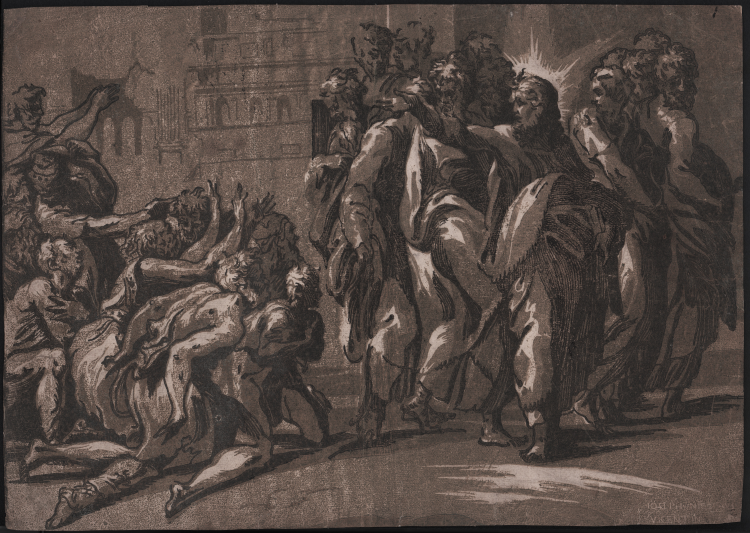
Chiaroscuro woodcut from 3 blocks, black and two shades of green, circa 1540-50.
Example of the first state with the inscription in the light tone block “IOSEPH NICOLAVS/VICENTINI”.
Christ Healing Lepers depicts the miraculous healing of lepers encountered by Jesus on his way to Jerusalem, in the company of the twelve apostles. The composition conforms in design and direction to a model of about the same size by Parmigianino, done in pen and brown ink with brown wash, accented with white, now at Chatsworth (Popham 1971). The monumental scale of the figures and the meticulous rendering of the drawing, with clear outlines and well-defined applications of washes and highlights, strongly suggest that Parmigianino conceived it in Bologna with a view to a print. Moreover, the image may be associated with the plague epidemic that struck northern Italy around 1528. Some of Parmigianino's drawings of similar execution were taken as models by Vicentino and Antonio da Trento.
Vicentino printed Christ Healing the Lepers in large numbers and in a variety of palettes, reflecting the popularity of the composition. Like other blocks from Vicentino's workshop, Christ Healing the Lepers was later reprinted by the by Andrea Andreani, who added the tile “AA in mantoua 1608” in the lower right corner of the darker block.
Popham and Landau, following Vasari, argue that the Vicentino carved the work after Parmigianino's death, ruling out, however, that the two artists had collaborated in making the chiaroscuro. Oberhuber, followed by Gnann, points out that Vicentino's style is reminiscent of Ugo da Carpi's and that Rossigliani probably met the artist and Parmigianino in Rome well before the Sack of 1527. The composition is also known through a translation print by Schiavone and one, in counterpart, by Leonard Thiry.
A magnificent impression, rich in tonal range, printed on contemporary laid paper; irregularly trimmed to the borderline; expertly executed restorations in the four corners and the central part of the right edge; otherwise in excellent condition.
When comparing this example of the Christ Healing the Lepers with those described in the Cini Foundation’s entry, it differs in color tones from all the ones listed.
https://archivi.cini.it/storiaarte/detail/49048/stampa-49048.html, I
Bibliografia
Naoko Takahatake, The Chiaroscuro Woodcut in Renaissance Italy, exhibition catalogue, Los Angeles County Museum of Art, 2018, pp. 131-135; Bartsch XII.39.15.I; B. Davis, Mannerist Prints, n. 51; Stiber Morenus L., Atlante delle xilografie italiane del Rinascimento, ALU.0992.1.
Niccolò ROSSIGLIANI detto "Il Vicentino" (Attivo a Vicenza 1540-50)
|
Italian woodcutter and printer. He signed five chiaroscuro woodcuts, each after a different artist and all undated. Probably the earliest is a two-block woodcut of Hercules and the Lion after Giulio Romano. Cloelia after Maturino or Giulio Romano, in three blocks, is still rather crudely cut and registered, and probably the next chronologically. A very cursive, elegant line manifests itself in subsequent works, such as Ajax and Agamemnon after Polidoro da Caravaggio, the Sacra Conversazione with St Catherine after a design attributed to Camillo Boccaccino and Christ Healing the Lepers after Parmigianino. An unsigned Adoration of the Magi and The Cardinal and the Doctor can also reasonably be ascribed to him. His hand is doubtless one of several discernible in a large group of anonymous chiaroscuros based on designs by Parmigianino that may represent the products of a workshop supervised by Vicentino. Vasari related how Parmigianino had certain chiaroscuros cut by Antonio da Trento, and that many other designs were printed after the painter’s death by ‘Joannicolo Vicentino’. A group of ten small anonymous two-block chiaroscuros after silverpoint drawings by Parmigianino as well as the Twelve Apostles in which two cutting hands are visible, are presumably part of this output, along with about a dozen more anonymous chiaroscuros. That Vicentino had a workshop is further suggested by the fact that a large number of the Parmigianino drawings related to the chiaroscuros remained together and that Andrea Andreani seems to have acquired many of the blocks and reprinted them later in the 16th century.
|