
| Reference: | S50259 |
| Author | Raffaello GUIDI |
| Year: | 1598 ca. |
| Measures: | 340 x 585 mm |
| Reference: | S50259 |
| Author | Raffaello GUIDI |
| Year: | 1598 ca. |
| Measures: | 340 x 585 mm |
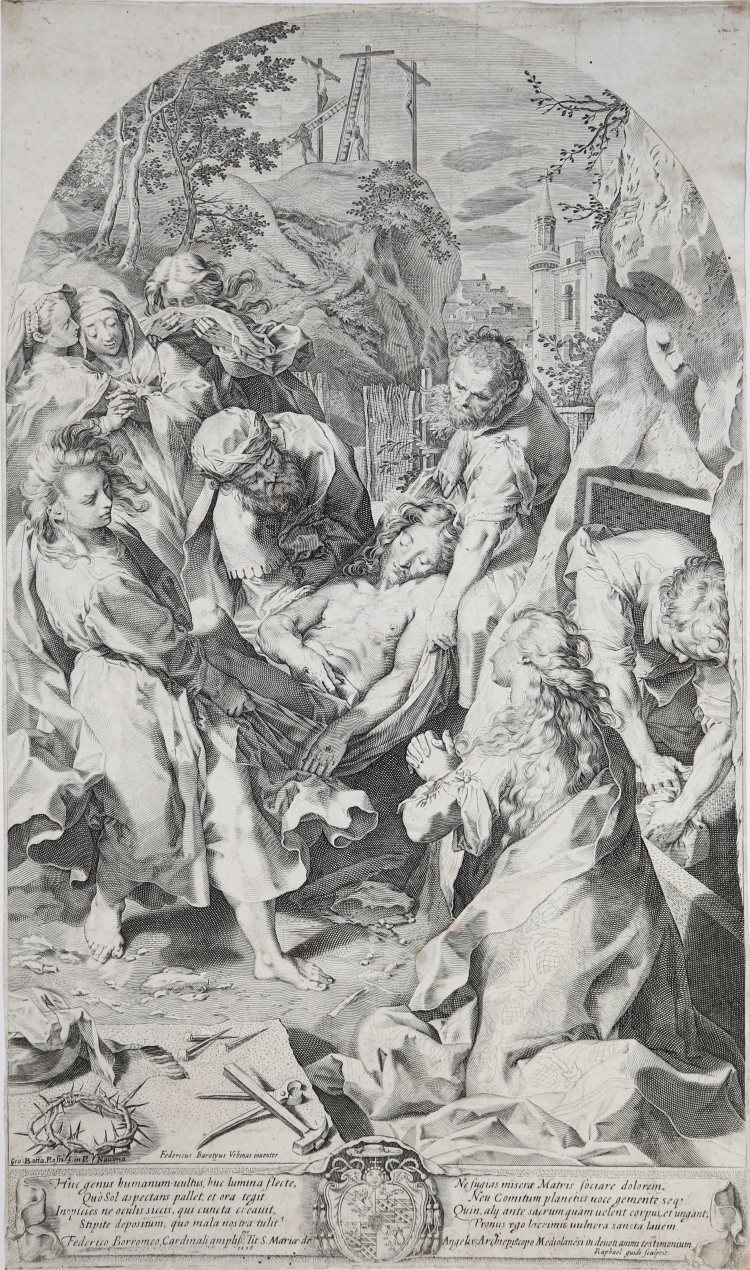
Entombment, after Federico Barocci. Jesus's body is lifted on a white shroud towards a coffin at left where Mary Magdalene kneels; Mary weeps flanked by two other women; on a slab in the foreground at right is the crown of thorns, nail, pliers and hammer, and at centre is another slab bearing a dedication and a coat of arms; in the background, the three crosses on a hill.
Engraving, 1598, lettered below left "Federicus Barotÿus Vrbinas inventor". Lettered on a banner below either side of a coat-of-arms in two columns, each four lines Huc genus humanum vultus, huc lumina flecte, / Quo' Sol aspectans pallet, et ora tegit. / Inspicies ne oculis siccis, qui cuncta creavit, / Stipte depositu, quo male nostra tullit? // Ne fugias miserae Matris dolorem, / Neu Comitum planctus voce gemente sequi. / Quin, alij ante sacrum quam velent corpus, et ungant, / Pronus ego lacrimis vulnera sancta lavem. Federico Borromeo Cardinali ampliss:mo Tit. S. Mariae de Angelis Archiepiscopo Mediolanesi in devoti animi testimonium. 1598. Raphael guidi scolpsit.
Example of the second state, with the imprint by Cesare Capranica erased and showing the address: Gio. Batta. Rossi f. in P. Navona.
Barocci's painting reproduced here was likely copied by Raffaello Guidi from the sheet engraved by Aegidius Sadeler between 1595 and 1597, during his stay in Verona. The same subject was also reproduced by Philippe Thomassin between 1585 and 1590. Federigo Borromeo, to whom the print is dedicated, is listed as Archbishop of Milan, which would date it to 1595 or later. The verses in the lower margin are by the Veronese poet Flaminio Valerini. The dedication to Federico Borromeo may have been intended to gain powerful support, and possibly even a gift.
Barocci originally created the painting, from which this print is based, between 1579 and 1582 as an altarpiece for the chapel of the Confraternity of the Cross and the Sacrament in Senigallia.
This reproduction engraving shows the painting the right way up, with the original arched upper portion, and overall the representation is very accurate. There are some subtle adjustments in relative dimensions that seem to bring the group of figures closer together: the fence and gate in the background are enlarged and therefore moved forward, compressing the space for the figures. The way the ribbon on which the inscription is written wraps around the coat of arms creates a forward plane behind which the pictorial space opens up.
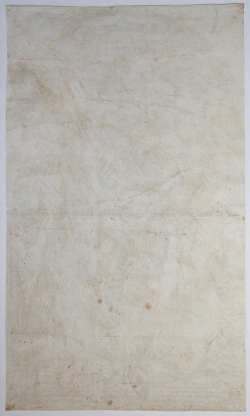
A beautiful work, printed on laid paper without watermark, traces of glue and small abrasions on the verso, otherwise in good condition.
Bibliografia
Silvia Massa, Le incisioni di riproduzione di Raffaello Guidi, in “Grafica d’Arte” n. 99, pp. 8-13, n. 12; Nagler G.K., Neues Allgemeines Künstler-Lexikon, V 5, p. 441; M. Bury, 'The Print in Italy 1550-1620', n. 68 (Aegidius Sadeler).
Raffaello GUIDI (Firenze 1561 circa – Roma, dopo il 1615)
|
The engravings of Raffaello Guidi, active in Rome between 1585 and 1615, have never been the subject of in-depth study. The chronological data available to date have only partially reconstructed Guidi's life. The artist was of Tuscan origin, perhaps a native of Florence, as indicated in the dedication of a print signed Raphael Gaidus Florentinum and in several documents where the same phrase appears. His birth year, set by most catalogues and repertoires at 1540, is a controversial issue. Bruwaert, without citing his sources, wrote that in 1586 Antonio Tempesta had announced himself to Raffaello Guidi, then 25 years old; this information would push the date back to 1561; this is more reasonable considering that Guidi's first dated work dates from 1585. Not only that, but he lived at least until 1616 and had a son, Michelangelo, also an engraver, who had his daughter baptized in 1617. Based on these data, it can therefore be assumed that Guidi was born in the early 1560s. Regarding Guidi's educational background, there is no certain information, except for some references to Agostino Carracci and Cornelis Cort, whose engraving style Guidi is considered a follower of. It is, however, likely that he moved to Rome around 1575; perhaps this occurred through Benedetto del Chiaro, a Florentine printer and merchant active in Rome, who published Guidi's first engraved work, the Madonna of San Giovanni. At this point, Guidi was perhaps introduced to the city's printers and engravers by the city's milieu, and may have served his apprenticeship with Cort until his death. However, he may also have known Agostino Carracci who resided in Rome on several occasions starting in 1581.
|
Raffaello GUIDI (Firenze 1561 circa – Roma, dopo il 1615)
|
The engravings of Raffaello Guidi, active in Rome between 1585 and 1615, have never been the subject of in-depth study. The chronological data available to date have only partially reconstructed Guidi's life. The artist was of Tuscan origin, perhaps a native of Florence, as indicated in the dedication of a print signed Raphael Gaidus Florentinum and in several documents where the same phrase appears. His birth year, set by most catalogues and repertoires at 1540, is a controversial issue. Bruwaert, without citing his sources, wrote that in 1586 Antonio Tempesta had announced himself to Raffaello Guidi, then 25 years old; this information would push the date back to 1561; this is more reasonable considering that Guidi's first dated work dates from 1585. Not only that, but he lived at least until 1616 and had a son, Michelangelo, also an engraver, who had his daughter baptized in 1617. Based on these data, it can therefore be assumed that Guidi was born in the early 1560s. Regarding Guidi's educational background, there is no certain information, except for some references to Agostino Carracci and Cornelis Cort, whose engraving style Guidi is considered a follower of. It is, however, likely that he moved to Rome around 1575; perhaps this occurred through Benedetto del Chiaro, a Florentine printer and merchant active in Rome, who published Guidi's first engraved work, the Madonna of San Giovanni. At this point, Guidi was perhaps introduced to the city's printers and engravers by the city's milieu, and may have served his apprenticeship with Cort until his death. However, he may also have known Agostino Carracci who resided in Rome on several occasions starting in 1581.
|