
| Reference: | A54402 |
| Author | Jacopo Barozzi detto il VIGNOLA |
| Year: | 1562 |
| Printed: | Rome |
| Measures: | 205 x 345 mm |
| Reference: | A54402 |
| Author | Jacopo Barozzi detto il VIGNOLA |
| Year: | 1562 |
| Printed: | Rome |
| Measures: | 205 x 345 mm |
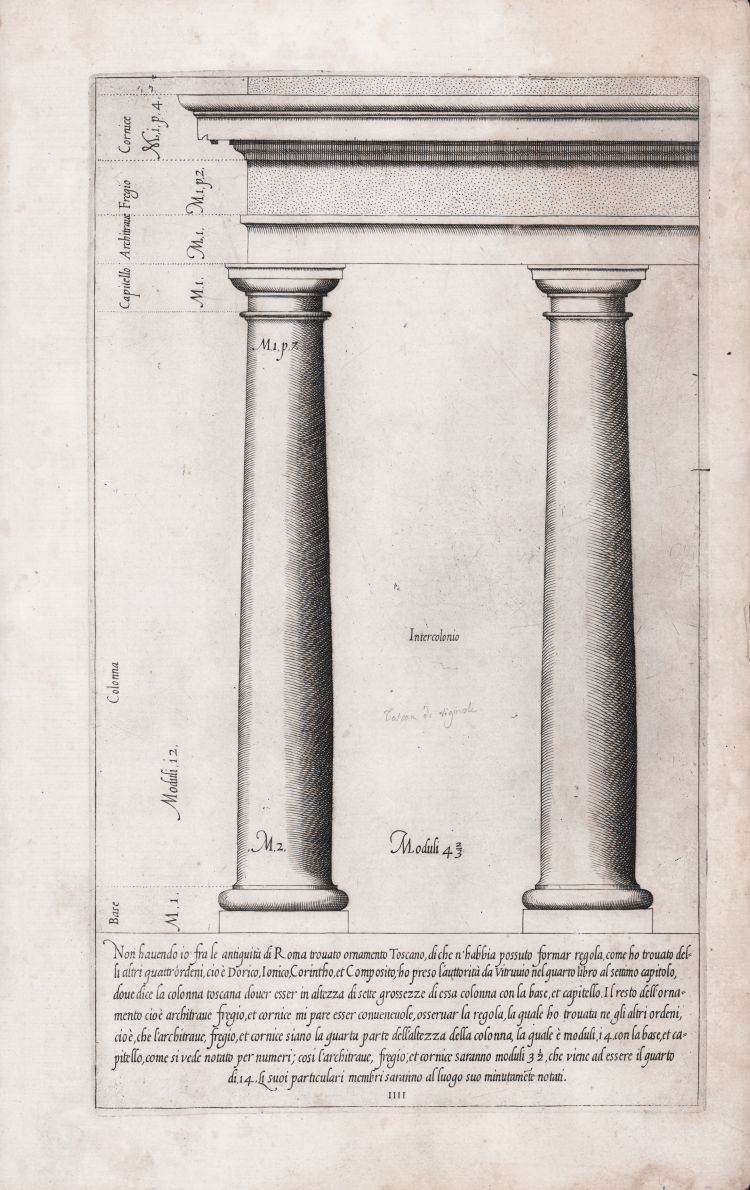
Architectural plate of the first edition of the Regola delli cinque ordini d’architettura [Rule of the Five Orders of Architecture], printed in Rome in 1562.
Published without typographical notes - but dated to 1562 based on a letter by Barozzi himself - the Regola delli cinque ordini d’architettura is one of the most famous and successful architectural books of the Renaissance, going through an impressive number of editions until the end of the 18th century. The Regola success is primarily due to its educational effectiveness. It is, in fact, a sort of handbook that presents a calculation system designed to facilitate the task of builders in designing and constructing their works according to the five architectural orders: Doric, Ionic, Corinthian, Tuscan, and Composite or Roman. For each order, Barozzi developed an algorithm that allowed him to calculate the thickness of the column from a given height, obtaining the radius of the column shaft, a unit of measurement used to calculate the dimensions of the other architectural elements (pedestal, capital, entablature), all of which had to comply with a strict general rule of proportion.
Etching and engraving, printed on contemporary laid paper, with margins, in excellent condition.
Jacopo Barozzi detto il VIGNOLA (Vignola 1507 - Roma 1573)
|
Jacopo Barozzi, originally from Vignola, was not only a great architect but also a painter, cartographer, and hydraulic engineer. After studying painting in Bologna, he directed the construction of the San Petronio factory in the Emilian capital from 1541 to 1550, designed the façade of the Palazzo dei Banchi, erected between 1565 and 1568 as part of a vast renovation of Piazza Maggiore, and demonstrated his versatility as a water and road engineer. Between 1541 and 1543, and again in 1545, he was summoned by Francis I, along with Primaticcio, Sebastiano Serlio, and Benvenuto Cellini, to the French court, where he painted perspectives and, on several occasions, cast bronze statues for the Palace of Fontainebleau. Having moved to Rome, between 1551 and 1555 he oversaw the construction of Villa Giulia in Rome for the new Pope Julius III. The palace, on the slopes of the Parioli hills, is considered one of his masterpieces. Concurrently, between 1551 and 1553, he built the small oval-plan church of Sant'Andrea on the Via Flaminia. The small temple, whose shape and size recalled Roman tombs, aroused the admiration of Palladio and became a model for entire generations of architects. During those years, Barozzi consolidated his relationships with various members of the Farnese family, who commissioned him to complete the Farnese palaces in Rome (the current French embassy, begun by Antonio da San Gallo in 1514 and continued by Michelangelo), Piacenza, and Caprarola. In Caprarola, where he conducted his first survey in 1556, Vignola was able to freely express his creativity, transforming the existing fortified structure into a sumptuous noble residence and completely redesigning the face of the small adjacent village. Having been awarded Roman citizenship, Jacopo Barozzi was buried in the Pantheon. His other great treatise, the Due regole della prospettiva prattica [Two Rules of Practical Perspective], published posthumously in 1583 by Egnazio Danti, represents a broad theoretical synthesis of the laws of perspective.
|
Jacopo Barozzi detto il VIGNOLA (Vignola 1507 - Roma 1573)
|
Jacopo Barozzi, originally from Vignola, was not only a great architect but also a painter, cartographer, and hydraulic engineer. After studying painting in Bologna, he directed the construction of the San Petronio factory in the Emilian capital from 1541 to 1550, designed the façade of the Palazzo dei Banchi, erected between 1565 and 1568 as part of a vast renovation of Piazza Maggiore, and demonstrated his versatility as a water and road engineer. Between 1541 and 1543, and again in 1545, he was summoned by Francis I, along with Primaticcio, Sebastiano Serlio, and Benvenuto Cellini, to the French court, where he painted perspectives and, on several occasions, cast bronze statues for the Palace of Fontainebleau. Having moved to Rome, between 1551 and 1555 he oversaw the construction of Villa Giulia in Rome for the new Pope Julius III. The palace, on the slopes of the Parioli hills, is considered one of his masterpieces. Concurrently, between 1551 and 1553, he built the small oval-plan church of Sant'Andrea on the Via Flaminia. The small temple, whose shape and size recalled Roman tombs, aroused the admiration of Palladio and became a model for entire generations of architects. During those years, Barozzi consolidated his relationships with various members of the Farnese family, who commissioned him to complete the Farnese palaces in Rome (the current French embassy, begun by Antonio da San Gallo in 1514 and continued by Michelangelo), Piacenza, and Caprarola. In Caprarola, where he conducted his first survey in 1556, Vignola was able to freely express his creativity, transforming the existing fortified structure into a sumptuous noble residence and completely redesigning the face of the small adjacent village. Having been awarded Roman citizenship, Jacopo Barozzi was buried in the Pantheon. His other great treatise, the Due regole della prospettiva prattica [Two Rules of Practical Perspective], published posthumously in 1583 by Egnazio Danti, represents a broad theoretical synthesis of the laws of perspective.
|