
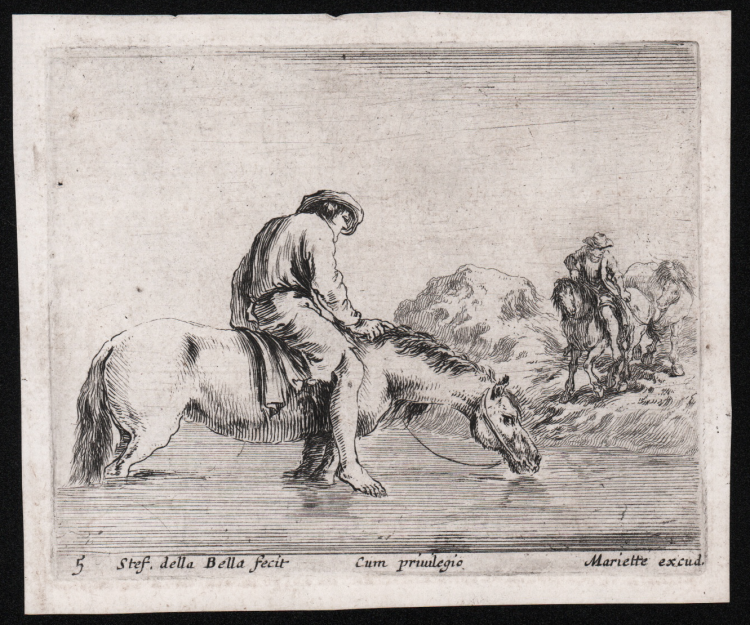


| Reference: | AS8 |
| Author | Stefano Della BELLA |
| Year: | 1644 ca. |
| Measures: | 95 x 80 mm |
| Reference: | AS8 |
| Author | Stefano Della BELLA |
| Year: | 1644 ca. |
| Measures: | 95 x 80 mm |
This print is part of the "Diversi Capricci" series, consisting of twenty-four plates. This sheet is number 5, as engraved at the bottom left.
Excellent impression, with intense blacks. Excellent condition, with traces of glue on the verso. Regular margins above the plate margin.
Status: IV/IV with Mariette's address
Bibliography: De Vesme-Massar, 134
Stefano Della BELLA (Firenze 1610 - 1664)
|
Stefano della Bella was one of the most interesting and ingenious artists of XVII century in Florence and can be considered as the sole real follower of Callot. He was educated in Florence at first, in the studio of Gasparo Mola and Orazio Vanni; this experience gave him a firm and careful hand when using the graver. He then went to Giovan Battista Vanni’s and, very likely, he also studied with Cantagallina and Cesare Dandini but, as Baldinucci said, he was still very young when he decided to leave painting and devoute entirely himself to engraving. His real master, then, can be considered Jacques Callot, the French engraver who lived for long time in Florence spreading his influence all around the city.
Lorenzo dè Medici became soon Stefano’s patron and invited the young artist in Rome between 1633 and 1636; in the Eternal City, the artist realized many copies from the antiquities and from Polidoro’s works. In 1633 he realized his first noteworthy work: Entrata a Roma dell’ambasciatore di Polonia Giorgio Ossolinsky.
In 1639 Stefano went to Paris where he lived, until 1650, out of a pension Lorenzo dè Medici had granted to him.
Around 1647, when travelling along the Netherlands, he met Rembrandt; from that moment the influence of the Dutch artist can be found in the entire Della Bella’s production.
|
Stefano Della BELLA (Firenze 1610 - 1664)
|
Stefano della Bella was one of the most interesting and ingenious artists of XVII century in Florence and can be considered as the sole real follower of Callot. He was educated in Florence at first, in the studio of Gasparo Mola and Orazio Vanni; this experience gave him a firm and careful hand when using the graver. He then went to Giovan Battista Vanni’s and, very likely, he also studied with Cantagallina and Cesare Dandini but, as Baldinucci said, he was still very young when he decided to leave painting and devoute entirely himself to engraving. His real master, then, can be considered Jacques Callot, the French engraver who lived for long time in Florence spreading his influence all around the city.
Lorenzo dè Medici became soon Stefano’s patron and invited the young artist in Rome between 1633 and 1636; in the Eternal City, the artist realized many copies from the antiquities and from Polidoro’s works. In 1633 he realized his first noteworthy work: Entrata a Roma dell’ambasciatore di Polonia Giorgio Ossolinsky.
In 1639 Stefano went to Paris where he lived, until 1650, out of a pension Lorenzo dè Medici had granted to him.
Around 1647, when travelling along the Netherlands, he met Rembrandt; from that moment the influence of the Dutch artist can be found in the entire Della Bella’s production.
|