
| Reference: | S49238.113 |
| Author | Gorge BRAUN |
| Year: | 1575 ca. |
| Zone: | Conil de la Frontera, Jerez de la Frontera |
| Printed: | Antwerpen & Cologne |
| Measures: | 465 x 320 mm |
| Reference: | S49238.113 |
| Author | Gorge BRAUN |
| Year: | 1575 ca. |
| Zone: | Conil de la Frontera, Jerez de la Frontera |
| Printed: | Antwerpen & Cologne |
| Measures: | 465 x 320 mm |
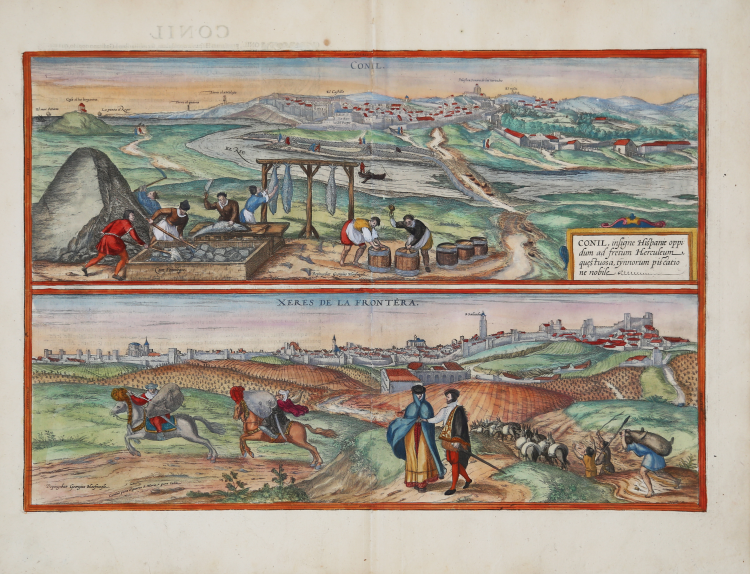
Two bird's-eye views on one sheet by Braun and Hogenberg after G. Hoefnagel: Conil de la Frontera and Jerez de la Frontera.
The plate is part of the second volume of Civitates Orbis Terrarum, published in 1575.
The Civitates Orbis Terrarum, is the first six-volume atlas devoted to town views and plans ever published.
The first volume of the Civitates Orbis Terrarum was published in Cologne in 1572. The sixth and the final volume appeared in 1617. This great city atlas, edited by Georg Braun and largely engraved by Franz Hogenberg, eventually contained 546 prospects, bird-eye views and map views of cities from all over the world. Fransz Hogenberg produced the plates for the first four books, and Simon van den Neuwel (Novellanus, active since 1580) those for volumes V and VI.
Georg Braun (1541-1622), a cleric of Cologne, was the principal editor of the work, and was greatly assisted in his project by the close, and continued interest of Abraham Ortelius, whose Theatrum Orbis Terrarum of 1570 was, as a systematic and comprehensive collection of maps of uniform style, the first true atlas. The Civitates, indeed, was intended as a companion for the Theatrum, as indicated by the similarity in the titles and by contemporary references regarding the complementary nature of two works. Nevertheless, the Civitates was designs to be more popular in approach, no doubt because the novelty of a collection of city plans and views represented a more hazardous commercial undertaking than a world atlas, for which there had been a number of successful precedents. Franz Hogenberg (1535-1590) was the son of a Munich engraves who settled in Malines. He engraved most of the plates for Ortelius's Theatrum and the majority of those in the Civitates and may have been responsible for originating the project.
Over a hundred different artists and cartographers, the most significant of whom was Antwerp artist Georg Hoefnagel (1542-1600), engraved the cooper-plates of the Civitates from drawings. He not only contributed most of the original material for the Spanish and Italian towns but also reworked and modified those of other contributors. After Hoefnagel's death his son Jakob continued the work for the Civitates.
The author set out to depict "non icones et typi urbium," that is, not generic and typified images, "sed urbes ipsae admirabili caelaturae artificio, spectantium oculis subiectae appareant": not intended to allude or idealize but to represent faithfully on paper, to reproduce exactly, and in real time, what the eye sees, as announced in the preface to the first volume of Civitates Orbis Terrarum.
Engraving with fine hand colour, in very good condition.
Bibliografia
Van der Krogt 4, 4659; Fauser, 4659; Taschen, Braun and Hogenberg, p.256.
|
George Braun (1541-1622), a cleric of Cologne, was the principal editor of the "Civitates Orbis Terrarum", published in Cologne in 1572. The sixth and the final volume appeared in 1617. 1572 Civitates Orbis Terrarum vol.I
1575 vol.II
1581 vol.III
c.1588 vol.IV
c.1598 vol.V
1618 vol.VI
these volumes were published originally with Latin text followed by re-issues with German and French translations.Volume VI comprised an issue of’Supplementary’plans.Sometime after 1618 the plates passed into possession of Abraham Hogenberg who was responsible for a number of further re-issues and after his death the plates were acquired by Jan Jansson.
Using them as a basis Jansson published an 8-volume edition and this in turn was followed by further re-issues.
1652-57 Illustriorum Germania Superior …Urbium tabulae(town plans):8 volumes:Latin
text :Jan Jansson
1682 re-issued by Jansson’s heirs in abridged form –no text
c.1694-1700 Theatrum praecipuarum totius Europae urbium by Frederick de Wit
1729 la Galerie Agréable du Monde ,by Pieter van der Aa ,reproduced many plans from plates formerly in F.de Wit’s possession
1750 re-issued for the last time by Cornelis Mortier and Johannes Covens.
|
|
George Braun (1541-1622), a cleric of Cologne, was the principal editor of the "Civitates Orbis Terrarum", published in Cologne in 1572. The sixth and the final volume appeared in 1617. 1572 Civitates Orbis Terrarum vol.I
1575 vol.II
1581 vol.III
c.1588 vol.IV
c.1598 vol.V
1618 vol.VI
these volumes were published originally with Latin text followed by re-issues with German and French translations.Volume VI comprised an issue of’Supplementary’plans.Sometime after 1618 the plates passed into possession of Abraham Hogenberg who was responsible for a number of further re-issues and after his death the plates were acquired by Jan Jansson.
Using them as a basis Jansson published an 8-volume edition and this in turn was followed by further re-issues.
1652-57 Illustriorum Germania Superior …Urbium tabulae(town plans):8 volumes:Latin
text :Jan Jansson
1682 re-issued by Jansson’s heirs in abridged form –no text
c.1694-1700 Theatrum praecipuarum totius Europae urbium by Frederick de Wit
1729 la Galerie Agréable du Monde ,by Pieter van der Aa ,reproduced many plans from plates formerly in F.de Wit’s possession
1750 re-issued for the last time by Cornelis Mortier and Johannes Covens.
|