

| Reference: | s28906 |
| Author | Hubert GOLTZIUS |
| Year: | 1683 |
| Zone: | Sicily |
| Printed: | Nurnberg |
| Measures: | 200 x 280 mm |
| Reference: | s28906 |
| Author | Hubert GOLTZIUS |
| Year: | 1683 |
| Zone: | Sicily |
| Printed: | Nurnberg |
| Measures: | 200 x 280 mm |
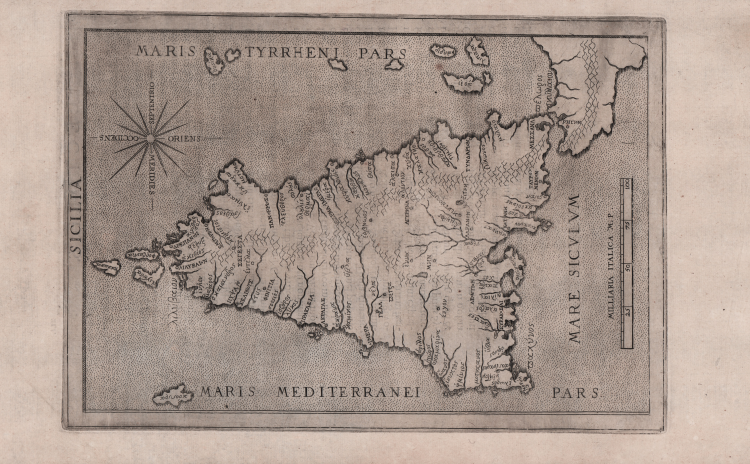
Carta geografica della Sicilia, disegnata da Hubert Goltzius per il "Sicilia e Magna Greaecia sive Histriae Urbium.." del 1576.
Esemplare tratto dal "Rara Magna Graecia Numismata, oblata A.1592 a Prospero Parisio…" di Volckamer, pubblicato a Norimberga nel 1683.
Il Volckamer, medico tedesco, curò la riedizione dell'opera cinquecentesca di Prospero Parisio sulla numismatica della Magna Grecia, per la prima volta edita nel 1592.
“Hubert Goltz (1526-1583), nativo di Venlo, iniziò i suoi studi a Liegi nella Accademia dei Romanisti. Trasferitosi ad Anversa entrò a far parte della corporazione di san Luca che raccoglieva artisti e artigiani. Appassionato studioso di antichità e in particolare di numismatica, artista, antiquario e collezionista, amico del geografo, cartografo e umanista Abraham Ortelius, nel 1558 si trasferì da Anversa a Bruges, dove intraprese l'attività editoriale e ove morì a 57 anni. A Roma, che visitò più volte, venne insignito della 'civitas' onoraria nel 1567. La carta della Sicilia è inserita in quella che è stata definita "in assoluto la prima opera dell'Europa post-romana interamente consacrata alle nozioni antiche di Sicilia e soprattutto di Magna Grecia" (Napolitano 1012:11).
Sebbene molto schematica, sembra avere come modello la mappa di Gastaldi, probabilmente nella copia inserita da Ortelius nel suo Theatrum, cosa più che probabile a giudicare dalla frequentazione e dall'amicizia tra i due storiografi, di cui vi è traccia nella corrispondenza orteliana e nei testi del Parergon. Ortelius gli dedicò anche una carta dell'Asia nel 1567, definendolo "historico, et totius antiquitatis reastauratori diligentiss." segno di una consolidata e antica amicizia. Nella dedica presente nell'Album ami- corum Ortelius lo definisce "archeologue de premier plan et ami excellent" e definisce la loro una "douce amitié" (Album Amicorum 1996).
I toponimi sono tutti scritti in greco, quasi a voler affermare la distanza temporale tra quella immagine storica e la realtà attuale, mentre i dati esterni (mari, scala e orientamento) sono in latino. Dalla dedica al Suo Lettore, apprendiamo l'uso didascalico delle due tavole allegate: "earundem regionum Tabulas Geographicas numismatibus continuò subiccimus, in quibus Urbes & Flumina, quoru[m] numismata exhibemus, litteris maioribus descripsimus", mentre le scritte in minuscolo sono dedicate ai quei luoghi che sono solo menzionati nel suo resoconto storico.
È interessante notare l'apparente contraddizione tra la scelta di una onomostatica strettamente antica e il riferimento invece a una immagine moderna, o 'non tolemaica' dell'isola, scelte non casuali ma dettate da un rigore filologico che lo porta a non confondere la realtà geografica dei luoghi con le conoscenze antiche. Oltre all'utilizzo dello stesso rame nelle due successive edizioni del 1618 e del 1644, la carta della Sicilia incisa per l'opera di Goltzius è stata più volte ricopiata: nell'edizione Huberti Goltzii De Re Nummaria Antiqua. Opera quae extant universa. Tomus Quartus. Continens Sicilia & Magna Graecia historiam, ex antiquis Numismatibus illustratam. Henricum & Cornelium Verdussen, 1708, la carta della Sicilia è pubblicata sul verso della avvertenza "Lectori S[uo]", e fronteggia la carta del regno di Napoli. Tuttavia questa carta proviene da altra incisione, come si evince dalla cornice realizzata da un'unica linea. Lo stesso avviene nell'opera numismatica di Prospero Parisio pubblicata per cura di Georg Volckamer (1616-1693) nel 1683; oltre alla carta della Sicilia (vedi scheda 135), Volckamer pubblica anche una copia semplificata della famosa carta del regno di Napoli di Prospero Parisio, in quattro fogli sciolti, incisa da Natale Bonifacio e pubblicata a Roma nel 1591. In sostanza i rami che si associano all'opera di Goltzius sono in realtà tre: quello dell'edizione del 1576, quello dell'Opera Omnia del 1718 ed infine quello pubblicato da Volckamer nel 1683.” (Valerio-Spagnolo "Sicilia 1477-1861", p. 172).
Acquaforte, in perfette condizioni. Rara.
Bibliografia:
L. Dufour - A. La Gumina, "Imago Siciliae", p. 144; Valerio-Spagnolo "Sicilia 1477-1861", pp. 172-173, n. 44.
Hubert GOLTZIUS (Venlo 1526 - 1583)
|
Hubert Goltzius or Hubertus Goltzius, latinized form of Hubrecht Goltz or Hubert Goltz (Venlo, 30 October 1526 – Bruges, 24 March 1583) was a Renaissance painter, engraver, publisher, printer and numismatist from the Habsburg Netherlands. He was also active as an art and antique dealer. He was the great-uncle of the now better known engraver and painter Hendrik Goltzius. He is now recognized mainly for his contribution to numismatics and has been referred to as the 'father of ancient numismatics'.
Goltzius was born in Venlo as the son of Rutger van Weertsburg and Catharina Goltzius. His father was an architect and painter originally from Wurzburg. His mother was the daughter of Hubrecht Goltz or Goltzius (the Elder), a painter who was originally from Hinsbeck in Upper Guelders (present-day Germany), a town close to Venlo, also in Upper Guelders (present-day Netherlands) where he had moved in 1494. His father had adopted the name of his wife at their marriage. Hubert was initially trained by his father. He was then sent to Liège where from 1544 to 1546 he studied painting and engraving at the academy operated by the prominent humanist and painter Lambert Lombard. In addition to being a painter, architect, printmaker and writer, Lombard was an avid coin collector, an activity he had likely started while residing in Rome. It was Lombard who introduced Goltzius to coin collecting and numismatics and thought him printmaking.
|