
- New
| Reference: | A53383 |
| Author | Giuseppe de Welz |
| Year: | 1826 |
| Zone: | Sicily |
| Printed: | Naples |
| Measures: | 530 x 430 mm |
| Reference: | A53383 |
| Author | Giuseppe de Welz |
| Year: | 1826 |
| Zone: | Sicily |
| Printed: | Naples |
| Measures: | 530 x 430 mm |
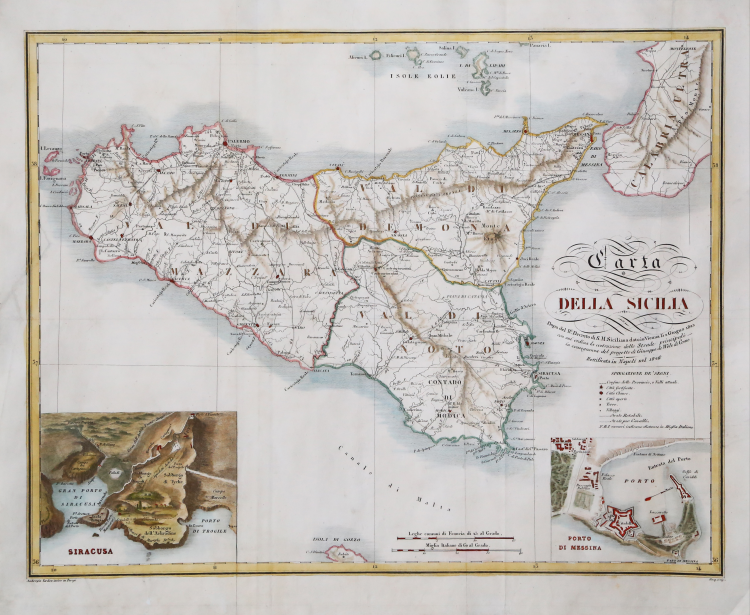
An important "road" map of the island. It features an elegant title set within a decorative oval, accompanied by a legend explaining the symbols used to identify cities, fortresses, borders, and ports. A detailed inset provides an aerial, perspective view of the ancient city and fortified harbor of Syracuse. A specific map insert focuses on the strategic and military layout of the Port of Messina area and the Strait.
The map appears in *Primo elemento della forza commerciale ossia nuovo metodo di costruire le strade* [Primary Element of Commercial Strength, or the New Method of Road Construction] by G. L. Mac-Adam, translated from the original English by G. De Welz... Naples, 1826.
The copperplate used for this map is the same one engraved and published in 1822 for inclusion in the *Saggio sui mezzi da moltiplicare prontamente le ricchezze della Sicilia* [Essay on Means to Rapidly Multiply the Wealth of Sicily]. The plate was simply retouched and adapted to meet new publishing requirements, serving to illustrate the Italian translation of John Loudon McAdam’s work on road construction (*Remarks on the Present System of Road Making*); this translation was produced by Giuseppe de Welz (whose real name was Velzi) and published in Naples in 1826.
This was the first Italian edition of McAdam’s work—based on the 1822 London edition—and is of significant interest to the economic history of transportation and the study of public works financing. The translation was primarily the work of the philologist, educator, and economist Francesco Fuoco (1774–1841), who had developed an interest in economics and credit for public works during a stay in Paris in the early 1820s.
Fuoco and de Welz aimed to provide Sicily with the roads and infrastructure necessary for the island's economic development. Their proposals attracted the interest of the Bourbon court, which had recently regained full control of the kingdom following the uprisings of 1820. It is no coincidence that the Royal Decree of Ferdinand IV was issued in Vienna, as noted in the phrase added beneath the title: "Following the Royal Decree of His Sicilian Majesty issued in Vienna on June 2, 1823, ordering the construction of main roads in accordance with the project by Giuseppe de Welz of Como." The map is marked "Rectified in Naples in 1826" and indeed, several modifications to the road network are evident, including the addition of new... ...arteries. The legend modifies the road classification, reducing the categories of first, second, and third order to simply "Roads for wheeled vehicles" and "Roads for horses". A careful examination might reveal significant differences between the two stages of knowledge regarding the Sicilian road network between 1822 and 1826. New settlements are also marked, and, above all, distances in miles between the various locations are indicated.
Etching, finely hand-colored, in excellent condition. Rare.
Bibliografia
V. Valerio, in Sicilia 1477-1861. La Collezione Spagnolo-Patermo in quattro secoli di cartografia, pp. 614-614, n. 315
Giuseppe de Welz (Como, 1785 - Milano, 1839)
|
He was born on April 5, 1785, in Como—specifically in the parish of San Fedele—to Pietro Velzi; nothing is known about his mother.
Giuseppe de Welz was, in fact, the pseudonym of Giuseppe Giulio Vincenzo Velzi (Banca moderna..., 2004). The reasons prompting him to change his surname to "de Welz" remain unclear, though the choice is generally attributed to a desire for an exotic flair intended to boost his business visibility (Severin, 1965, p. 18). After completing a classical education at the *ginnasio-liceo* in Como, he moved to Milan at a very young age to begin his commercial training; as a commercial agent, he soon embarked on business trips across Europe. By the time he was twenty, he was already acting as a commission agent for a network of over fifty international manufacturing firms spanning Italy, Switzerland, Germany, England, France, and Sweden. Thanks to his exceptional organizational skills and an uncommon aptitude for commerce, he was invited between 1808 and 1814 to enter into a business partnership with the Milanese merchant and banker Paolo Battaglia, who entrusted him with managing various trading houses located in Genoa, Naples, and Kostajnica (Croatia).
The Napoleonic era offered de Welz a highly fortunate opportunity to develop his expertise in international trade and to shape his economic convictions.
Thanks to Battaglia’s patronage, the support of prominent politicians—such as Ferdinando Marescalchi and Antonio Aldini—and the backing of diplomats of various ranks across Europe, he was able to carry out significant commercial ventures, establishing relationships with numerous countries during his frequent business travels. He lived for extended periods in France, England, and Austria, focusing primarily on the trade of cotton and fabrics between the Middle East, France, and Italy, and secondarily on other goods, including pack animals. He established livestock quarantine depots in Hungary and set up a base of operations in Thessaloniki—enabling various commercial agents to visit and familiarize themselves with key markets in Greece and Asia Minor—while securing privileges for himself and his agents to operate within Turkish provinces.
The travels and experiences of this intense period of professional growth also gave de Welz the opportunity to refine his economic convictions through direct observation of the economic and financial conditions in other states and the study of the institutional and political factors that had shaped their respective development paths. Convinced by the positive impact the Napoleonic "Continental Blockade" system had on previously stagnant industrial sectors, he became a staunch advocate of protectionism, a stance he never wavered from over time.
Following the fall of the Napoleonic Empire and the dissolution of his partnership with Paolo Battaglia, he settled permanently in Naples, where he lived until 1828. He had previously passed through the city in 1810, immediately establishing business ties with local entrepreneurs. Indeed, records from October 1814 confirm the dissolution of *de Welz e Viollier*—a general partnership based in Naples that he had founded with Augusto Viollier to engage in general financial and banking activities. He maintained enduring ties with this Swiss-born entrepreneur and merchant—who was active in various sectors (ranging from paper and wine to shipping and finance) across Naples and Sicily—even going so far as to co-found a new general partnership in 1814: *de Welz & Co.* In addition to Viollier, the powerful local banker of Swiss descent, Emanuele Appelt, also joined this venture. Although this partnership was short-lived—dissolving in 1816—it bears witness to the solid relationships he had established within the financial circles of the restored Bourbon Kingdom, connections that remained intact despite the shifting political fortunes of the ensuing years.
Indeed, in January 1821—during the nine-month constitutional period following the 1820 revolutionary uprisings—he collaborated with Viollier and Appelt to spearhead a proposal for a twenty-year loan designed to meet the State's massive financial needs. The plan was presented to Parliament by the newly appointed Minister of Finance, Giuseppe Carignani di Novoli. It stipulated that "Messrs. de Welz and Viollier, as well as the Appelt firm" (F. Barbagallo, *Carignani Giuseppe*, in *Dizionario biografico degli Italiani*, XX, Rome 1977, pp. 91–93), would advance a sum of 10 million ducats, secured by a mortgage on the *Tavoliere delle Puglie* and other state assets yet to be specified. The Neapolitan Parliament approved the proposal, though its own tenure ended just over a month later following the second Bourbon restoration.
|