
- New
| Reference: | S30361.2 |
| Author | Robert Rive |
| Year: | 1865 ca. |
| Zone: | Genova |
| Measures: | 255 x 200 mm |
| Reference: | S30361.2 |
| Author | Robert Rive |
| Year: | 1865 ca. |
| Zone: | Genova |
| Measures: | 255 x 200 mm |
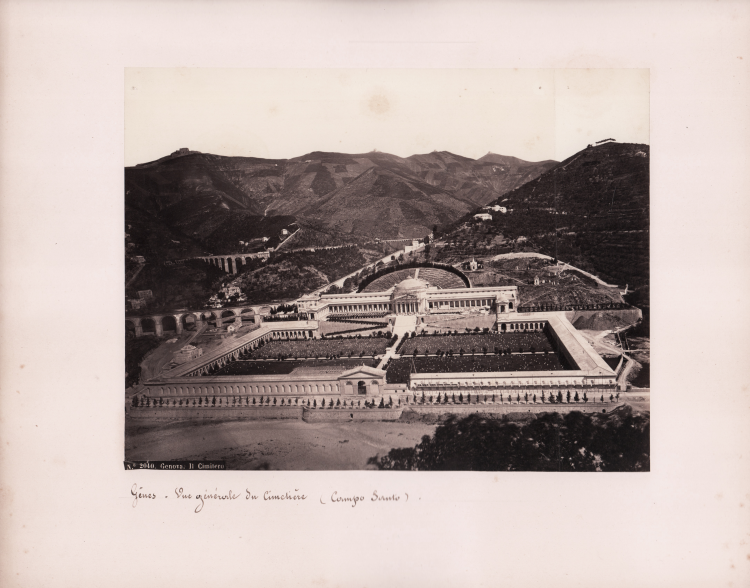
Albumen on paper, mounted on a contemporary support, circa 1865/70.
The photo bears the signature and inscription at the bottom of the historic photographic studio of Robert Rive (also known as Roberto Rive), a renowned photographer of Prussian origins active in Italy in the second half of the 19th century.
The shot depicts the Monumental Cemetery of Staglieno in Genoa, also historically known as the Campo Santo. Located on the hills of the Staglieno neighborhood in the Bisagno Valley, the cemetery is a symbol of the city's rich history. Genoese architect Giovanni Battista Resasco designed the original project in the mid-19th century, and it was officially opened in 1851. It is considered one of the most important monumental cemeteries in Europe thanks to its extraordinary concentration of statues, bas-reliefs, and marble chapels of great artistic value created between the 19th and 20th centuries.
Rive included this view among his extensive production of albumen prints intended for travelers on the Grand Tour, documenting the most important Italian monuments and landscapes of the period.
Robert Rive (Breslau, March 27, 1817 – Torre del Greco, March 30, 1868) was a Prussian-born French photographer. Known in Italy as Roberto, Rive was active in Naples from 1850. His Neapolitan studio sold various photographic albums, now preserved in the historical archives of the Fondazione Fotografia Modena. Rive also photographed Naples, the Amalfi and Sorrento Coasts, Capri, Pompeii, and Rome. He also created glimpses and monumental views of Florence, Pisa, Lake Como, Siena, Posillipo, Ischia, and Messina. His residence was in Naples, where he had studios in Palazzo Serracapriola and Palazzo Lieti. He took numerous photographs of the excavations of Pompeii, ancient Roman sculptures, and the first casts of victims of the 1879 eruption of Vesuvius. In 1867, he participated in the Universal Exhibition in Paris and was one of the first photographers to produce stereographic views, highly prized as souvenirs. Charles-Henri Favrod wrote about him: "Ten years later [in 1862], in Naples, Giorgio Sommer and Robert Rive began a systematic census of monuments and daily life, gathering a fantastic wealth of information on Campania and Sicily. It was then that the images of Vesuvius and Etna multiplied".
Robert Rive (Breslau 1817 - Napoli 1868)
|
Robert Rive (Breslau, March 27, 1817 – Torre del Greco, March 30, 1868) was a Prussian-born French photographer. Known in Italy as Roberto, Rive was active in Naples from 1850. His Neapolitan studio sold various photographic albums, now preserved in the historical archives of the Fondazione Fotografia Modena. Among these, the album titled "Photographies d'Italie par R. Rive, Naples" contains 47 albumen photographs of Italian locations such as Genoa, Turin, Milan, Venice, Taormina, and Palermo.
Rive also photographed Naples, the Amalfi and Sorrento Coasts, Capri, Pompeii, and Rome. He also created glimpses and monumental views of Florence, Pisa, Lake Como, Siena, Posillipo, Ischia, and Messina. His residence was in Naples, where he had studios in Palazzo Serracapriola and Palazzo Lieti. He took numerous photographs of the excavations of Pompeii, ancient Roman sculptures, and the first casts of victims of the 1879 eruption of Vesuvius. In 1867, he participated in the Universal Exhibition in Paris and was one of the first photographers to produce stereographic views, highly prized as souvenirs. Charles-Henri Favrod wrote about him: "Ten years later [in 1862], in Naples, Giorgio Sommer and Robert Rive began a systematic census of monuments and daily life, collecting a fantastic wealth of information on Campania and Sicily. It was then that the images of Vesuvius and Etna multiplied."
His Neapolitan photographic studio produced photographs in various formats, including large, medium (mezzana), cabinet, stereoscopic, and carte de visite. Elegant hardback albums were also released, featuring collections of his photographs, such as "Souvenirs de Pompei" with 39 photos, "Napoli" with 8 panoramic photos of the Riviera di Chiaia, "Pompei" with 80 photos, and "Naples" with 30 carte de visite-sized photos. The company that bore his name continued production even after his death.
|
Robert Rive (Breslau 1817 - Napoli 1868)
|
Robert Rive (Breslau, March 27, 1817 – Torre del Greco, March 30, 1868) was a Prussian-born French photographer. Known in Italy as Roberto, Rive was active in Naples from 1850. His Neapolitan studio sold various photographic albums, now preserved in the historical archives of the Fondazione Fotografia Modena. Among these, the album titled "Photographies d'Italie par R. Rive, Naples" contains 47 albumen photographs of Italian locations such as Genoa, Turin, Milan, Venice, Taormina, and Palermo.
Rive also photographed Naples, the Amalfi and Sorrento Coasts, Capri, Pompeii, and Rome. He also created glimpses and monumental views of Florence, Pisa, Lake Como, Siena, Posillipo, Ischia, and Messina. His residence was in Naples, where he had studios in Palazzo Serracapriola and Palazzo Lieti. He took numerous photographs of the excavations of Pompeii, ancient Roman sculptures, and the first casts of victims of the 1879 eruption of Vesuvius. In 1867, he participated in the Universal Exhibition in Paris and was one of the first photographers to produce stereographic views, highly prized as souvenirs. Charles-Henri Favrod wrote about him: "Ten years later [in 1862], in Naples, Giorgio Sommer and Robert Rive began a systematic census of monuments and daily life, collecting a fantastic wealth of information on Campania and Sicily. It was then that the images of Vesuvius and Etna multiplied."
His Neapolitan photographic studio produced photographs in various formats, including large, medium (mezzana), cabinet, stereoscopic, and carte de visite. Elegant hardback albums were also released, featuring collections of his photographs, such as "Souvenirs de Pompei" with 39 photos, "Napoli" with 8 panoramic photos of the Riviera di Chiaia, "Pompei" with 80 photos, and "Naples" with 30 carte de visite-sized photos. The company that bore his name continued production even after his death.
|