
| Reference: | A53193 |
| Author | Harmensz van Rijn detto REMBRANDT |
| Year: | 1670 ca. |
| Measures: | 85 x 107 mm |
| Reference: | A53193 |
| Author | Harmensz van Rijn detto REMBRANDT |
| Year: | 1670 ca. |
| Measures: | 85 x 107 mm |
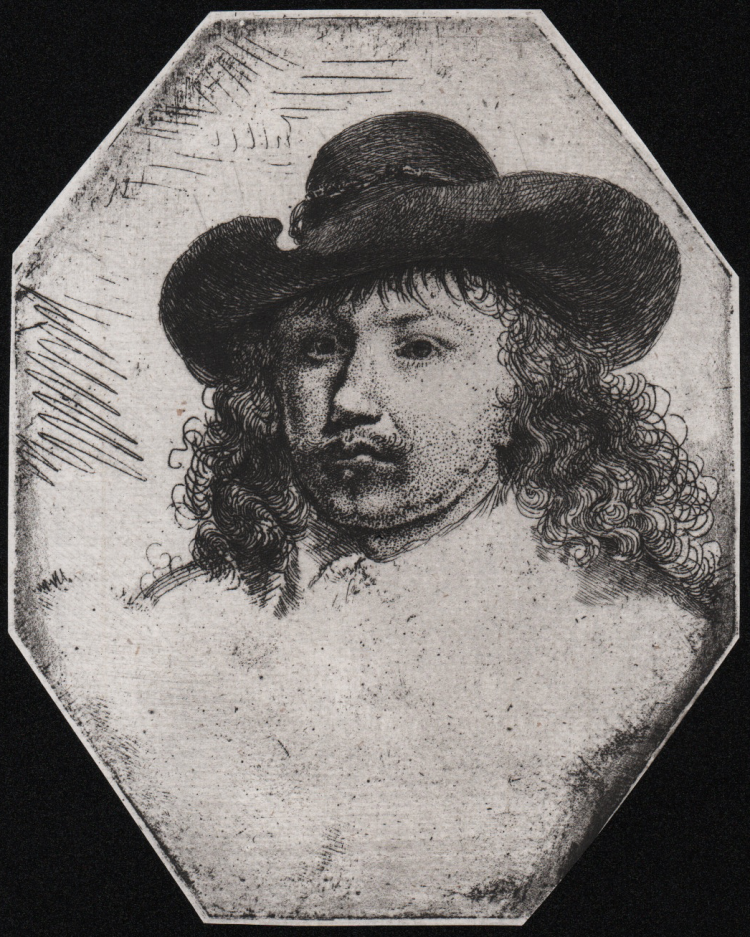
Portrait of a Man with a Wide-brimmed Hat, finely etched by an unknown pupil of Rembrandt's school.
Attributed by Bartsch to the Master, this engraving is identified by Ludwig Munz as a portrait of Gerard Dou (Gerrit Douw, Leiden, 1613-1675), a famous Dutch painter and printmaker, contemporary and follower of Rembrandt, and attributed to his pupil Godfried Schalcken (1643-1706).
In White & Boon, the print is catalogued among the etchings of an unidentified engraver from Rembrandt's circle.
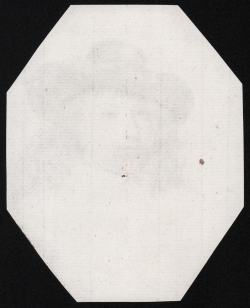
Etching, octagonal plate, printed on laid paper, trimmed to the platemark, minimal wormhole in the center, otherwise in excellent condition.
Bibliografia
Bartsch n. 329; Ludwig Munz, Rembrandt (1954); White & Boon, Rembrandt’s Etchings, p. 182, n. B329.
Harmensz van Rijn detto REMBRANDT (Leida 1606 - Amsterdam 1669)
|
Born in Leiden, Holland in 1606, Rembrandt studied with Jacob Isaacsz van Swanenburgh (1571-1638) and Pieter Lastman (1583-1633). By 1626 he was an independent painter, working in Leiden alongside Jan Lievens (1607-74), another pupil of Lastman.
In 1631 Rembrandt moved to Amsterdam where he painted portraits of wealthy merchants. Three years later, he married his first wife, Saskia, and by the end of the 1630s he had moved into a substantial house (now the Rembrandt House Museum). In 1642, the year Rembrandt completed The Nightwatch (Rijksmuseum, Amsterdam), Saskia died.
By 1649, Hendrikje Stoffels had become his housekeeper and partner. Both Saskia and Hendrikje Stoffels posed for many paintings and sketches, often appearing as Susannah, Diana, Flora, Artemisa and other classical or Biblical figures. Rembrandt, however, was plagued by financial troubles and in 1656 his assets were made over to the courts, and many were sold. With his wife and son in financial control, Rembrandt continued to paint. Hendrikje died in 1663, his son Titus in 1668 and Rembrandt himself in 1669.
In his drawings, etchings and paintings, Rembrandt treated every subject: histories, landscapes, portraits, self-portraits, everyday scenes or sketches from nature. Rembrandt's biographer, Cornelis de Bie, praised his paintings, 'which enlighten every mind', and his etchings which are 'the very soul of life that lives therein'.
|
Harmensz van Rijn detto REMBRANDT (Leida 1606 - Amsterdam 1669)
|
Born in Leiden, Holland in 1606, Rembrandt studied with Jacob Isaacsz van Swanenburgh (1571-1638) and Pieter Lastman (1583-1633). By 1626 he was an independent painter, working in Leiden alongside Jan Lievens (1607-74), another pupil of Lastman.
In 1631 Rembrandt moved to Amsterdam where he painted portraits of wealthy merchants. Three years later, he married his first wife, Saskia, and by the end of the 1630s he had moved into a substantial house (now the Rembrandt House Museum). In 1642, the year Rembrandt completed The Nightwatch (Rijksmuseum, Amsterdam), Saskia died.
By 1649, Hendrikje Stoffels had become his housekeeper and partner. Both Saskia and Hendrikje Stoffels posed for many paintings and sketches, often appearing as Susannah, Diana, Flora, Artemisa and other classical or Biblical figures. Rembrandt, however, was plagued by financial troubles and in 1656 his assets were made over to the courts, and many were sold. With his wife and son in financial control, Rembrandt continued to paint. Hendrikje died in 1663, his son Titus in 1668 and Rembrandt himself in 1669.
In his drawings, etchings and paintings, Rembrandt treated every subject: histories, landscapes, portraits, self-portraits, everyday scenes or sketches from nature. Rembrandt's biographer, Cornelis de Bie, praised his paintings, 'which enlighten every mind', and his etchings which are 'the very soul of life that lives therein'.
|