
| Reference: | A54195 |
| Author | Bartolomeo PINELLI |
| Year: | 1815 |
| Printed: | Rome |
| Measures: | 295 x 215 mm |
| Reference: | A54195 |
| Author | Bartolomeo PINELLI |
| Year: | 1815 |
| Printed: | Rome |
| Measures: | 295 x 215 mm |
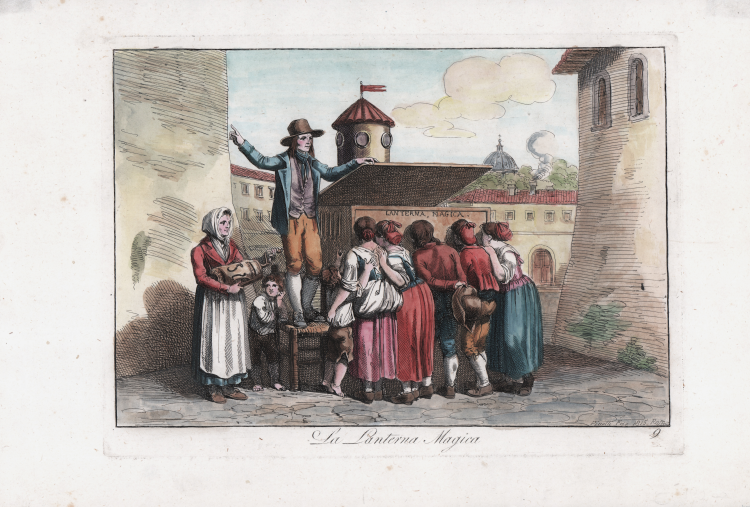
The Magic Lantern of the renowned Roman artist Bartolomeo Pinelli (1781–1835). It was a form of early 19th-century street entertainment in Rome, in which a showman would display images or optical illusions to a group of curious onlookers by means of a large box (the "magic lantern"—also known as a *gucaccio* or internal-light viewer).
Popular costume, taken from Nuova raccolta di cinquanta costumi de' contorni di Roma compresi diversi fatti di brigandi disegnati ed incisi all'acqua forte, published in Rome by Giovanni Scudellari in 1815.
Copperplate, finely hand-colored, in excellent state of preservation.
Bartolomeo PINELLI (Roma, 1781 - Rome, 1835)
|
Italian printmaker, painter, sculptor and draughtsman. He learnt the rudiments of sculpture from his father, a maker of cheap religious statuettes. This early training encouraged Pinelli to emphasize plasticity and expression over the Neo-classical values prevalent in Rome. Although only a few of his terracotta figures survive however, he did produce a volume of etchings, Gruppi pittoreschi (Rome, 1834), depicting rustic groups. Its emphasis on naturalism and everyday subject-matter is also characteristic of his sculptures. Although he studied both at the Accademia di San Luca in Rome and at the Accademia di Belle Arti in Bologna, helped financially by Conte Lambertini, Pope Benedict XIV’s nephew, Pinelli was not interested in pursuing the traditional path to artistic success via religious or history painting. On returning to Rome in the late 1790s he chose to peddle his works at the cafés frequented by tourists.
|