
| Reference: | A53154 |
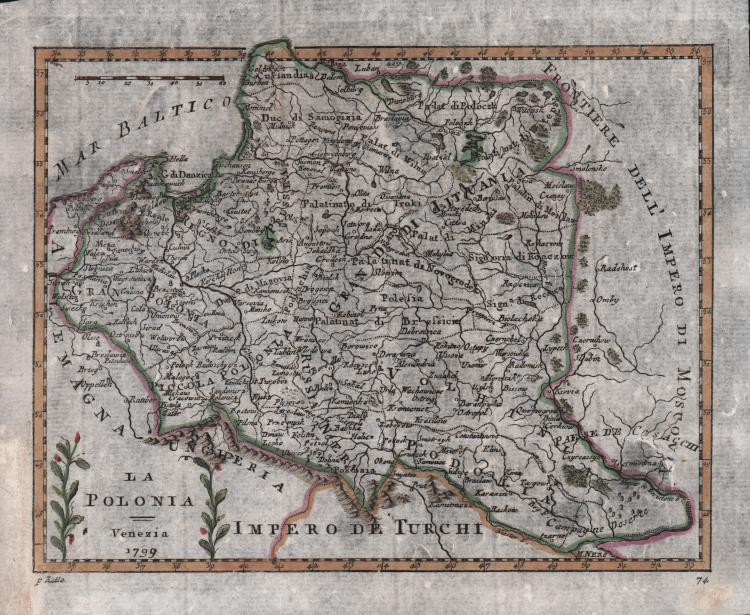
| Author | Antonio ZATTA |
| Year: | 1799 |
| Zone: | Poland |
| Printed: | Venice |
| Measures: | 220 x 175 mm |
| Reference: | A53154 |
| Author | Antonio ZATTA |
| Year: | 1799 |
| Zone: | Poland |
| Printed: | Venice |
| Measures: | 220 x 175 mm |
A rare map from a minor publication by the Venetian publisher Antonio Zatta, the Nuovo Atlante, first printed in 1799, consisting of just 24 plates, and updated in the early 19th century with the new "regions" formed with the Napoleonic occupation.
Antonio Zatta was one of the most important Italian map publishers between the late 18th and early 19th centuries. He was also a cartographer, typographer, and bookseller. His workshop, based in Venice, published maps and atlases, as well as numerous literary classics. His work marked a significant shift in the chalcographic style, replacing the mythical elements of traditional cartouches with representative images of the city of Venice. His most important and best-known work is the Atlante Novissimo, published in four volumes between 1775 and 1789. His output features a significant portion of intaglio illustrations (frontispieces, friezes, vignettes, portraits), mostly entrusted to his brother Giacomo and P. A. Novelli.
Etchings, finely hand-colored, in excellent condition.
Antonio ZATTA (Venezia 1722 - 1804)
|
Antonio Zatta (1775-1797) was the most prominent Italian map publisher of the late 18th and early 19th century. His firm, based in Venice, produced maps that mark an important transition from 18th to 19th century cartographic styles. He updates and redefines the traditional title cartouche by replacing the mythic elements common to the 17th and 18th century with more representative images of Venice. His most important work is the four volume Atlante novissimo published from 1775 to 1789.
|
Antonio ZATTA (Venezia 1722 - 1804)
|
Antonio Zatta (1775-1797) was the most prominent Italian map publisher of the late 18th and early 19th century. His firm, based in Venice, produced maps that mark an important transition from 18th to 19th century cartographic styles. He updates and redefines the traditional title cartouche by replacing the mythic elements common to the 17th and 18th century with more representative images of Venice. His most important work is the four volume Atlante novissimo published from 1775 to 1789.
|