
- New
| Reference: | S48308.15 |
| Author | Giuseppe Napoleone PRIMOLI |
| Year: | 1900 |
| Measures: | 380 x 280 mm |
| Reference: | S48308.15 |
| Author | Giuseppe Napoleone PRIMOLI |
| Year: | 1900 |
| Measures: | 380 x 280 mm |
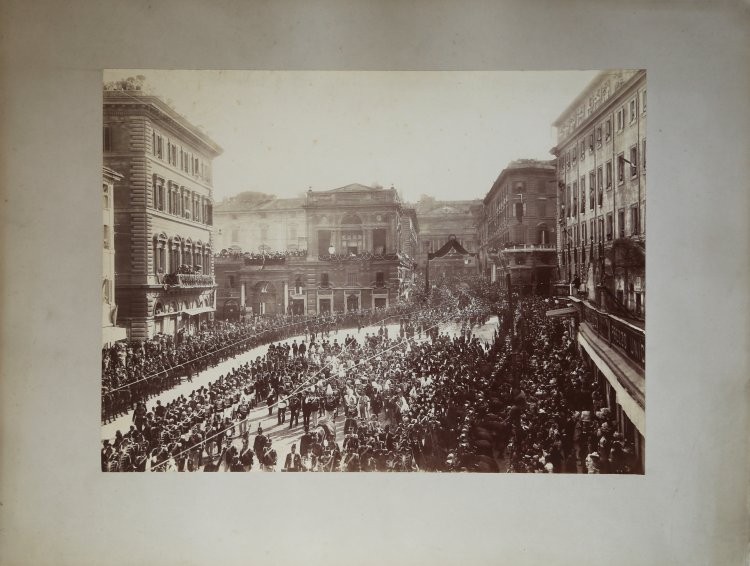
Silver bromide gelatin, applied on contemporary cardboard, 1900.
The photograph shows the solemn funeral procession of King Umberto I of Savoy in Rome, which took place in August 1900. The funeral of the King, assassinated in Monza on July 29, 1900 by the anarchist Gaetano Bresci; the procession passes through Via Quattro Novembre, awaited by a massive crowd. The body, arriving from Termini station, was taken to pay its last respects before being buried in the Pantheon.
The photograph is attributed to the renowned Count Giuseppe Primoli. The pioneer of Roman and international photography extensively documented the funeral of King Umberto I on August 9, 1900, taking several snapshots of the day. His shots (including the one here) are now part of Rome's historical visual heritage and are preserved within the archival collections dedicated to him, such as that of the Primoli Foundation.
Giuseppe Napoleone Primoli (Rome, 1851-1927) was an Italian art collector, bibliophile, and pioneer of photography in Rome. He lived in Paris during the Second Empire, between 1853 and 1870, and in Paris he came into contact with the cultural, artistic, and social circles that revolved around the salon of his great-aunt Mathilde Bonaparte. In the final decades of the 19th century, Giuseppe Primoli developed a passion for photography, shared with his brother Luigi Primoli (1858-1925) and his cousin Placido Gabrielli, producing over 15,000 photographs, many previously unpublished. He is today considered one of the most gifted photographers of his generation. He also knew how to capture instantaneous images outdoors. In his will, he established the Primoli Foundation, which manages the Library, Archives, and Photographic Cabinet.
Giuseppe Napoleone PRIMOLI (Roma 1851 - 1927)
|
Giuseppe Napoleone Primoli (Rome, May 2, 1851 – Rome, June 13, 1927) was an Italian art collector, bibliophile, and pioneer of photography in Rome. He was born to Pietro Primoli, Count of Foglia (1820–1883), and his wife Carlotta Onorina Giuseppina Paolina Bonaparte (1832–1901), daughter of Charles Lucien Bonaparte and Zénaïde Bonaparte, cousins as the children of two of Napoleon I's brothers, Lucien Bonaparte (1775–1840) and Joseph Bonaparte (1768–1844). Among his family and friends, he was nicknamed Gégé. He lived in Paris during the Second Empire, between 1853 and 1870, and in Paris he came into contact with the cultural, artistic, and social circles that revolved around the salon of his great-aunt Mathilde Bonaparte. In particular, he befriended Guy de Maupassant, Alexandre Dumas fils, Sarah Bernhardt, and Théophile Gautier, who contributed significantly to the formation of his taste for literature and rare and precious objects. He then spent long periods between Paris and Rome, finally establishing his residence in Rome, in the Palazzo Primoli, overlooking what is now Via Zanardelli, which had been owned by his family since the 1820s. In Italy, he befriended Arrigo Boito, Giuseppe Giacosa, Matilde Serao, Gabriele D'Annunzio, and Enrico Nencioni. Following the development of the Tiber embankments and the construction of the Muraglioni, Palazzo Primoli underwent expansion and modernization (1904-1911) that gave it its current appearance. Here, Giuseppe Primoli assembled a collection of objects related to the public and private history of the Bonaparte family, a library rich in books by French and Italian authors, many with handwritten dedications, an archive containing thousands of letters, and a photographic archive with plates and developed photographs. His collections are now divided between the Napoleonic Museum in Rome and the Primoli Foundation. In the final decades of the 19th century, Giuseppe Primoli developed a passion for photography, shared with his brother Luigi Primoli (1858-1925) and his cousin Placido Gabrielli, producing more than 15,000 works, many unpublished. He is today considered one of the most gifted photographers of his generation. He also knew how to capture instantaneous images, outdoors. In his will, he established the Primoli Foundation, which manages the Library, Archives, and Photographic Cabinet. The collection of Napoleonic objects and documents, now held by the Napoleonic Museum, was donated to the City of Rome. Giuseppe Primoli died on June 13, 1927, and was buried in the Verano Cemetery.
|