
| Reference: | S42733.15 |
| Author | Neue Photographische Gesellschaft |
| Year: | 1910 ca. |
| Measures: | 245 x 190 mm |
| Reference: | S42733.15 |
| Author | Neue Photographische Gesellschaft |
| Year: | 1910 ca. |
| Measures: | 245 x 190 mm |
Silver gelatin, circa 1910.
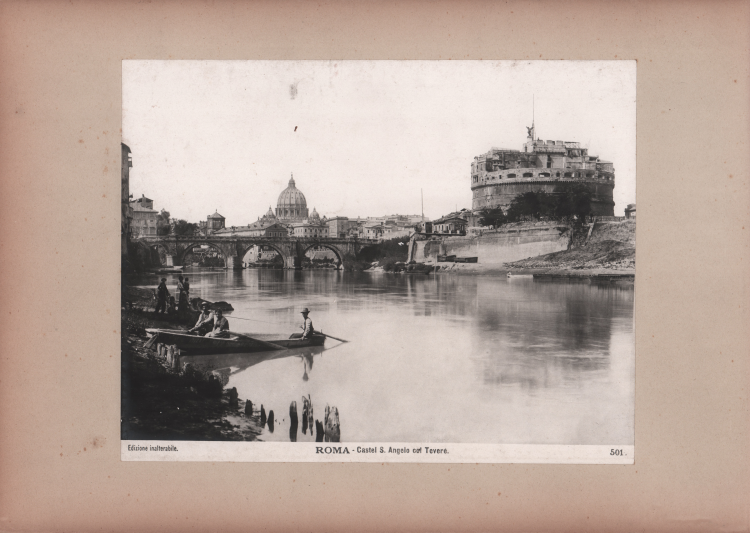
View of Rome with the Tiber River, Ponte Sant'Angelo, Castel Sant'Angelo, and, in the background, the dome of St. Peter's Basilica. The catalog number 501 and the words Edizione inalterabile identify the Neue Photographische Gesellschaft, a German company based in Schöneberg.
This specific period shot, titled "ROMA - Castel S. Angelo col Tevere", is part of the celebrated art collection of the second half of the 19th century, originally captured by renowned Roman photographic studios of the time, such as that of the D'Alessandri Brothers and James Anderson. Although the NPG printed the view in the early 20th century, the original image dates back to an earlier period (circa 1870). It faithfully reproduces the famous river view originally captured by pioneers of Roman photography, before the construction of the Lungotevere walls forever altered the river's sandy banks.
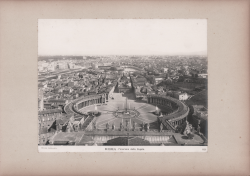
On the back, a photograph taken from the Dome of St. Peter's clearly captures the famous "Spina di Borgo" in the center, the dense network of historic buildings and medieval alleys that arose immediately after Bernini's colonnade. This urban area was entirely demolished in 1936 to make way for the monumental Via della Conciliazione that stands today.
The Neue Photographische Gesellschaft m.b.H. (NPG) was a German company active from 1894 to 1948. It developed the NPG pigment process, simplified the mass production of photographs, and is considered the inventor of "mile photography." This technique involved the use, for the first time, of photographic paper in rolls one kilometer long, rather than single sheets. The company also operated as a publishing house. Photographic prints, sometimes hand-colored, were typically issued with serial numbers and the company logo, often without the photographer's name. The company was founded on July 5, 1894, in Schöneberg by Arthur Schwarz (born 1862 in Braunsberg, East Prussia – died 1943). NPG was one of the best-known and most important companies in the production of postcards, photographs, and stereoscopic images. The company distinguished itself through the further development of silver bromide photographic paper, its use in rotary printing (silver bromide printing), and research into the fundamentals of color photography. With the invention of kilometer photography, NPG was the first company to use roll photographic paper, greatly simplifying the mass production of photographs.
Neue Photographische Gesellschaft (attiva tra il 1894 e il 1948)
|
The Neue Photographische Gesellschaft m.b.H. (NPG) was a German company active from 1894 to 1948. It developed the NPG pigment process, simplified the mass production of photographs, and is credited with inventing "mile photography." This technique involved the use, for the first time, of photographic paper in kilometer-long rolls, rather than individual sheets. The company also operated as a publishing house. The photographic prints, sometimes hand-colored, were typically issued with serial numbers and the company logo, often without the photographer's name. The company was founded on July 5, 1894, in Schöneberg by Arthur Schwarz (born 1862 in Braunsberg, East Prussia – died 1943). The headquarters were initially located on Sebastianstrasse and, from 1897 to 1921, on Siemensstrasse. NPG was one of the most well-known and important companies in the production of postcards, photographs, and stereoscopic images. The company distinguished itself with the further development of silver bromide photographic paper, its use in rotary printing (silver bromide printing), and research into the fundamentals of color photography. With the invention of kilometer photography, NPG was the first company to use roll photographic paper, greatly simplifying the mass production of photographs. Automatic exposure and development machines accelerated the process and replaced glass plate photography. The foundations of color photography were developed by chemist Rudolf Fischer and his colleague Hans Sigrist in the NPG laboratories between 1910 and 1912. In 1899, the company was transformed into a joint-stock company. This led to a boom for NPG, with branches in London, Paris, Rome, and New York. By 1904 it had 650 employees and by 1910 NPG employed approximately 1,200 people.
|
Neue Photographische Gesellschaft (attiva tra il 1894 e il 1948)
|
The Neue Photographische Gesellschaft m.b.H. (NPG) was a German company active from 1894 to 1948. It developed the NPG pigment process, simplified the mass production of photographs, and is credited with inventing "mile photography." This technique involved the use, for the first time, of photographic paper in kilometer-long rolls, rather than individual sheets. The company also operated as a publishing house. The photographic prints, sometimes hand-colored, were typically issued with serial numbers and the company logo, often without the photographer's name. The company was founded on July 5, 1894, in Schöneberg by Arthur Schwarz (born 1862 in Braunsberg, East Prussia – died 1943). The headquarters were initially located on Sebastianstrasse and, from 1897 to 1921, on Siemensstrasse. NPG was one of the most well-known and important companies in the production of postcards, photographs, and stereoscopic images. The company distinguished itself with the further development of silver bromide photographic paper, its use in rotary printing (silver bromide printing), and research into the fundamentals of color photography. With the invention of kilometer photography, NPG was the first company to use roll photographic paper, greatly simplifying the mass production of photographs. Automatic exposure and development machines accelerated the process and replaced glass plate photography. The foundations of color photography were developed by chemist Rudolf Fischer and his colleague Hans Sigrist in the NPG laboratories between 1910 and 1912. In 1899, the company was transformed into a joint-stock company. This led to a boom for NPG, with branches in London, Paris, Rome, and New York. By 1904 it had 650 employees and by 1910 NPG employed approximately 1,200 people.
|