
| Reference: | S42732.22 |
| Author | Michele Mang |
| Year: | 1865 ca. |
| Measures: | 255 x 205 mm |
| Reference: | S42732.22 |
| Author | Michele Mang |
| Year: | 1865 ca. |
| Measures: | 255 x 205 mm |
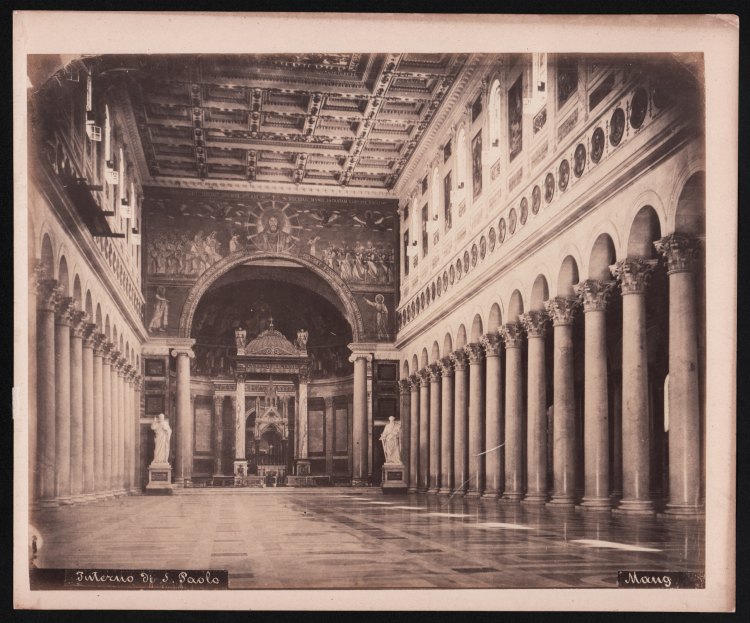
Albumen on paper, mounted on a contemporary support, circa 1865. At the bottom left is the original handwritten inscription “Interno di S. Paolo” followed by the photographer's signature on the right ("Mang").
The image depicts the central nave of the Basilica di San Paolo fuori le mura, leading to the high altar and the triumphal arch of Galla Placidia. The photograph shows the structure faithfully reconstructed after the disastrous fire on the night of July 15, 1823, which destroyed much of the ancient early Christian basilica dating back to the 4th century.
Michele Mang (c. 1840 – Rome, February 22, 1909) was a German-born Italian photographer. Mang came from the Kingdom of Bavaria and arrived in Italy in the 1860s. From early 1863, he lived in Rome, where he was a member of the Deutscher Künstlerverein and specialized in portraiture and photographic views of the city. In particular, he was interested in stereoscopy. Piero Becchetti wrote in this regard that around 1865, he "began a broad photographic campaign of the most important monuments of the Eternal City. It was during these years that he carried out a vast, detailed stereoscopic survey of Rome: he reproduced the walls, gates, churches, cloisters, squares, streets, the ruins of the most important monuments, including the surrounding areas, villas and fountains, as well as the masterpieces of the Vatican and Capitoline Museums. These views, later also reproduced in a 'visit' version, are often snapshots and characterized by the presence of figures, as the photographers Altobelli and Molins had already been doing for some time [...]". Initially, he had his studio at Piazza di Spagna 9. In 1871, he took over the photography studio of his friend Oswald Ufer at Via Felice 113 (now Via Sistina 113). On the occasion of the papal jubilee of Pius IX, he painted a portrait of the pope. The known period of his work extends until 1887, when he was succeeded as owner of the studio by the photographer Teodoro Fabbri.
Michele Mang (Monaco di Baviera ? 1840 circa - Roma 1909)
|
Michele Mang (German Confederation, c. 1840 – Rome, February 22, 1909) was a German-born Italian photographer. Mang came from the Kingdom of Bavaria and arrived in Italy in the 1860s. From early 1863, he lived in Rome, where he was a member of the Deutscher Künstlerverein and specialized in portraiture and photographic cityscapes. He was particularly interested in stereoscopy. Piero Becchetti writes in this regard that around 1865 he "began a vast photographic campaign of the most important monuments of the Eternal City. It was during these years that he carried out a vast, detailed stereoscopic survey of Rome: he reproduced the walls, gates, churches, cloisters, squares, streets, the ruins of the most important monuments, including those in the surrounding area, the villas and fountains, as well as the masterpieces of the Vatican and Capitoline Museums. These views, later also reproduced in a 'visit' version, are often snapshots and characterized by the presence of figures, as the photographers Altobelli and Molins had already been doing for some time [...]". Initially, he had his studio at Piazza di Spagna 9. In 1871, he took over the photography studio of his friend Oswald Ufer at Via Felice 113 (now Via Sistina 113). On the occasion of the papal jubilee of Pius IX, he painted a portrait of the pope. The known period of his work extends until 1887, when he was succeeded as studio owner by photographer Teodoro Fabbri. He obtained patents for improvements in the production of stereoscopic cameras and, together with Ufer, for a process for printing photographs using a common ink press, acquired from inventors Hom and Grossmann of Berlin. Together with Ufer, Mang perfected the photographic printing process invented in Berlin using a common ink press in Rome.
|
Michele Mang (Monaco di Baviera ? 1840 circa - Roma 1909)
|
Michele Mang (German Confederation, c. 1840 – Rome, February 22, 1909) was a German-born Italian photographer. Mang came from the Kingdom of Bavaria and arrived in Italy in the 1860s. From early 1863, he lived in Rome, where he was a member of the Deutscher Künstlerverein and specialized in portraiture and photographic cityscapes. He was particularly interested in stereoscopy. Piero Becchetti writes in this regard that around 1865 he "began a vast photographic campaign of the most important monuments of the Eternal City. It was during these years that he carried out a vast, detailed stereoscopic survey of Rome: he reproduced the walls, gates, churches, cloisters, squares, streets, the ruins of the most important monuments, including those in the surrounding area, the villas and fountains, as well as the masterpieces of the Vatican and Capitoline Museums. These views, later also reproduced in a 'visit' version, are often snapshots and characterized by the presence of figures, as the photographers Altobelli and Molins had already been doing for some time [...]". Initially, he had his studio at Piazza di Spagna 9. In 1871, he took over the photography studio of his friend Oswald Ufer at Via Felice 113 (now Via Sistina 113). On the occasion of the papal jubilee of Pius IX, he painted a portrait of the pope. The known period of his work extends until 1887, when he was succeeded as studio owner by photographer Teodoro Fabbri. He obtained patents for improvements in the production of stereoscopic cameras and, together with Ufer, for a process for printing photographs using a common ink press, acquired from inventors Hom and Grossmann of Berlin. Together with Ufer, Mang perfected the photographic printing process invented in Berlin using a common ink press in Rome.
|