
| Reference: | A53962 |
| Author | Christoph WEIGEL |
| Year: | 1719 |
| Zone: | Rome |
| Printed: | Nurnberg |
| Measures: | 410 x 345 mm |
| Reference: | A53962 |
| Author | Christoph WEIGEL |
| Year: | 1719 |
| Zone: | Rome |
| Printed: | Nurnberg |
| Measures: | 410 x 345 mm |
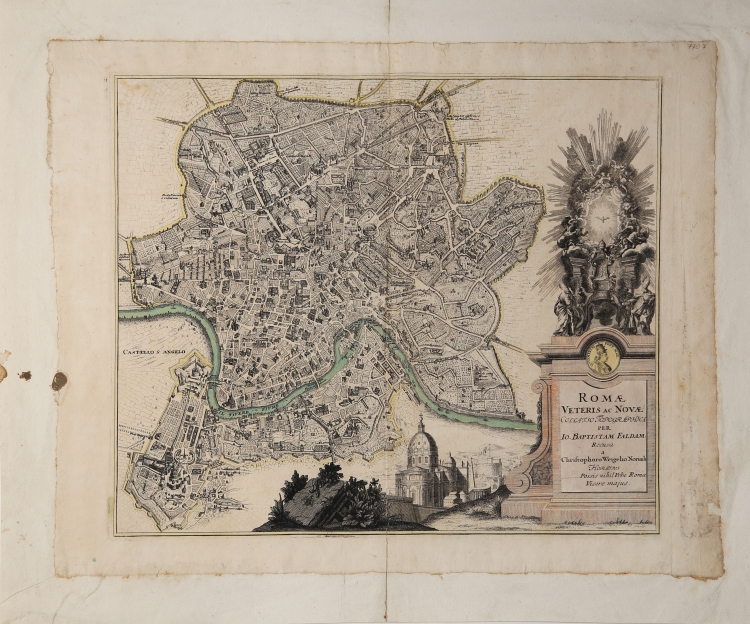
Mixed projection map, oriented with north to the left, circa 1719. The main monuments alone are given in elevation. On the title there is a medallion of Clement XI.
As announced in the title, this is a derivation of the large map of Falda and more precisely of the reworking that Graevio did in 1696; although in fact published in 1719, the city depicted is still the one portrayed by Falda in 1676; only the port of Ripetta (1704) is missing, as well as the works carried out by Innocenzo XII (including the sea customs house at Ripa Grande in 1694). Only the architectural elements are depicted in elevation, the other built lots are sampled in dotted lines (cf. Marigliani p. 231).
Christoph Weigel the Elder [1654-1725] was a German goldsmith, engraver, printer and mapmaker. He was initially apprenticed as an engraver in the publishing center of Augsburg, after which he held various positions in Vienna and Frankfurt. In 1698, he became a citizen of the city of Nuremberg and established his own publishing firm there. Weigel is known to have worked closely with the most prominent of the Nuremberg map publishers, Johann Baptist Homann [1663-1724] as well as with his brother, Johann Christoph Weigel [1654 - 1726] and the German academic, Johann David Koehler [1684-1755], the latter in the publication of a number of School atlases. His cartographic output included the Atlas Scholasticus [1712], Bequemer Schul und Reisen Atlas (in association with Koehler) [1724], and the Orbis Antiquus 1724. Following Weigel's death in 1725, control of the firm passed to his widow, who published many of her late husband's maps and atlases posthumously. The widow Weigel eventually ceded control of the firm to her son, Johann Christoph Weigel the Younger [d.1746], who later went into partnership with Adam Gottlieb Schneider, forming the firm of Schneider-Weigel. Which continued as Nuremberg publishers until the early 19th century.
Copperplate with original colouring, good condition.
Literature
Scaccia Scarafoni (1939): p. 114, n. 215; Marigliani (2007): p. 231, n. 136.
Christoph WEIGEL (1654 - 1725)
|
Johann Christoph Weigel, known as Christoph Weigel the Elder (9 November 1654 – 5 February 1725), was a German engraver, art dealer and publisher. He was born at Redwitz, Free imperial city of Eger in Egerland, and died in Nuremberg, aged 70. Christoph Weigel the Elder learned the art of engraving in Augsburg. After various positions, including in Vienna and Frankfurt am Main, he acquired citizenship in Nuremberg in 1698. Weigel's first work from his own, successfully run publishing house in Nuremberg was Bilderlust from 1698. Around 70 books and a series of engravings were published by this publishing house during his lifetime. One of his most important works is the Register of Estates from 1698. In it, Weigel described and described more than two hundred types of crafts and services, each illustrated by a copper engraving, based on life. Weigel visited almost all of the workshops himself, drew and observed on-site, coordinated the content of his articles with the master craftsmen, and copied important equipment from the original. Another important work by Weigel is the new edition of the Coat of Arms book by Johann Siebmacher. The work was published under the title The Great and Complete, initially Siebmachers Wappenbuch / then Fürstischen and Helmerische / and now Weigelian Coat of Arms Book. In six parts with coats of arms, shields, helmets and jewels, numbering 14,767, prefigured in copper plates. It was first published by his widow with Lorenz Bieling in Nuremberg; In 1734, it was published in two volumes by the company's publisher. Weigel worked particularly brilliantly in the scraping and line manner. He was the first engraver to use a type of machine for the underground. In Nuremberg, he worked very closely with the imperial geographer and cartographer Johann Baptist Homann (1664–1724) when producing his maps. His younger brother Johann Christoph Weigel ran an art shop in Nuremberg around the same time and was also very successful. Weigel's publishing house was continued after 1725 by his widow, who published a number of her late husband's works, for example, his coat of arms book
|
Christoph WEIGEL (1654 - 1725)
|
Johann Christoph Weigel, known as Christoph Weigel the Elder (9 November 1654 – 5 February 1725), was a German engraver, art dealer and publisher. He was born at Redwitz, Free imperial city of Eger in Egerland, and died in Nuremberg, aged 70. Christoph Weigel the Elder learned the art of engraving in Augsburg. After various positions, including in Vienna and Frankfurt am Main, he acquired citizenship in Nuremberg in 1698. Weigel's first work from his own, successfully run publishing house in Nuremberg was Bilderlust from 1698. Around 70 books and a series of engravings were published by this publishing house during his lifetime. One of his most important works is the Register of Estates from 1698. In it, Weigel described and described more than two hundred types of crafts and services, each illustrated by a copper engraving, based on life. Weigel visited almost all of the workshops himself, drew and observed on-site, coordinated the content of his articles with the master craftsmen, and copied important equipment from the original. Another important work by Weigel is the new edition of the Coat of Arms book by Johann Siebmacher. The work was published under the title The Great and Complete, initially Siebmachers Wappenbuch / then Fürstischen and Helmerische / and now Weigelian Coat of Arms Book. In six parts with coats of arms, shields, helmets and jewels, numbering 14,767, prefigured in copper plates. It was first published by his widow with Lorenz Bieling in Nuremberg; In 1734, it was published in two volumes by the company's publisher. Weigel worked particularly brilliantly in the scraping and line manner. He was the first engraver to use a type of machine for the underground. In Nuremberg, he worked very closely with the imperial geographer and cartographer Johann Baptist Homann (1664–1724) when producing his maps. His younger brother Johann Christoph Weigel ran an art shop in Nuremberg around the same time and was also very successful. Weigel's publishing house was continued after 1725 by his widow, who published a number of her late husband's works, for example, his coat of arms book
|