
| Reference: | S41678 |
| Author | Lievin CRUYL |
| Year: | 1773 |
| Zone: | Rome |
| Printed: | Rome |
| Measures: | 830 x 505 mm |
| Reference: | S41678 |
| Author | Lievin CRUYL |
| Year: | 1773 |
| Zone: | Rome |
| Printed: | Rome |
| Measures: | 830 x 505 mm |
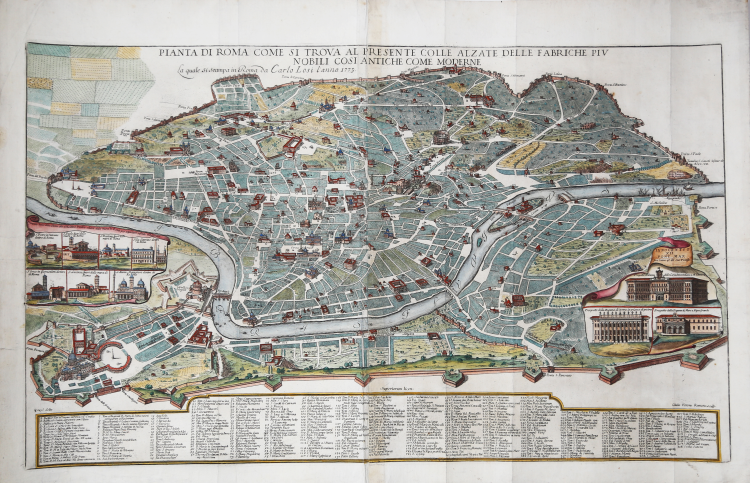
At the top center is the title: PIANTA DI ROMA COME SI TROVA AL PRESENTE COLLE ALZATE DELLE FABRICHE PIU NOBILI COSI ANTICHE COME MODERNE.. At the top edge of the frame: on the left, L. Cruyl delin.; in the center, Superiorum licen.; on the right, Giulio Testone Romano Sculp.
Cruyl's map, first published in 1665 by the De Rossi printing house, is one of the rare images of the city that presents both an iconographic and a perspective layout.
The views in this map are the same as those that were later the subject of specific engravings by the Flemish artist, almost like a sort of personal catalog.
The copy in question was published by Giovanni Battista De Rossi in 1665. There is a known reprint with the addition of some views of notable places by Matteo Gregorio de Rossi (1696) and a further edition by Carlo Losi, dated 1773.
Engraved by Giulio Testone on two copper plates, finely hand-colored, in perfect condition.
Lievin Cruyl (1640-1720) was a Flemish perspective artist from Ghent who moved to Rome in 1644. Together with Giovan Battista Falda and Israel Silvestre, he was one of the innovators of 17th-century Roman perspective painting. Although he was influenced by the 16th-century conception of the role of antiquity in the image of Rome, he depicted the architectural and urban innovations of the Rome of Alexander VII (Fabio Chigi, 1655-1667), characterizing his views with small genre scenes in the Flemish tradition. In his representation of urban space, Cruyl altered the perspective, raising the viewpoint and expanding the field of vision, using the most advanced optical techniques of the time.
A magnificent example of Carlo Losi's print run, in perfect condition. A very rare and sought-after work.
Bibliografia
Arrigoni-Bertarelli (1939): n. 142; Christie’s (1998): p. 50, n. 1043; Ehrle (1908): p. 23; Frutaz (1962): pp. 216-217, n. CLIV, Tav. 343; Hülsen (1915): XXIV, pp. 87-89, nn. 110-111; Jatta (1992): p. 166, n. 31s; Jatta (2012); Marigliani (2007): pp. 216-217, n. 124 e p. 249, n. 155; Roma Veduta (2000): p. 175, n. 31; Scaccia Scarafoni (1939): pp. 125-126, n. 241.
Lievin CRUYL (Ghendt 1640 - 1720)
|
Flemish priest, draughtsman and etcher, active also in Italy and France. While living in Wetteren (nr Ghent), he was involved in the completion of the Gothic St Michielskerk in Ghent. The construction of the western tower had been interrupted in 1566 because of religious unrest, and in 1652 steps were taken to complete it. After a Renaissance design was proposed in 1653, Cruyl submitted a drawing in Brabantine Late Gothic style (Ghent, Bib. Rijksuniv.) in 1662. His tower was to have been 134 m high, higher than the north tower of Antwerp Cathedral (1521). However, the project was never realized because of lack of funds. Although unoriginal and of an outdated style, the design had elegance and grandeur
|
Lievin CRUYL (Ghendt 1640 - 1720)
|
Flemish priest, draughtsman and etcher, active also in Italy and France. While living in Wetteren (nr Ghent), he was involved in the completion of the Gothic St Michielskerk in Ghent. The construction of the western tower had been interrupted in 1566 because of religious unrest, and in 1652 steps were taken to complete it. After a Renaissance design was proposed in 1653, Cruyl submitted a drawing in Brabantine Late Gothic style (Ghent, Bib. Rijksuniv.) in 1662. His tower was to have been 134 m high, higher than the north tower of Antwerp Cathedral (1521). However, the project was never realized because of lack of funds. Although unoriginal and of an outdated style, the design had elegance and grandeur
|