
- New
| Reference: | A53985 |
| Author | Edoardo PERINO |
| Year: | 1885 |
| Zone: | Rome |
| Printed: | Rome |
| Measures: | 780 x 580 mm |
| Reference: | A53985 |
| Author | Edoardo PERINO |
| Year: | 1885 |
| Zone: | Rome |
| Printed: | Rome |
| Measures: | 780 x 580 mm |
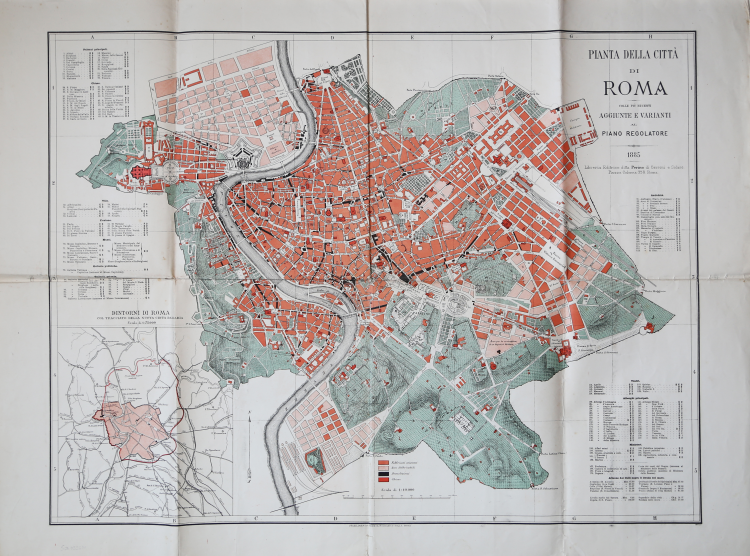
Map of Rome from 1885, illustrating the additions and changes to the Master Plan following the proclamation of Rome as the capital city. This map highlights in red the new areas of urban expansion (such as the Prati and Esquilino neighborhoods) planned during that period. Published in Rome by the Piedmontese publisher Edoardo Perino, it was printed in chromolithograph by the Luigi Rolla.
The map uses different colors to identify existing buildings, building areas, demolitions, and churches. Work on the embankments has just begun: the Lungotevere is completed on the right bank only in the section between Tiber Island and the future Ponte Mazzini and between the Alhambra and Viale delle Milizie, and on the left bank between Tiber Island and Ponte Sisto. Demolitions include the extension of Via della Lungara, various sections of the Lungotevere, the extension of Via Cavour to Piazza Venezia, and the final section of Corso Vittorio from Piazza della Chiesa Nuova to the river. Key to 170 numbers. The map was reprinted at least six times until the one published by the Solaro brothers in 1891” (cf. Marigliani, p. 460).
Chromolithograph, usual folds, otherwise in excellent condition.
Bibliografia
C. Marigliani, Le piante di Roma nelle collezioni private, p. 460, n. 408; Scaccia Scarafoni n. 347.
Edoardo PERINO (Torino 1845 - Rocca di Papa 1895)
|
Edoardo Perino (Turin, October 15, 1845 – Rocca di Papa, August 31, 1895) was an Italian printer and publisher. He is considered one of the most significant figures in Italian publishing (especially in Rome) during the Umberto I era. Son of Antonio, a printer, and Felicita Magnone, he was introduced to the art of printing by his brother Giovanni, under whose guidance he became a skilled master printer. In 1865, he left his hometown, following the transfer of the Italian capital from Turin to Florence, later joined by his brother. He entered the printing house of the Florentine newspaper La Riforma, earning a salary of 100 lire a week, a testament to his uncommon typographical skill. With the breach of Porta Pia, he followed the Italians to Rome where, thanks to his accumulated savings (several thousand lire at the time), he took over a space in Piazza Colonna next to the entrance to Palazzo Ferrajoli. There he set up his "newspaper company," from which he launched his business in the capital. Perino delivered to Rome all the newspapers he could acquire, even foreign ones like Le Figaro and the Times. At that time, in the early years of post-unification Italy, Perino was virtually the only one practicing this profession, quickly becoming a point of reference for information in the city. It is difficult to determine exactly when Perino began his publishing career, due to subsequent moves (first to Via delle Colonnette and Via della Frezza, then to Via Torino with the purchase of the "La Bodoniana" printing house). What is certain is that in 1885, a building on Via del Lavatore housed a substantial organization, from the printing house to the administration. From the modest "pedalina" he soon moved on to much more modern printing presses; he purchased a rotary press capable of printing 25,000 copies per hour. Perino became the publisher of many talented, yet still unknown, authors, such as Grazia Deledda and Giustino Ferri. He also published Salvatore Di Giacomo, Enrico Panzacchi, and several small volumes of poems by Gioacchino Belli. He was the first to introduce serialized works to Rome, a practice already successfully experimented with in Milan and Turin. With Le memorie di Mastro Titta, a fictionalized biography of the famous executioner Mastro Titta, and Beatrice Cenci (by Francesco Domenico Guerrazzi of Livorno), Edoardo Perino had a real stroke of luck: sales reached unprecedented heights. These and other works were true serial novels, aimed at a general public. In 1887, he wanted to launch a Roman newspaper and so became editor of Rugantino. He appointed Giggi Zanazzo as its editor, whom Perino considered an excellent poet in the vernacular and a distinguished writer, for whom he had already edited several volumes. With the newspaper's support, Perino organized the first Roman song festival, the famous Sangiovanni, which was held for decades in front of the basilica of the saint. Perino's last publication was "Il Valore Italiano," an illustrated periodical that covered historical, military, and patriotic themes. It was founded in 1895 and directed by Oreste Gorra.
|
Edoardo PERINO (Torino 1845 - Rocca di Papa 1895)
|
Edoardo Perino (Turin, October 15, 1845 – Rocca di Papa, August 31, 1895) was an Italian printer and publisher. He is considered one of the most significant figures in Italian publishing (especially in Rome) during the Umberto I era. Son of Antonio, a printer, and Felicita Magnone, he was introduced to the art of printing by his brother Giovanni, under whose guidance he became a skilled master printer. In 1865, he left his hometown, following the transfer of the Italian capital from Turin to Florence, later joined by his brother. He entered the printing house of the Florentine newspaper La Riforma, earning a salary of 100 lire a week, a testament to his uncommon typographical skill. With the breach of Porta Pia, he followed the Italians to Rome where, thanks to his accumulated savings (several thousand lire at the time), he took over a space in Piazza Colonna next to the entrance to Palazzo Ferrajoli. There he set up his "newspaper company," from which he launched his business in the capital. Perino delivered to Rome all the newspapers he could acquire, even foreign ones like Le Figaro and the Times. At that time, in the early years of post-unification Italy, Perino was virtually the only one practicing this profession, quickly becoming a point of reference for information in the city. It is difficult to determine exactly when Perino began his publishing career, due to subsequent moves (first to Via delle Colonnette and Via della Frezza, then to Via Torino with the purchase of the "La Bodoniana" printing house). What is certain is that in 1885, a building on Via del Lavatore housed a substantial organization, from the printing house to the administration. From the modest "pedalina" he soon moved on to much more modern printing presses; he purchased a rotary press capable of printing 25,000 copies per hour. Perino became the publisher of many talented, yet still unknown, authors, such as Grazia Deledda and Giustino Ferri. He also published Salvatore Di Giacomo, Enrico Panzacchi, and several small volumes of poems by Gioacchino Belli. He was the first to introduce serialized works to Rome, a practice already successfully experimented with in Milan and Turin. With Le memorie di Mastro Titta, a fictionalized biography of the famous executioner Mastro Titta, and Beatrice Cenci (by Francesco Domenico Guerrazzi of Livorno), Edoardo Perino had a real stroke of luck: sales reached unprecedented heights. These and other works were true serial novels, aimed at a general public. In 1887, he wanted to launch a Roman newspaper and so became editor of Rugantino. He appointed Giggi Zanazzo as its editor, whom Perino considered an excellent poet in the vernacular and a distinguished writer, for whom he had already edited several volumes. With the newspaper's support, Perino organized the first Roman song festival, the famous Sangiovanni, which was held for decades in front of the basilica of the saint. Perino's last publication was "Il Valore Italiano," an illustrated periodical that covered historical, military, and patriotic themes. It was founded in 1895 and directed by Oreste Gorra.
|