
- New
| Reference: | A54563 |
| Author | Matthaus SEUTTER "il vecchio" |
| Year: | 1730 |
| Zone: | Malta |
| Printed: | Augsburg |
| Measures: | 585 x 505 mm |
| Reference: | A54563 |
| Author | Matthaus SEUTTER "il vecchio" |
| Year: | 1730 |
| Zone: | Malta |
| Printed: | Augsburg |
| Measures: | 585 x 505 mm |
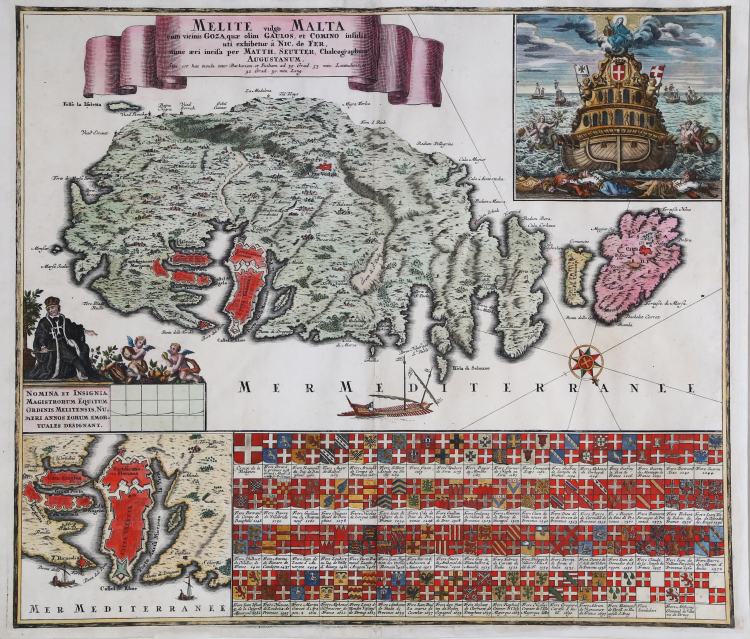
A large, decorative map of Malta—oriented with north towards the bottom right—featuring an inset view of Valletta, the coats of arms of the Grand Masters of the Knights of Malta, and an allegorical scene depicting the Order's naval power.
This is a fine example of Mattheus Seutter’s decorative map of Malta and its neighboring islands, published in Augsburg. The map and the coats of arms (67 of which appear at the bottom right) are based on an earlier map by Nicolas De Fer (1722); however, Seutter added an inset showing the fortifications surrounding Valletta and the Grand Harbour (bottom left) and a separate engraving of a ship belonging to the Knights of St. John (top right). The islands of Malta, Comino, and Gozo are depicted in great detail, including the network of watchtowers that encircled both Malta and Gozo, as well as major churches and aqueducts.
With this spectacular 1730 map, Matthias Seutter celebrates the victory over the Ottomans during the Great Siege of Malta in 1565, an event of such magnitude that it remained a pivotal moment in the European consciousness well into the 18th century.
Matthäus Seutter (1678–1757) was one of the most important and prolific German map publishers of the 18th century; he began his career as an engraver under the tutelage of the renowned J. B. Homann. In the early 18th century, Seutter left Homann to return to Augsburg, where he worked for the prominent art publisher Jeremia Wolff (1663–1724), engraving maps and other prints for him. Around 1717, he established his own independent map publishing firm in Augsburg. Most of Seutter's maps were heavily based on—if not direct copies of—earlier works by the Homann and De L'Isle firms. Nevertheless, by 1731–32, Seutter had become one of the most prolific publishers of his time; he was honored by the German Emperor Charles VI with the title of Imperial Geographer, after which most of his subsequent maps bore the designation *Avec Privilege*. Seutter continued publishing until his death in 1757, at the height of his career.
Etching, finely hand-colored; in good condition.
Matthaus SEUTTER "il vecchio" (1678 - 1757)
|
Matthäus Seutter (1678 - 1757) was one of the most important and prolific German map publishers of the 18th century. Seutter was born the son of a goldsmith but apprenticed as a brewer. Apparently uninspired by the beer business, Seutter abandoned his apprenticeship and moved to Nuremberg where he apprenticed as an engraver under the tutelage of the prominent J. B. Homann. Sometime in the early 1700s Seutter left Homann to return to Augsburg, where he worked for the prominent art publisher jeremiad Wolff (1663 - 1724), for whom he engraved maps and other prints. Sometime around 1717 he established his own independent cartographic publishing firm in Augsburg. Though he struggled in the early years of his independence, Seutter's engraving skill and commitment to diversified map production eventually attracted a substantial following. Most of Seutter's maps are heavily based upon, if not copies of, earlier work done by the Homann and De L'Isle firms. Nonetheless, by 1731/32 Seutter was one of the most prolific publishers of his time and was honored by the German Emperor Karl VI who gave him the title of Imperial Geographer, after which most subsequent maps included the Avec Privilege designation. Seutter continued to publish until his death, at the height of his career, in 1757. Seutter had two engraver sons, Georg Matthäus Seutter (1710 - 173?) and Albrecht Carl Seutter (1722 - 1762). Georg Matthäus quit the business and relocated to Woehrdt in 1729 (and probably died shortly thereafter), leaving the family inheritance to his wastrel brother Albrecht Carl Seutter, who did little to advance the firm until in own death in 1762. Following Albrecht's death, the firm was divided between the established Johann Michael Probst (1727 - 1776) firm and the emerging firm of Tobias Conrad Lotter. Lotter, Matthäus Seutter's son-in-law, was a master engraver and worked tirelessly on behalf of the Suetter firm. It is Lotter, who would eventually become one of the most prominent cartographers of his day, and his descendants, who are generally regarded as the true successors to Matthäus Seutter.
|