

| Reference: | S50311 |
| Author | Pierre MORTIER |
| Year: | 1704 |
| Zone: | Bergamo |
| Printed: | Amsterdam |
| Measures: | 605 x 445 mm |
| Reference: | S50311 |
| Author | Pierre MORTIER |
| Year: | 1704 |
| Zone: | Bergamo |
| Printed: | Amsterdam |
| Measures: | 605 x 445 mm |
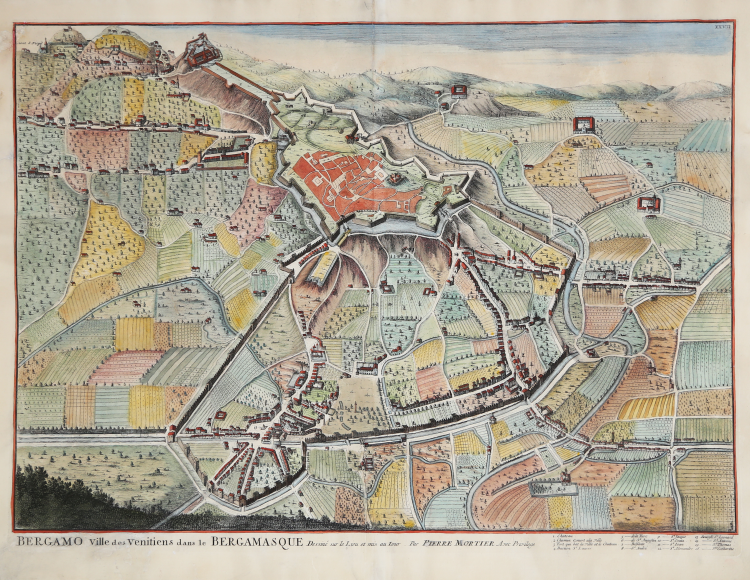
Beautiful city map published by Pierre Mortier in Amsterdam in 1704.
It is based on the model by Giovanni Macheri and Pietro Micheli and dedicated to Francesco Amedeo Martinengo Colleoni.
This map was part of the first volume of Pierre Mortier's “Nouveau Theatre de l'Italie” published in Amsterdam in 1704/5 and 1724, as a supplement to Johannes Baleu's project, begun in 1663, of the great “book of cities” lacking plans of most of the northern part of the peninsula. The images had, presumably, already been engraved by Joan Blaeu before the printing house burned down and, upon its liquidation, were purchased by Mortier, who published them in his Nouveau Theatre de l'Italie.
Blaeu, during his long publishing activity published three volumes on Italian cities. In 1663 the first three, divided into Church State, Rome and Kingdom of Naples and Sicily. Upon his death his heirs gave birth to two more volumes dated 1682 focusing on the cities of Piedmont and Savoy, later reprinted by other publishers in 1693 and 1697. The Frenchman Pierre Mortier published a reprint in 1704/5, entitled Nouveau Theatre de l'Italie. The work is in four volumes and includes Blaeu's plates, retouched and modified in small part, supplemented by the addition of several new maps of his own design, depicting the cities of the northern part of the peninsula, enclosed in the first volume of the work. Mortier's atlas was published with Latin, French and Dutch texts. The special feature that differentiates the two editions by Blaeu and Mortier is that the text is not on the verso of the individual map (which is therefore blank in the back) but is found at the beginning of each individual volume. The great success of the work gave rise to a further reprint, virtually identical, edited by R. Alberts and published in 1724/5.
Etching with fine later hand colour, expert repairs at the left corners, otherwise good condition.
Bibliografia
Arrigoni-Bertarelli (1931): p. 2, n. 13; Serra Patrick, Tacconi Mario, Bergamo nelle stampe. Dal 1400 al 1800. Il territorio, piante e vedute della città, piante e vedute della provincia, 1975; Serra Patrick, Antiche stampe di Bergamo dal XV al XVIII secolo. Xilografie, bulini, acqueforti, 1982.
|
Pierre Mortier (January 26, 1661 - February 18, 1711) or Pieter Mortier was a cartographer, engraver, and print seller active in Amsterdam during the later 17th and early 18th centuries. Mortier, then known as Pieter, was born in Leiden. He relocated to Paris from 1681 to 1685, adopting the French name Pierre, which he retained throughout his career. While in France, he developed deep French connections by bringing sophisticated Dutch printing technology and experience to nascent French map publishers such as Guillaume De L'Isle (1675 - 1726), Alexis-Hubert Jaillot (c. 1632 - 1712), and Nicholas de Fer (1646 - 1720). Consequently, much of Mortier's business was built upon issuing embellished high quality editions of contemporary French maps - generally with the permissions of their original authors. In the greater context of global cartography, this was a significant advantage as most Dutch map publishes had, at this point, fallen into the miasma of reprinting their own outdated works. By contrast, the cartographers of France were producing the most accurate and up to date charts anywhere. Mortier's cartographic work culminated in the magnificent nautical atlas, Le Neptune Francois. He was awarded the Privilege, an early form of copyright, in 1690. Upon Pierre's death in 1711 this business was inherited by his widow. In 1721, his son Cornelius Mortier took over the day to day operation of the firm. Cornelius partnered with his brother-in-law Jean Covens to form one of history's great cartographic partnerships - Covens and Mortier - which continued to publish maps and atlases until about 1866.
|
|
Pierre Mortier (January 26, 1661 - February 18, 1711) or Pieter Mortier was a cartographer, engraver, and print seller active in Amsterdam during the later 17th and early 18th centuries. Mortier, then known as Pieter, was born in Leiden. He relocated to Paris from 1681 to 1685, adopting the French name Pierre, which he retained throughout his career. While in France, he developed deep French connections by bringing sophisticated Dutch printing technology and experience to nascent French map publishers such as Guillaume De L'Isle (1675 - 1726), Alexis-Hubert Jaillot (c. 1632 - 1712), and Nicholas de Fer (1646 - 1720). Consequently, much of Mortier's business was built upon issuing embellished high quality editions of contemporary French maps - generally with the permissions of their original authors. In the greater context of global cartography, this was a significant advantage as most Dutch map publishes had, at this point, fallen into the miasma of reprinting their own outdated works. By contrast, the cartographers of France were producing the most accurate and up to date charts anywhere. Mortier's cartographic work culminated in the magnificent nautical atlas, Le Neptune Francois. He was awarded the Privilege, an early form of copyright, in 1690. Upon Pierre's death in 1711 this business was inherited by his widow. In 1721, his son Cornelius Mortier took over the day to day operation of the firm. Cornelius partnered with his brother-in-law Jean Covens to form one of history's great cartographic partnerships - Covens and Mortier - which continued to publish maps and atlases until about 1866.
|