
| Reference: | S47425 |
| Author | Filippo De Rossi |
| Year: | 1650 ca. |
| Zone: | Genova |
| Measures: | 180 x 125 mm |
| Reference: | S47425 |
| Author | Filippo De Rossi |
| Year: | 1650 ca. |
| Zone: | Genova |
| Measures: | 180 x 125 mm |
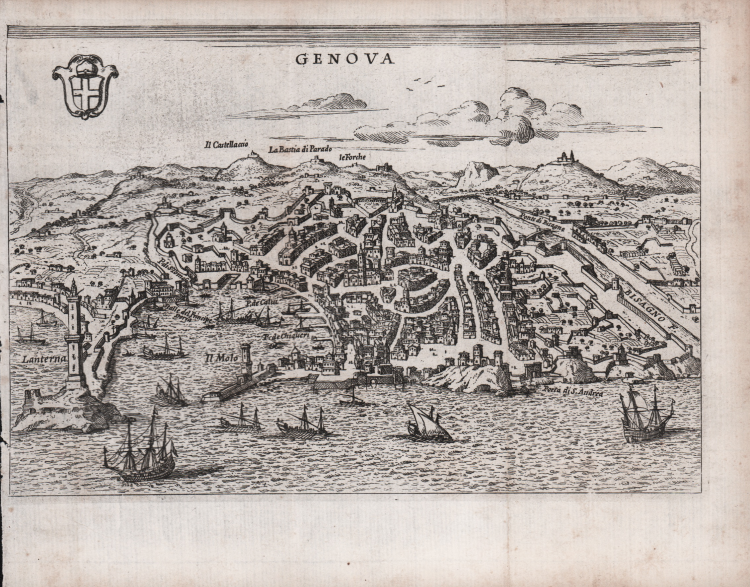
Plan of the city taken from the Roman edition of "Itinerario, overo nova descrittione de' viaggi principali d'Italia [...] di Francesco Scoto" first published in 1650 by Filippo de Rossi, one of the sons of Giuseppe de Rossi, progenitor of the great family of Roman publishers.
Franz Schott (1548-1622), Italianized as Francesco Scoto, was a native of Antwerp. A jurist and great traveler, brother of the better known Andreas, a Jesuit, philologist and antiquarian, he compiled "Itinerario overo decrittione de' viaggi principali in Italia." The work first appeared in Antwerp on the occasion of the Jubilee of 1600, under the title Itinerari Italiae rerumq[ue] romanarum libri tres, printed in the Officina Plantiniana by Joannes Moretus. Devoid of the iconographic apparatus, it was intended as a service to pilgrims traveling to Italy and an expression of a particular form of odeporic writing that embraced all those texts that take on the character of a travel guide and offer themselves as a tool aimed at orienting the traveler in his journey. It was a great success and was then published in numerous subsequent editions in Latin, Italian, French and English.
The Itinerary of Italy had its full development in the numerous Italian editions, which were richly illustrated with perspective views and city plans. The first illustrated Italian edition was edited by Pietro Bertelli and Francesco Bolzetta (Vicenza or Venice 1601); several editions by Bolzetta followed with an increasing number of cartographic illustrations. Schott's text was also used for their own editions of the Itinerario d'Italia by Matteo Cadorin (Padua 1654 and later) and Pietro Bigonci (Venice 1665).
Also in Rome, in the Jubilee year 1650, the publisher Filippo de Rossi printed Itinerario overo Nuova Descrittione de' Viaggi Principali d'Italia. There are 19 prints to which the map of Italy is added, and they are slightly more accurate.
The plates of the Roman edition (made by means of new copper plates) were reprinted in later editions - augmented - by the publishers Michelangelo and Pier Vincenzo de Rossi (1669, 1700 and 1717) and then in those edited by Fausto Amidei, a book dealer on the Corso, who had Antonio de Rossi print the first of his three editions of Francesco Scoto's Itinerario d'Italia in 1737. The others were in 1747 in the printing house of Bernabò and Lazzarini and in 1761 in the printing house of Generoso Salomoni.
Etching, usual editorial paper folds, in very good condition.
Filippo De Rossi (attivo a Roma nella metà del XVII secolo)
|
Filippo de' Rossi was a renowned printer, bookseller, and publisher active in Rome during the 17th century. He belonged to a celebrated Roman dynasty of typographers and engravers, famous for documenting the art and architecture of Baroque Rome. His most well-known work, Ritratto di Roma moderna, was first published in Rome in 1645—printed by Francesco Moneta and financed by de' Rossi himself—and subsequently reprinted in 1652. It serves as an essential illustrated guide to the city’s Renaissance and Baroque churches, palaces, and monuments. The De Rossi dynasty operated one of the most significant printing houses in the capital, located near the church of Santa Maria della Pace. Their publications played a decisive role in disseminating the styles of 17th- and 18th-century Roman architecture and engraving throughout Europe. Filippo’s son, Lorenzo Filippo De Rossi - active during the first half of the 18th century - sold the family’s entire collection of printing plates and engravings. This collection was acquired in 1738 by Pope Clement XII to establish the Calcografia Camerale, which is known today as the Istituto Centrale per la Grafica.
|