

| Reference: | S50317 |
| Author | Etienne DUPERAC |
| Year: | 1575 ca. |
| Zone: | Villa Giulia |
| Printed: | Rome |
| Measures: | 410 x 295 mm |
| Reference: | S50317 |
| Author | Etienne DUPERAC |
| Year: | 1575 ca. |
| Zone: | Villa Giulia |
| Printed: | Rome |
| Measures: | 410 x 295 mm |
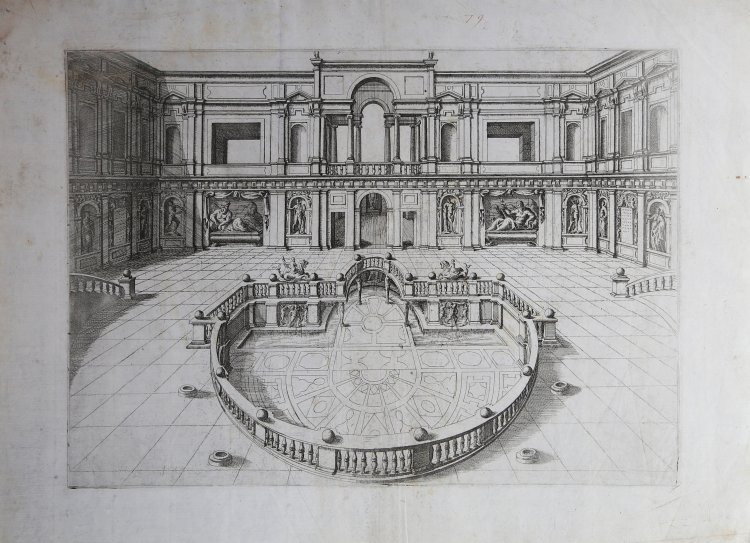
Etching, circa 1575/80, unsigned and without printing details.
Attributed for stylistic reasons to the hand of Etienne Duperac, the work is not included in the Lafreri catalogue but is part of the posthumous copies of the Speculum Romanae Magnificentiae.
Example of the first state of three, before the Giovanni Orlandi’s address.
“The engraving depicts Villa Giulia, commissioned by Julius III (1550-1555) from Vignola. Work began in 1551. ‘Unlike the western hemicycle with its rustic attic, this front appears completely architecturally defined in its parts and crowned in the center by a large pergola. The back wall of the nymphaeum must have appeared as a diaphragm open towards the garden composed of a central Serlian opening on either side of which were the two aviaries separated by niches. A series of aedicules frames these niches supported by free-standing columns in the central sector and reduced at the sides to flat pilasters. […] The position of the sculptures seems to correspond to that indicated by contemporary descriptions: it is in fact possible to recognize even the secondary objects such as the sea monsters and the balls placed above the central balustrade». The three engravings (see cat. VI.26 and VI.28) are not signed by Lafréry as publisher, and are not included in the Index compiled by him” (see Marigliani, VI.26).
The work belongs to the Speculum Romanae Magnificentiae, the earliest iconography of ancient Rome.
The Speculum originated in the publishing activities of Antonio Salamanca and Antonio Lafreri (Lafrery). During their Roman publishing careers, the two editors-who worked together between 1553 and 1563-started the production of prints of architecture, statuary, and city views related to ancient and modern Rome. The prints could be purchased individually by tourists and collectors, but they were also purchased in larger groups that were often bound together in an album. In 1573, Lafreri commissioned a frontispiece for this purpose, where the title Speculum Romanae Magnificentiae appears for the first time. Upon Lafreri's death, two-thirds of the existing copperplates went to the Duchetti family (Claudio and Stefano), while another third was distributed among several publishers. Claudio Duchetti continued the publishing activity, implementing the Speculum plates with copies of those "lost" in the hereditary division, which he had engraved by the Milanese Amborgio Brambilla. Upon Claudio's death (1585) the plates were sold - after a brief period of publication by the heirs, particularly in the figure of Giacomo Gherardi - to Giovanni Orlandi, who in 1614 sold his printing house to the Flemish publisher Hendrick van Schoel. Stefano Duchetti, on the other hand, sold his own plates to the publisher Paolo Graziani, who partnered with Pietro de Nobili; the stock flowed into the De Rossi typography passing through the hands of publishers such as Marcello Clodio, Claudio Arbotti and Giovan Battista de Cavalleris. The remaining third of plates in the Lafreri division was divided and split among different publishers, some of them French: curious to see how some plates were reprinted in Paris by Francois Jollain in the mid-17th century. Different way had some plates printed by Antonio Salamanca in his early period; through his son Francesco, they goes to Nicolas van Aelst's. Other editors who contributed to the Speculum were the brothers Michele and Francesco Tramezzino (authors of numerous plates that flowed in part to the Lafreri printing house), Tommaso Barlacchi, and Mario Cartaro, who was the executor of Lafreri's will, and printed some derivative plates. All the best engravers of the time - such as Nicola Beatrizet (Beatricetto), Enea Vico, Etienne Duperac, Ambrogio Brambilla, and others - were called to Rome and employed for the intaglio of the works.
All these publishers-engravers and merchants-the proliferation of intaglio workshops and artisans helped to create the myth of the Speculum Romanae Magnificentiae, the oldest and most important iconography of Rome. The first scholar to attempt to systematically analyze the print production of 16th-century Roman printers was Christian Hülsen, with his Das Speculum Romanae Magnificentiae des Antonio Lafreri of 1921. In more recent times, very important have been the studies of Peter Parshall (2006) Alessia Alberti (2010), Birte Rubach and Clemente Marigliani (2016).
A good impression on contemporary laid paper with “pilgrim in a circle with star” watermark, with margin, in good condition.
Bibliografia
C. Hülsen, Das Speculum Romanae Magnificentiae des Antonio Lafreri (1921), n. 164; cfr. Peter Parshall, Antonio Lafreri's 'Speculum Romanae Magnificentiae, in “Print Quarterly”, 1 (2006); B. Rubach, Ant. Lafreri Formis Romae (2016), n. 382, I/III; A. Alberti, L’indice di Antonio Lafrery (2010), n. A154 I/III; Marigliani, Lo splendore di Roma nell’Arte incisoria del Cinquecento (2016), n. VI.27.
|
Etcher, engraver, painter and architect, from Bordeaux. Active in Venice and from 1559 in Rome.Returned to France either in 1578 or 1582. Died in Paris.
Duperac worked for various Roman print dealers, including Lafreri, Vaccari ,Faleti and P.P. Palumbo.He himself published some of his own work.Specialized in antiquities,maps and views.
Urbis Romae sciographia ex antiquis monumentis accuratiss. Delineata,1574.
Also the series,Vestigi dell’antichità di Roma ,1575.
|
|
Etcher, engraver, painter and architect, from Bordeaux. Active in Venice and from 1559 in Rome.Returned to France either in 1578 or 1582. Died in Paris.
Duperac worked for various Roman print dealers, including Lafreri, Vaccari ,Faleti and P.P. Palumbo.He himself published some of his own work.Specialized in antiquities,maps and views.
Urbis Romae sciographia ex antiquis monumentis accuratiss. Delineata,1574.
Also the series,Vestigi dell’antichità di Roma ,1575.
|