
| Reference: | S48308.6 |
| Author | James ANDERSON |
| Year: | 1875 ca. |
| Measures: | 260 x 195 mm |
| Reference: | S48308.6 |
| Author | James ANDERSON |
| Year: | 1875 ca. |
| Measures: | 260 x 195 mm |
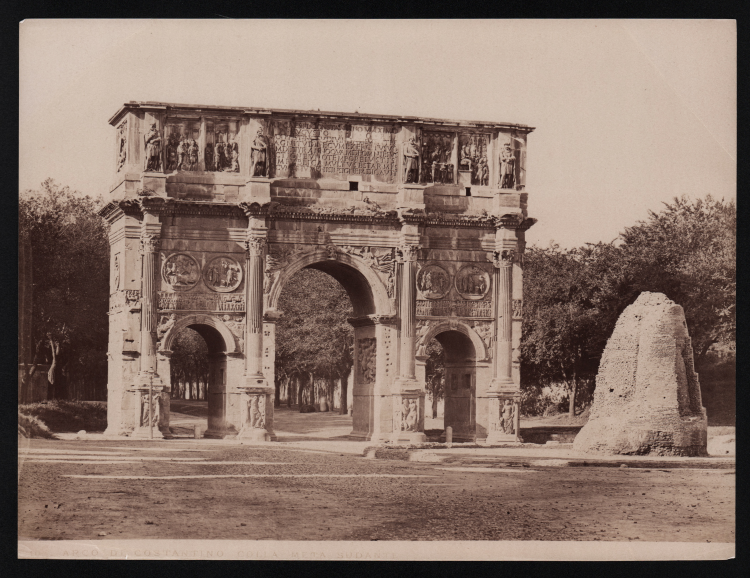
Albumen on paper, circa 1870/75. Unsigned, the photograph bears the inscription Arco di Costantino colla Meta Sudante" at the bottom. On the verso of the photograph is a blue ink stamp "Fotografia Anderson – Roma" and an old ownership inscription in pencil "MacMahone Rome May 18, 1886". The period is that of Domenico Anderson, but the photograph may have been taken from an even earlier negative, dating from 1870–1875, and perhaps by James Anderson himself (d. 1877), who in the meantime had been joined in the work by his son Domenico.
The subject, depicting the Arch of Constantine with the Meta Sudans visible on the right, can be identified with the one in the 1881 catalog, number 11, with the title Arco di Costantino, lato orientale con i palmi di San Bonaventura". It is difficult to establish the precise date of the photograph, since even a comparison with various other photographs from the 1960s and 1970s reveals no major changes in the context of the Arch. The church of San Bonaventura, however, is not visible in the upper right corner because it is covered by vegetation; earlier shots, however, still show the church.
James Isaac Atkinson Anderson (Blencarn, March 11, 1813 – Rome, February 27, 1877) was a British painter and photographer who settled in Rome in 1838. He is mentioned among the painters active in Rome in an 1841 guide, and his signature is found in the Artists' Directory of the Caffè Greco, describing him as "Painter, Via del Muro Nuovo, no. 89," but also as "Anderson James photographer, outside Porta del Popolo, no. 19." This shows how Anderson, who upon coming to Rome must have envisioned building a career as a watercolorist in the ever-thriving market of illustrations and city views—for use by foreigners, but not only—had already begun working with the new photographic technique, creating calotypes (a process patented in 1841). He lived in Rome until his death, creating his own photographic studio, which three generations of Andersons—first with his son Domenico (1854-1938), and then with his sons Alessandro and Giorgio—brought to a lasting international fortune.
James ANDERSON (Blencarn 1813 - Roma 1877)
|
James Isaac Atkinson Anderson (Blencarn, 11 March 1813 – Rome, 27 February 1877) was a British painter and photographer who settled in Rome in 1838. He was born into a farming family in the village of Blencarn, Cumbria. After studying watercolour painting in Paris, he arrived in Rome in 1838 and took the pen name W. Nugent Dumbar. Under this name and with three well-received views, he participated in an exhibition at the Palazzina Valadier in Piazza del Popolo in 1839. He was then mentioned among the painters active in Rome in a guide of 1841, and his signature is found in the Rubrica degli artisti of the Caffè Greco, where he is identified under the letter D—on an unspecified date, but prior to 1845, when the Caffè opened the Rubrica—as "Painter, Via del Muro Nuovo, n. 89". Curiously, the same hand signs, under the letter A, a note "Anderson James photographer, outside Porta del Popolo, no. 19." This shows that Anderson, who upon coming to Rome must have envisioned building a career as a watercolorist in the ever-thriving market of illustrations and views of the city—for the use of foreigners, but not only—had already begun working with the new photographic technique, creating calotypes (a process patented in 1841). The artist, an Anglican, settled well in Rome, where he also married (Maria De Mutis, who between 1854 and 1863 bore him four sons, and died of cholera in 1867), and his children were all later baptized Catholics (the city, after all, was still the capital of the Papal States). He lived in Rome until his death, creating his own photographic studio there, to which three generations of Andersons contributed; First with his son Domenico (1854-1938), and then with his sons Alessandro and Giorgio, they achieved a long-lasting international success. The company, founded in 1851, lasted until 1963 when the Società Anonima Domenico Anderson was acquired by an Italian Institute for Cultural Collaboration, based at Via del Collegio Romano 2. The documentary quality of the photographic images—obviously more faithful to life than engravings—was meanwhile conquering the market of travelers, scholars, and antiques enthusiasts, especially foreigners: Anderson soon realized this and intensified his work in this field. In 1851, he then entrusted the distribution of his works to the Spithöver bookshop. In 1859, Anderson published his first and only catalogue (Catalogue des photographies de Rome de James Anderson): 28 pages in 9 x 13 format, with a summary description of 667 photographs.
|
James ANDERSON (Blencarn 1813 - Roma 1877)
|
James Isaac Atkinson Anderson (Blencarn, 11 March 1813 – Rome, 27 February 1877) was a British painter and photographer who settled in Rome in 1838. He was born into a farming family in the village of Blencarn, Cumbria. After studying watercolour painting in Paris, he arrived in Rome in 1838 and took the pen name W. Nugent Dumbar. Under this name and with three well-received views, he participated in an exhibition at the Palazzina Valadier in Piazza del Popolo in 1839. He was then mentioned among the painters active in Rome in a guide of 1841, and his signature is found in the Rubrica degli artisti of the Caffè Greco, where he is identified under the letter D—on an unspecified date, but prior to 1845, when the Caffè opened the Rubrica—as "Painter, Via del Muro Nuovo, n. 89". Curiously, the same hand signs, under the letter A, a note "Anderson James photographer, outside Porta del Popolo, no. 19." This shows that Anderson, who upon coming to Rome must have envisioned building a career as a watercolorist in the ever-thriving market of illustrations and views of the city—for the use of foreigners, but not only—had already begun working with the new photographic technique, creating calotypes (a process patented in 1841). The artist, an Anglican, settled well in Rome, where he also married (Maria De Mutis, who between 1854 and 1863 bore him four sons, and died of cholera in 1867), and his children were all later baptized Catholics (the city, after all, was still the capital of the Papal States). He lived in Rome until his death, creating his own photographic studio there, to which three generations of Andersons contributed; First with his son Domenico (1854-1938), and then with his sons Alessandro and Giorgio, they achieved a long-lasting international success. The company, founded in 1851, lasted until 1963 when the Società Anonima Domenico Anderson was acquired by an Italian Institute for Cultural Collaboration, based at Via del Collegio Romano 2. The documentary quality of the photographic images—obviously more faithful to life than engravings—was meanwhile conquering the market of travelers, scholars, and antiques enthusiasts, especially foreigners: Anderson soon realized this and intensified his work in this field. In 1851, he then entrusted the distribution of his works to the Spithöver bookshop. In 1859, Anderson published his first and only catalogue (Catalogue des photographies de Rome de James Anderson): 28 pages in 9 x 13 format, with a summary description of 667 photographs.
|