
| Reference: | S36534 |
| Author | Jacques CALLOT |
| Year: | 1632 ca. |
| Measures: | 45 x 74 mm |
| Reference: | S36534 |
| Author | Jacques CALLOT |
| Year: | 1632 ca. |
| Measures: | 45 x 74 mm |
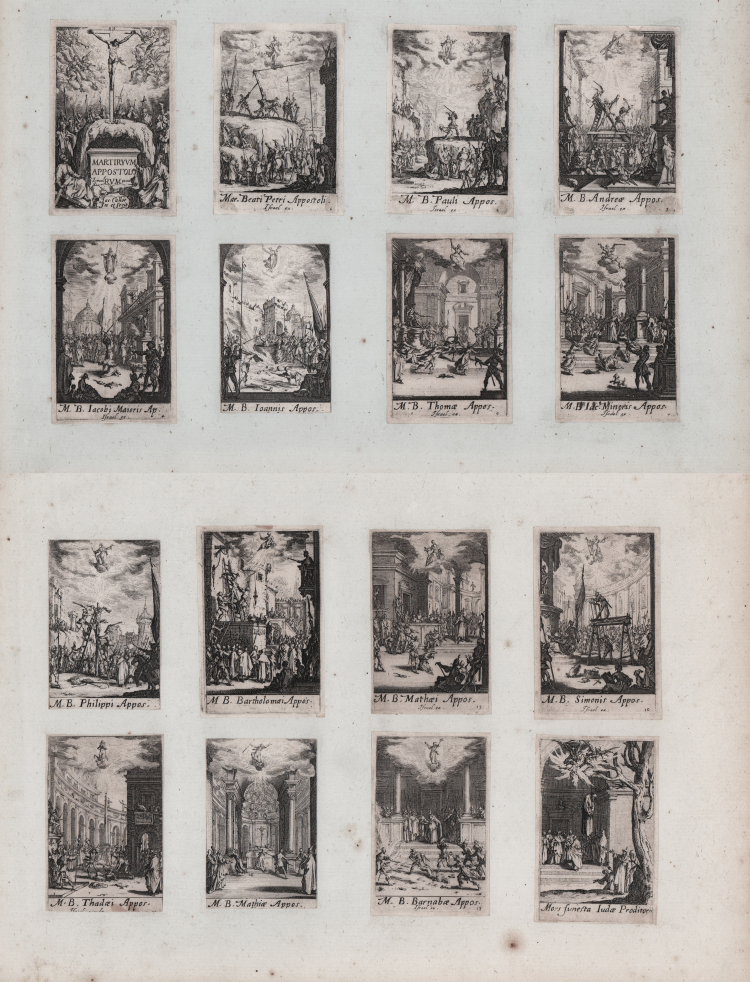
The complete set of title and 15 plates. Title in the third state (of three) and plates in the third state (of four) bearing the imprint of Israel Henriet.
Etchings, signed in the title "Jac. Callot In et fecit", printed on contemporary laid paper, trimmed to the platemark or with thin margins, laid down on antique mounting, good conditions.
The series was engraved in 1632 according to Meaume and cat. exhib. 'Jacques Callot' (Nancy, 1992), No.638-653, but in early 1634 according to Lieure.
Very rare as a set.
In the first half of the 17th century, Jacques Callot renewed the language of graphic art by developing and enhancing the potential of etching. Born in Nancy in 1592, he completed his artistic training in Italy, staying in Rome between 1608 and 1611, were he learned to engrave with a burin and established his first contacts with the engraver community. His patron, between 1612 and 1620, was Cosimo II de' Medici, at whose court he earned great renown both as an engraver of refined skill and as a judge of taste and intelligence. The years of his Florentine sojourn were filled with works that cemented his fame. After Cosimo II's death in 1621, Callot returned to Nancy, where he received new illustrious patrons, including the Duke of Lorraine and the Infanta of Spain. His fame was finally cemented with the commission, received through Richelieu, to engrave The Siege of La Rochelle and the Île de Ré for the King of France, Louis XIII. In 1630, he began collaborating with the publisher Israel Henriet in Paris, who edited many of his works. For his inexhaustible inventiveness in subject matter, his technical expertise, and his attention to detail and the minuscule, Callot's work stands as a decisive benchmark for the entire development of European engraving.
|
Lieure 1927, 1386-1401.
|
Jacques CALLOT (Nancy 1592 - 1635)
|
He was a baroque graphics artist, draftsman and printmaker from the Duchy of Lorraine (an independant state on the North-Eastern border with France). He made etchings that chronicled the people and the life of his period (soldiers, clowns, drunkards, wanderers, beggars, and various outcasts). These images of people are often contrasted by spectacular landscapes (see, for instance, "The Temptation of St. Anthony"). His skill in shading and his use of different tones were remarkable for the period and he is often compared to Albrecht Dürer.
|
|
Lieure 1927, 1386-1401.
|
Jacques CALLOT (Nancy 1592 - 1635)
|
He was a baroque graphics artist, draftsman and printmaker from the Duchy of Lorraine (an independant state on the North-Eastern border with France). He made etchings that chronicled the people and the life of his period (soldiers, clowns, drunkards, wanderers, beggars, and various outcasts). These images of people are often contrasted by spectacular landscapes (see, for instance, "The Temptation of St. Anthony"). His skill in shading and his use of different tones were remarkable for the period and he is often compared to Albrecht Dürer.
|