
| Reference: | A54099 |
| Author | Jan de BISSCHOP |
| Year: | 1670 ca. |
| Measures: | 100 x 215 mm |
| Reference: | A54099 |
| Author | Jan de BISSCHOP |
| Year: | 1670 ca. |
| Measures: | 100 x 215 mm |
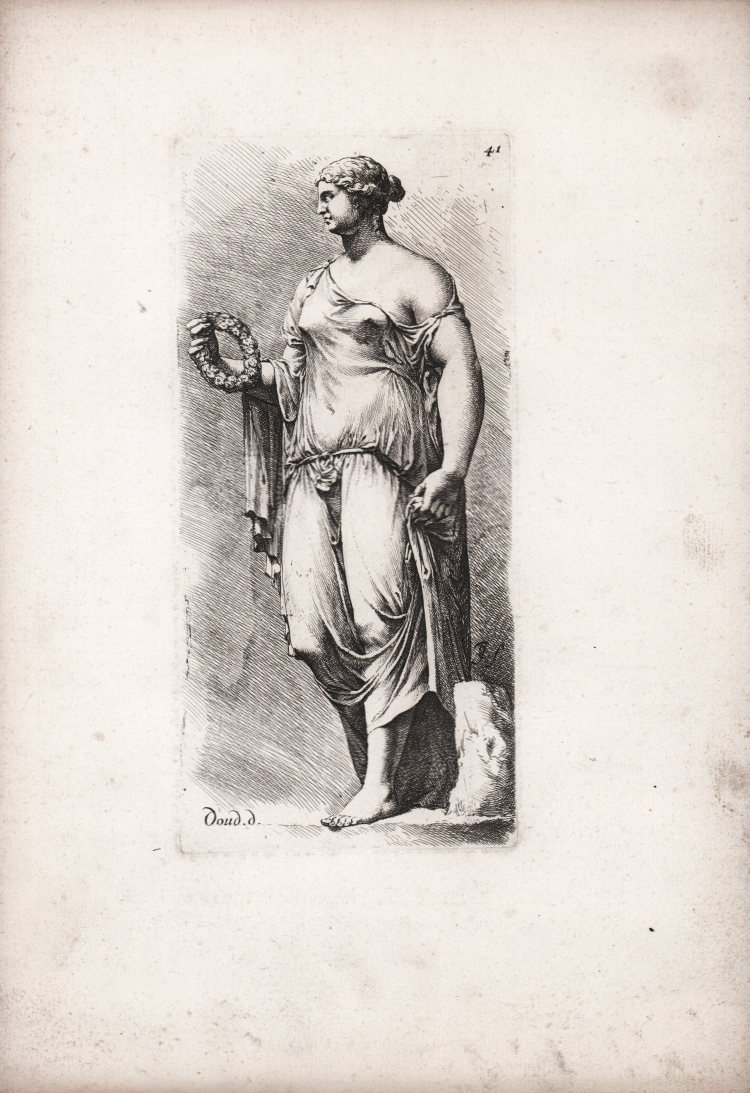
Etching, 1670 circa, signed on plate with the monogram. A fine impression, printed on contemporary laid paper, with margins, very good condition.
This statue is a Roman-period creation based on a model created at Athens to depict Aphrodite at the end of the 5th century BC. The belt knotted at the sides is to be attributed to the copyist. This style of dress is similar to a fashion popular in the mid-2nd century AD. The Farnese statue must date to this period, or later. Flore Maior appears headless and lacking its extremities in a drawing by Maarten van Heemskerck, an artist active at Rome between 1532 and 1536, and in an anonymous drawing from the beginning of the 16th century. Thus it could not have come from the Baths, since the Farnese began to excavate here after 1545.
The identification of the statue as Flora, goddess of nature, derived from an antiquarian tradition and was reinforced by the restorations made by Guglielmo della Porta, who gave her a head crowned with flowers and a garland in her right hand. These additions were replaced by those of Carlo Albacini at the end of the 18th century. After he arrived in Naples, Filippo Tagliolini remade the head in plaster and replaced the 16th century garland with a bouquet of flowers.
The plate si taken from Signorum veterum icones, a collection of Roman sculptures & statues by Jan de Bisschop (Joh. Episcopius), first published in 1668.
This suite of 100 prints by de Bisschop comprises of classical sculptures housed in Dutch and Italian collections in the seventeenth century. Ancient statues were highly regarded as works of art, in particular by artists who admired their representation of anatomy, drapery and poses. This suite includes some of the most important sculptures, from various view points, from which the artist could study.
Some of the classical sculptures reproduced in de Bisschop’s Icones were from the seventeenth-century collections of Gerrit Uylenburgh and Hendrik Scholten, to which de Bisschop had direct access. The sequence of the Icones adhered strictly to the classical tradition: first the individual parts of the body were illustrated (this section was left unfinished at de Bisschop’s premature death), then completesculptures, followed by poses and suggestions for compositions with more than one figure. The prints were intended to provide artists with examples of ideal poses. From the paintings of Adriaen van der Werrff and Nicolaes Verkolje, it is clear just how influential these studies were in the development of Dutch classical painting during the late 17th century.
|
Jan de Bisschop was the son of Harmen Jansz. de Bisschop and Aaltje Adriaensz. van Noort. Jan preferred to call himself Episcopius (Latin for Bishop) as he had a strong preference for the latin language. He is assumed to have been an apprentice of Bartholomeus Breenbergh (Deventer, 1598-Amsterdam, 1657), though he was a dillettante. Jan studied Law in Leyden after which he settles as a lawyer in The Hague in 1652. He married Anna van Baerle (1615-1676) in 1653. In The Hague de Bisschop held close connections and friendship with the Huygens family, especially with Constantijn Huygens Jr (1628-1697). Together with Jacob van der Does Sr., Maerten Lengele, Willem Doudijns and probably Constantijn Huygens Jr. as well, Jan de Bisschop founded a private drawing academy to promote Classicism. De Bisschops most important publications on Claccisism would follow several years later with Signorum veterum Icones after classical sculptures in Rome and Paradigmata Graphices Variorum Artificium with etchings after drawings by Italian Masters. Jan de Bisschop died of tuberculosis in 1671, after which his drawings and prints were auctioned. The copper plates for his etchings were purchased by Nicolaus Visscher who published a new edition of his graphics (Icones and Paradigmata). Jan de Bisschop started copying after paintings by 16th and 17th century Masters around 1655. His goal was to recreate the original painting fully respecting the artists style and rendering, though translated into another medium with brush and ink on paper.
|
|
Jan de Bisschop was the son of Harmen Jansz. de Bisschop and Aaltje Adriaensz. van Noort. Jan preferred to call himself Episcopius (Latin for Bishop) as he had a strong preference for the latin language. He is assumed to have been an apprentice of Bartholomeus Breenbergh (Deventer, 1598-Amsterdam, 1657), though he was a dillettante. Jan studied Law in Leyden after which he settles as a lawyer in The Hague in 1652. He married Anna van Baerle (1615-1676) in 1653. In The Hague de Bisschop held close connections and friendship with the Huygens family, especially with Constantijn Huygens Jr (1628-1697). Together with Jacob van der Does Sr., Maerten Lengele, Willem Doudijns and probably Constantijn Huygens Jr. as well, Jan de Bisschop founded a private drawing academy to promote Classicism. De Bisschops most important publications on Claccisism would follow several years later with Signorum veterum Icones after classical sculptures in Rome and Paradigmata Graphices Variorum Artificium with etchings after drawings by Italian Masters. Jan de Bisschop died of tuberculosis in 1671, after which his drawings and prints were auctioned. The copper plates for his etchings were purchased by Nicolaus Visscher who published a new edition of his graphics (Icones and Paradigmata). Jan de Bisschop started copying after paintings by 16th and 17th century Masters around 1655. His goal was to recreate the original painting fully respecting the artists style and rendering, though translated into another medium with brush and ink on paper.
|