
| Reference: | A54064 |
| Author | Jan de BISSCHOP |
| Year: | 1670 ca. |
| Measures: | 230 x 170 mm |
| Reference: | A54064 |
| Author | Jan de BISSCHOP |
| Year: | 1670 ca. |
| Measures: | 230 x 170 mm |
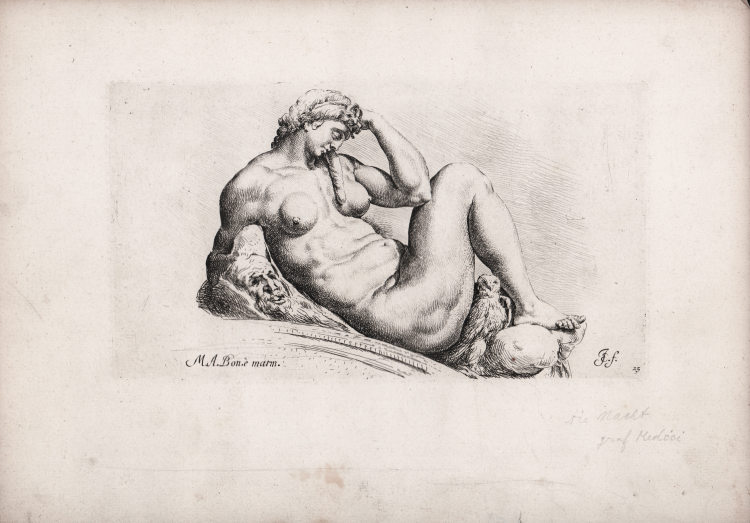
The plate showing the Night (Notte) a sculpture in marble by Michelangelo. Dating from 1526 to 1531, it is part of the decoration of the New Sacristy and part of an allegory of the four parts of a day. It is situated on the left of the sarcophagus of the tomb of Giuliano di Lorenzo de' Medici, Duke of Nemours.
Plate taken from Paradigmata graphices variorum artificum by Jan de Bisschop.
First published in part in 1671 in the Hague by Bisschop, the work contains 57 etchings after Italian Renaissance drawings, including Giulio Romano, Michelangelo, and Raphael.
Each plate bears Bisschop’s Latin monogram: JE. f. (Johannes Episcopius fecit)
The work is usually issued with the artist's Signorum veterum icons (1668).
Etching, in very good condition.
|
Jan de Bisschop was the son of Harmen Jansz. de Bisschop and Aaltje Adriaensz. van Noort. Jan preferred to call himself Episcopius (Latin for Bishop) as he had a strong preference for the latin language. He is assumed to have been an apprentice of Bartholomeus Breenbergh (Deventer, 1598-Amsterdam, 1657), though he was a dillettante. Jan studied Law in Leyden after which he settles as a lawyer in The Hague in 1652. He married Anna van Baerle (1615-1676) in 1653. In The Hague de Bisschop held close connections and friendship with the Huygens family, especially with Constantijn Huygens Jr (1628-1697). Together with Jacob van der Does Sr., Maerten Lengele, Willem Doudijns and probably Constantijn Huygens Jr. as well, Jan de Bisschop founded a private drawing academy to promote Classicism. De Bisschops most important publications on Claccisism would follow several years later with Signorum veterum Icones after classical sculptures in Rome and Paradigmata Graphices Variorum Artificium with etchings after drawings by Italian Masters. Jan de Bisschop died of tuberculosis in 1671, after which his drawings and prints were auctioned. The copper plates for his etchings were purchased by Nicolaus Visscher who published a new edition of his graphics (Icones and Paradigmata). Jan de Bisschop started copying after paintings by 16th and 17th century Masters around 1655. His goal was to recreate the original painting fully respecting the artists style and rendering, though translated into another medium with brush and ink on paper.
|
|
Jan de Bisschop was the son of Harmen Jansz. de Bisschop and Aaltje Adriaensz. van Noort. Jan preferred to call himself Episcopius (Latin for Bishop) as he had a strong preference for the latin language. He is assumed to have been an apprentice of Bartholomeus Breenbergh (Deventer, 1598-Amsterdam, 1657), though he was a dillettante. Jan studied Law in Leyden after which he settles as a lawyer in The Hague in 1652. He married Anna van Baerle (1615-1676) in 1653. In The Hague de Bisschop held close connections and friendship with the Huygens family, especially with Constantijn Huygens Jr (1628-1697). Together with Jacob van der Does Sr., Maerten Lengele, Willem Doudijns and probably Constantijn Huygens Jr. as well, Jan de Bisschop founded a private drawing academy to promote Classicism. De Bisschops most important publications on Claccisism would follow several years later with Signorum veterum Icones after classical sculptures in Rome and Paradigmata Graphices Variorum Artificium with etchings after drawings by Italian Masters. Jan de Bisschop died of tuberculosis in 1671, after which his drawings and prints were auctioned. The copper plates for his etchings were purchased by Nicolaus Visscher who published a new edition of his graphics (Icones and Paradigmata). Jan de Bisschop started copying after paintings by 16th and 17th century Masters around 1655. His goal was to recreate the original painting fully respecting the artists style and rendering, though translated into another medium with brush and ink on paper.
|