
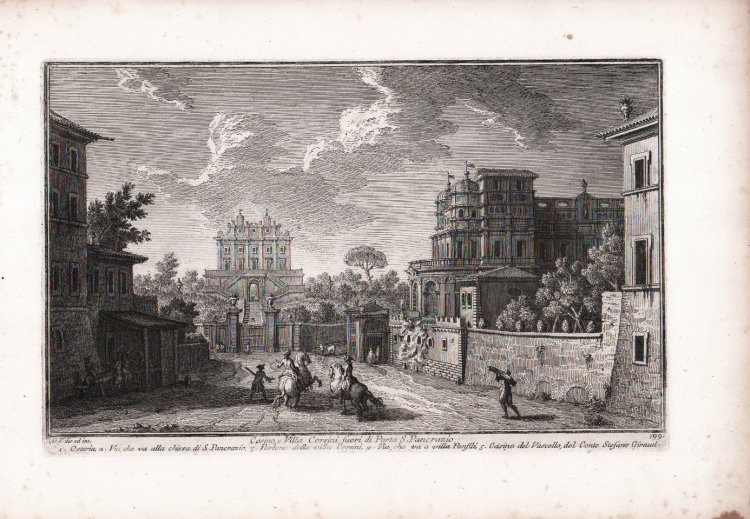
| Reference: | A54851 |
| Author | Giuseppe VASI |
| Year: | 1761 |
| Zone: | Villa Corsini |
| Printed: | Rome |
| Measures: | 344 x 218 mm |
| Reference: | A54851 |
| Author | Giuseppe VASI |
| Year: | 1761 |
| Zone: | Villa Corsini |
| Printed: | Rome |
| Measures: | 344 x 218 mm |
View taken from 1786 edition of the Vasi’s Delle Magnificenze di Roma Antica e Moderna (first edition, in X books, published between 1747-61).
The work was enlarged and reissued under the title "Raccolta delle più belle vedute antiche, e moderne di Roma" by Mariano Vasi after his father's death. This edition contains most of the plates from the original work, supplemented by a small number of new engravings. Vasi fils appears to have kept this edition in print for a number of years (a further edition appeared in 1803), and, as RIBA notes, the 'total [number of plates] appears to have been made up with whatever prints were to hand, in addition to a the numbered core of the work (which was itself somewhat fluid)'.
Etching, in very good condition.
|
Scalabroni, 304
|
Giuseppe VASI (Corleone, 27 Agosto 1710 - Roma, 16 Aprile 1782)
|
Italian engraver and painter. After completing a classical education, he trained as a printmaker in Palermo, possibly at the Collegio Carolino, which was founded by the Jesuit Order in 1728 and at which the etcher Francesco Ciché ( fl before 1707; d Palermo, 1742) was a teacher. Vasi was already an accomplished engraver when, in 1736, he contributed to the illustration of La reggia in trionfo by Pietro La Placa, which described the festivities held in Palermo to mark the coronation of Charles VII of Naples (the future Charles III of Spain). That same year Vasi moved to Rome, where, as a Neapolitan subject, he was immediately afforded the protection of the ambassador, Cardinal Troiano Aquaviva d’Aragona (1694–1747). In Rome he met other artists who worked for the same patron: Sebastiano Conca, Luigi Vanvitelli and Ferdinando Fuga. It is against this background that Vasi’s work in Rome, when he was in residence at the Palazzo Farnese, should be considered: his monopoly as the engraver of the Roman records of the monarch, the plates for the festivals of the ‘Chinea’ and the triumphal arches erected in front of the Palatine gardens on the occasion of temporal sovereignty over Rome
|
|
Scalabroni, 304
|
Giuseppe VASI (Corleone, 27 Agosto 1710 - Roma, 16 Aprile 1782)
|
Italian engraver and painter. After completing a classical education, he trained as a printmaker in Palermo, possibly at the Collegio Carolino, which was founded by the Jesuit Order in 1728 and at which the etcher Francesco Ciché ( fl before 1707; d Palermo, 1742) was a teacher. Vasi was already an accomplished engraver when, in 1736, he contributed to the illustration of La reggia in trionfo by Pietro La Placa, which described the festivities held in Palermo to mark the coronation of Charles VII of Naples (the future Charles III of Spain). That same year Vasi moved to Rome, where, as a Neapolitan subject, he was immediately afforded the protection of the ambassador, Cardinal Troiano Aquaviva d’Aragona (1694–1747). In Rome he met other artists who worked for the same patron: Sebastiano Conca, Luigi Vanvitelli and Ferdinando Fuga. It is against this background that Vasi’s work in Rome, when he was in residence at the Palazzo Farnese, should be considered: his monopoly as the engraver of the Roman records of the monarch, the plates for the festivals of the ‘Chinea’ and the triumphal arches erected in front of the Palatine gardens on the occasion of temporal sovereignty over Rome
|