
| Reference: | A54848 |
| Author | Giuseppe VASI |
| Year: | 1756 |
| Zone: | Santa Cecilia |
| Printed: | Rome |
| Measures: | 331 x 221 mm |
| Reference: | A54848 |
| Author | Giuseppe VASI |
| Year: | 1756 |
| Zone: | Santa Cecilia |
| Printed: | Rome |
| Measures: | 331 x 221 mm |
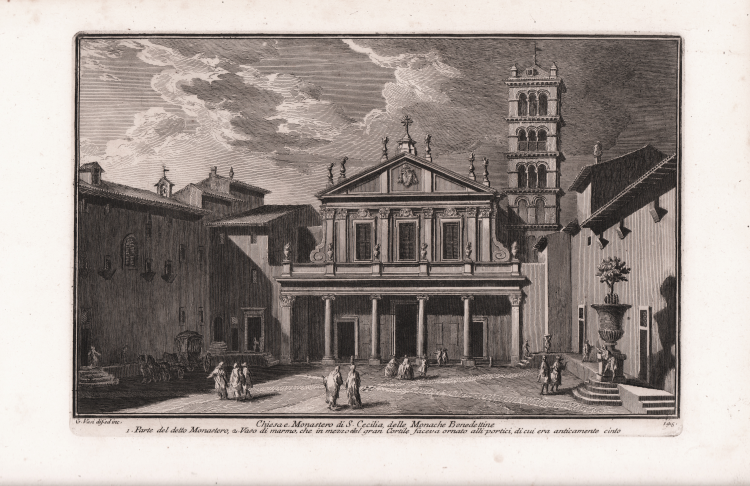
The engraving depicts the Basilica and Monastery of Santa Cecilia in Trastevere in Rome, designed by the architect Ferdinando Fuga. Rising on the right is the 12th-century Romanesque bell tower, which survived the subsequent Baroque renovations. The area today has remained virtually identical to Vasi's view, with the only altered element being the central fountain designed by Antonio Muñoz in 1929. The courtyard, originally bare and paved, now hosts an orderly Italianate garden. At its exact center, a new monumental basin has been constructed, inside of which the cantaro (from the Greek kantharos)—the ancient Early Christian vase visible on the right in the engraving—has been permanently relocated. This piece was so famous for its size and beauty that it attracted the attention of renowned artists of the caliber of Giovanni Battista Piranesi, who dedicated an entire, detailed print to it, precisely titled "Vaso Antico di marmo di gran mole si vede nel cortile del monastero di S. Cecilia in Trastevere" (Ancient marble vase of great size seen in the courtyard of the monastery of S. Cecilia in Trastevere).
View taken from the monumental work Delle magnificenze di Roma antica e moderna.
Published in 10 volumes from 1747 to 1761, the work features 238 copper engravings, each engraving with a narrative text that provides historical and documentary information.
Known by most simply as the "master" of Giovanni Battista Piranesi, Giuseppe Vasi reveals in this monumental work the fullness of his graphic creativity.
The 10 books that compose it each have a title page with a different title and date: Libro primo che contiene le porte e mura; Libro secondo, che contiene le piazze principali di Roma con obelischi, colonne, ed altri ornamenti; Libro terzo, che contiene le basiliche e chiese antiche di Roma; Libro quarto che contiene i palazzi e le vie più celebri; Libro quinto che contiene i ponti e gli edifizj sul Libro sesto che contiene la chiese parrocchiali; Libro settimo che contiene i conventi e case dei chierici regolari; Libro ottavo che contiene i monasteri e conservatorj di donne; Libro nono che contiene i collegj, spedali, e luoghi pii; decimo che contiene le ville e giardini più rimarchevoli.
The Magnificences provide a complete and at the same time unconventional panorama of the City: thus, together with the usual, celebrated shots taken from the best tradition of vedutistica, one also finds an unusual Rome, one that, at times, no longer exists. The author had worked on this work, of central importance in Roman publishing in the middle of the eighteenth century, for almost twenty years, producing a monumental guide to the “Urbe” where, alongside the usual and famous shots taken from the best tradition of vedutistica, he also immortalized unusual views that have since disappeared with the change of the city. The text that accompanies the views in the first volume is by Giuseppe Bianchini, in the second by Orazio Orlandi and in the remaining ones by Vasi himself.
Starting from the edition of 1786, the work of Vasi, was updated by his son Mariano, who published it under the title Raccolta delle più belle vedute antiche, e moderne di Roma, showing only the name of his father as author. This new edition presented many plates of the first edition, and some new ones. The publication of Mariano Vasi was also printed several times, always with the addition of new plates.
View taken from 1786 edition of the Vasi’s Delle Magnificenze di Roma Antica e Moderna.
Etching, printed on contemporary laid paper, in very good condition.
|
Scalabroni, 244
|
Giuseppe VASI (Corleone, 27 Agosto 1710 - Roma, 16 Aprile 1782)
|
Italian engraver and painter. After completing a classical education, he trained as a printmaker in Palermo, possibly at the Collegio Carolino, which was founded by the Jesuit Order in 1728 and at which the etcher Francesco Ciché ( fl before 1707; d Palermo, 1742) was a teacher. Vasi was already an accomplished engraver when, in 1736, he contributed to the illustration of La reggia in trionfo by Pietro La Placa, which described the festivities held in Palermo to mark the coronation of Charles VII of Naples (the future Charles III of Spain). That same year Vasi moved to Rome, where, as a Neapolitan subject, he was immediately afforded the protection of the ambassador, Cardinal Troiano Aquaviva d’Aragona (1694–1747). In Rome he met other artists who worked for the same patron: Sebastiano Conca, Luigi Vanvitelli and Ferdinando Fuga. It is against this background that Vasi’s work in Rome, when he was in residence at the Palazzo Farnese, should be considered: his monopoly as the engraver of the Roman records of the monarch, the plates for the festivals of the ‘Chinea’ and the triumphal arches erected in front of the Palatine gardens on the occasion of temporal sovereignty over Rome
|
|
Scalabroni, 244
|
Giuseppe VASI (Corleone, 27 Agosto 1710 - Roma, 16 Aprile 1782)
|
Italian engraver and painter. After completing a classical education, he trained as a printmaker in Palermo, possibly at the Collegio Carolino, which was founded by the Jesuit Order in 1728 and at which the etcher Francesco Ciché ( fl before 1707; d Palermo, 1742) was a teacher. Vasi was already an accomplished engraver when, in 1736, he contributed to the illustration of La reggia in trionfo by Pietro La Placa, which described the festivities held in Palermo to mark the coronation of Charles VII of Naples (the future Charles III of Spain). That same year Vasi moved to Rome, where, as a Neapolitan subject, he was immediately afforded the protection of the ambassador, Cardinal Troiano Aquaviva d’Aragona (1694–1747). In Rome he met other artists who worked for the same patron: Sebastiano Conca, Luigi Vanvitelli and Ferdinando Fuga. It is against this background that Vasi’s work in Rome, when he was in residence at the Palazzo Farnese, should be considered: his monopoly as the engraver of the Roman records of the monarch, the plates for the festivals of the ‘Chinea’ and the triumphal arches erected in front of the Palatine gardens on the occasion of temporal sovereignty over Rome
|