

| Reference: | S52538 |
| Author | Giuseppe VASI |
| Year: | 1739 |
| Zone: | San Giovanni dei Fiorentini |
| Printed: | Rome |
| Measures: | 290 x 195 mm |
| Reference: | S52538 |
| Author | Giuseppe VASI |
| Year: | 1739 |
| Zone: | San Giovanni dei Fiorentini |
| Printed: | Rome |
| Measures: | 290 x 195 mm |
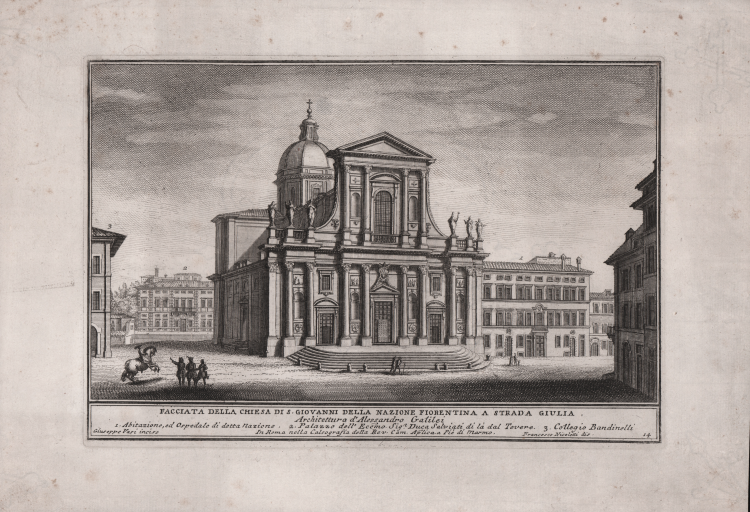
Etching, 1739, after Alessandro Galilei.
View of the façade of San Giovanni dei Fiorentini along the Via Giulia. Includes a view of the adjacent hospital designed by Alessandro Galilei under Clement XII (1 in image), the Palazzo Salviati (2 in image), and the Collegio Bandinelli (3 in image).
A good impression, on contemporary laid paper, with margins, good condition.
Bibliografia
Scalabroni L., Giuseppe Vasi, 20, p. 47; C.A. Petrucci, Catalogo Generale Delle Stampe Tratte Dai Rami Incisi Posseduti Dalla Calcografia Nazionale, 1412, p. 125.
Giuseppe VASI (Corleone, 27 Agosto 1710 - Roma, 16 Aprile 1782)
|
Italian engraver and painter. After completing a classical education, he trained as a printmaker in Palermo, possibly at the Collegio Carolino, which was founded by the Jesuit Order in 1728 and at which the etcher Francesco Ciché ( fl before 1707; d Palermo, 1742) was a teacher. Vasi was already an accomplished engraver when, in 1736, he contributed to the illustration of La reggia in trionfo by Pietro La Placa, which described the festivities held in Palermo to mark the coronation of Charles VII of Naples (the future Charles III of Spain). That same year Vasi moved to Rome, where, as a Neapolitan subject, he was immediately afforded the protection of the ambassador, Cardinal Troiano Aquaviva d’Aragona (1694–1747). In Rome he met other artists who worked for the same patron: Sebastiano Conca, Luigi Vanvitelli and Ferdinando Fuga. It is against this background that Vasi’s work in Rome, when he was in residence at the Palazzo Farnese, should be considered: his monopoly as the engraver of the Roman records of the monarch, the plates for the festivals of the ‘Chinea’ and the triumphal arches erected in front of the Palatine gardens on the occasion of temporal sovereignty over Rome
|
Giuseppe VASI (Corleone, 27 Agosto 1710 - Roma, 16 Aprile 1782)
|
Italian engraver and painter. After completing a classical education, he trained as a printmaker in Palermo, possibly at the Collegio Carolino, which was founded by the Jesuit Order in 1728 and at which the etcher Francesco Ciché ( fl before 1707; d Palermo, 1742) was a teacher. Vasi was already an accomplished engraver when, in 1736, he contributed to the illustration of La reggia in trionfo by Pietro La Placa, which described the festivities held in Palermo to mark the coronation of Charles VII of Naples (the future Charles III of Spain). That same year Vasi moved to Rome, where, as a Neapolitan subject, he was immediately afforded the protection of the ambassador, Cardinal Troiano Aquaviva d’Aragona (1694–1747). In Rome he met other artists who worked for the same patron: Sebastiano Conca, Luigi Vanvitelli and Ferdinando Fuga. It is against this background that Vasi’s work in Rome, when he was in residence at the Palazzo Farnese, should be considered: his monopoly as the engraver of the Roman records of the monarch, the plates for the festivals of the ‘Chinea’ and the triumphal arches erected in front of the Palatine gardens on the occasion of temporal sovereignty over Rome
|