
| Reference: | S42733.28 |
| Author | Giovanni CRUPI |
| Year: | 1885 ca. |
| Measures: | 225 x 165 mm |
| Reference: | S42733.28 |
| Author | Giovanni CRUPI |
| Year: | 1885 ca. |
| Measures: | 225 x 165 mm |
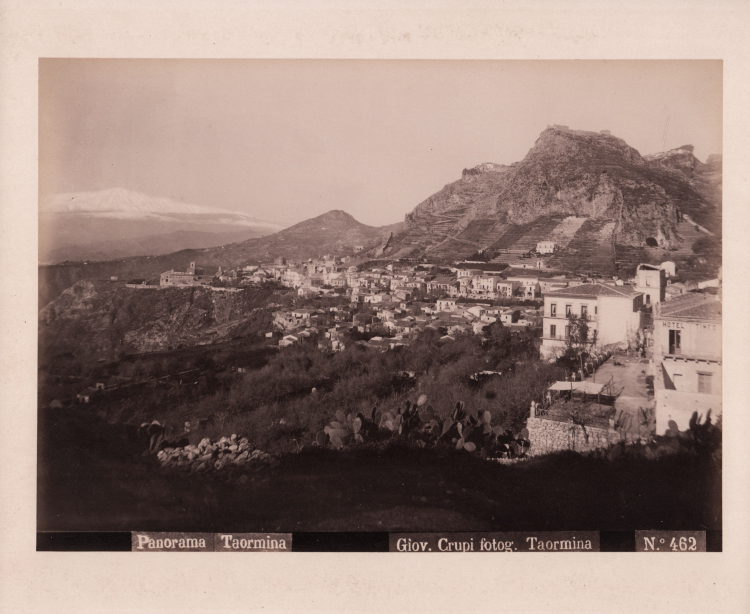
Albumen on paper, mounted on a contemporary support, circa 1885/1899. The image bears the signature of the renowned Sicilian photographer Giovanni Crupi at the bottom. The photograph, marked with the official catalog number N. 462, captures the Sicilian city nestled on the hill from a raised perspective. In the background on the left, the blurred profile of Mount Etna is visible, while on the right, a portion of the historic Grand Hotel Timeo emerges in the foreground.
Giovanni Crupi (Taormina 1861 – 1925) was an Italian landscape photographer, active in Taormina and Egypt (Heliopolis). For Crupi, photography was initially a hobby; only in 1885 did he transform it into a professional activity. He was a friend and colleague of Wilhelm von Gloeden, although the theory that he was the German photographer's teacher is unsupported. Crupi's artistic photographs are usually easily distinguished by a thick black band at the bottom, containing the image title and catalog number, as was customary in commercial photography of the time, along with Crupi's signature. In 1899, Crupi emigrated and opened a photography studio in Heliopolis, near Cairo. He returned home only in 1910 and, until his death, assisted a relative who had taken over his business, but never took up photography again.
On the back is a photograph of Taormina by the Fratelli Alinari.
Giovanni CRUPI (Taormina 1861-1925)
|
Giovanni Crupi (Taormina, December 19, 1861 – Taormina, 1925) was an Italian landscape photographer, active in Taormina and Egypt (Heliopolis). For Crupi, photography was initially a hobby; only in 1885 did he transform it into a professional activity. He was a friend and colleague of Wilhelm von Gloeden, although the theory that he was the German photographer's teacher is unfounded: Gloeden himself stated in an autobiographical work in 1898 that he too had learned the rudiments of photography from Giuseppe Bruno. It cannot be denied, however, that in their landscape work, some points of contact can be found, in both senses. Likewise, a small number of Crupi's male nudes, set in archaeological sites in Syracuse, can be attributed to Gloeden's influence. Confusion between the two photographers is fueled by a small number of images bearing both Gloeden's and Crupi's stamps. However, these images are stylistically quite different from Crupi's work, so it's possible that the double stamp is due to Crupi acting as Gloeden's distributor: Gloeden's photographs are known to bear a second stamp by Brogi or Angelo Pedo, who we know for certain were distributors for third parties. Crupi's artistic photographs are, however, easily distinguishable, usually by the presence of a thick black band at the bottom, containing the image's title and catalog number, as was customary in commercial photography of the time, along with Crupi's signature. In 1899, Crupi emigrated and opened a photography studio in Heliopolis, near Cairo. He returned home only in 1910 and, until his death, assisted a relative who had taken over his company, but never resumed photography.
|
Giovanni CRUPI (Taormina 1861-1925)
|
Giovanni Crupi (Taormina, December 19, 1861 – Taormina, 1925) was an Italian landscape photographer, active in Taormina and Egypt (Heliopolis). For Crupi, photography was initially a hobby; only in 1885 did he transform it into a professional activity. He was a friend and colleague of Wilhelm von Gloeden, although the theory that he was the German photographer's teacher is unfounded: Gloeden himself stated in an autobiographical work in 1898 that he too had learned the rudiments of photography from Giuseppe Bruno. It cannot be denied, however, that in their landscape work, some points of contact can be found, in both senses. Likewise, a small number of Crupi's male nudes, set in archaeological sites in Syracuse, can be attributed to Gloeden's influence. Confusion between the two photographers is fueled by a small number of images bearing both Gloeden's and Crupi's stamps. However, these images are stylistically quite different from Crupi's work, so it's possible that the double stamp is due to Crupi acting as Gloeden's distributor: Gloeden's photographs are known to bear a second stamp by Brogi or Angelo Pedo, who we know for certain were distributors for third parties. Crupi's artistic photographs are, however, easily distinguishable, usually by the presence of a thick black band at the bottom, containing the image's title and catalog number, as was customary in commercial photography of the time, along with Crupi's signature. In 1899, Crupi emigrated and opened a photography studio in Heliopolis, near Cairo. He returned home only in 1910 and, until his death, assisted a relative who had taken over his company, but never resumed photography.
|