
| Reference: | S42733.30 |
| Author | Giorgio Sommer |
| Year: | 1867 ca. |
| Measures: | 235 x 180 mm |
| Reference: | S42733.30 |
| Author | Giorgio Sommer |
| Year: | 1867 ca. |
| Measures: | 235 x 180 mm |
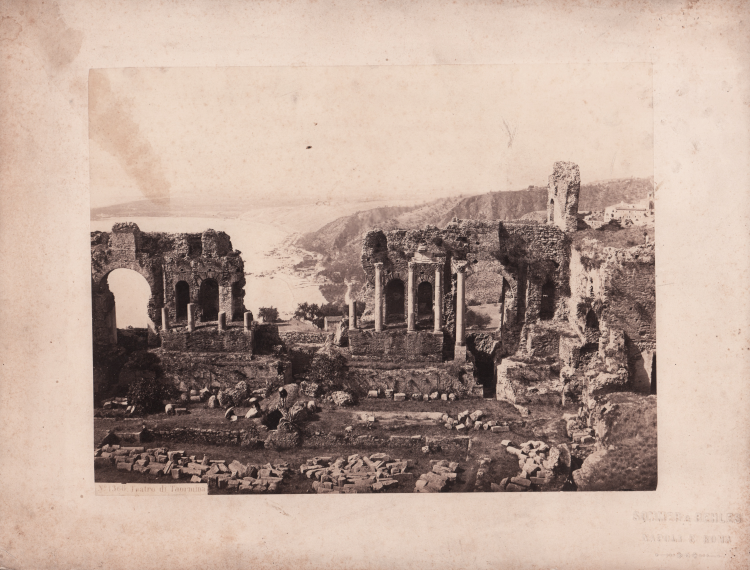
Albumen on paper, mounted on a contemporary support, circa 1867/1874.
Nineteenth-century photograph of the Ancient Theatre of Taormina, also known as the Greek Theatre, printed by the photography studio founded by the collaboration between German photographers Giorgio Sommer and Edmund Behles. Behles's blind stamp "Sommer & Behles Napoli e Roma" is imprinted on the paper support at the bottom.
The partnership between the two photographers spans the period from 1867 to 1874, when they joined forces, opening studios in prestigious locations, including Via Mario de' Fiori in Rome and Via Monte di Dio in Naples. Works from this period bear the characteristic stamp imprinted on the cardboard support.
The Sommer & Behles photography studio was born from the collaboration of German photographers Giorgio Sommer (1834-1914) and Edmund Behles (1841-1921), both naturalized Italians. The studios were located in Rome at no. 28 Mario di Fiori, and in Naples at no. 4 Monte di Dio. The works dating from those years are signed by one or the other, or by both. The two photographers favored the genre of archaeological monuments or souvenir views of Southern Italy—Florence, Rome, and Naples—intended for sale to tourists and travelers, in keeping with the Grand Tour trend. Sommer and Behles became the most prolific photographers in Italy. They participated in numerous exhibitions, winning countless prizes and awards for their work.
Edmund Behles, who moved to Rome around 1860, opened another shop in 1871 at Via del Corso 196, where he sold his photographs, as well as engravings and other artistic materials.
Giorgio Sommer (1834–1914) was one of the most important and prolific photographers of the 19th century in Italy, known for his detailed documentation of the customs and landscapes of Southern Italy. In 1857, he arrived in Rome, where he worked intensively, collaborating with his compatriot and friend, also a photographer, Edmond Behles. Through the Deutscher Künstlerverein, he participated in the climate of passionate interest in the study of antiquity and archaeology, and met German-born photographers living or working in Rome, as well as many painters. He worked briefly in Rome, and by the end of 1857, he had moved from Rome to Naples, then still governed by Ferdinand II of Bourbon. He opened a studio on Strada di Chiaia, and then, around 1860, on Via Monte di Dio. He began selling the photographs he had taken in Rome in collaboration with Behles under his own name. The Neapolitan photography studio offered portraits, art reproductions, and landscapes.
Giorgio Sommer (Francoforte 1834 - Napoli 1914)
|
Giorgio Sommer was born in Frankfurt am Main on September 2, 1834. He became interested in photography at a very young age and soon devoted himself to it professionally. In 1857 he arrived in Rome, where he worked intensively, collaborating with his compatriot and friend, also a photographer, Edmond Behles. Through the Deutscher Künstlerverein, he participated in the climate of passionate interest in the study of antiquity and archaeology and met photographers of German origin resident or active in Rome, as well as many painters. He worked in Rome for a short period in September and October 1857 and again in the summer of 1859. He adopted large (28x38), medium (20x25), stereoscopic, and carte-de-visite formats. He photographed many works of art from the Vatican Museums. By the end of 1857 he had moved from Rome to Naples, then still governed by Ferdinand II of Bourbon; He opened a studio on Chiaia Street and then, around 1860, on Monte di Dio Street. He began selling photographs he had taken in Rome in collaboration with Behles under his own name. The Neapolitan photography studio offered portraits, art reproductions, and landscapes. Sommer also traded in artistic bronzes, publishing catalogs for them separately or as a section of photography catalogs. In 1860, on behalf of the government, he went on a campaign in Pompeii. On September 25 of that year, he photographed Garibaldi visiting the excavations. On June 16, 1861, he married Antonia Schmid, daughter of a famous piano maker of Moravian origin. The couple had two children: Edmondo and Carolina. In 1861, he was in Gaeta, photographing the battlefields and the destruction caused to the Bourbon stronghold by the siege of Savoy troops. On behalf of the Italian government, he documented the repression of banditry in the southern provinces. In 1865, Sommer and Behles were awarded a gold medal by Vittorio Emanuele II. That same year, they participated in the International Exhibition of Arts and Manufactures in Dublin, where they exhibited ten photographs. Sommer was awarded a gold medal by Charles of Württemberg. He continued to reproduce the two medals awarded by Vittorio Emanuele II and Charles of Württemberg on the covers of his catalogues until 1903. His association with Behles ended around 1866. In 1867, he participated in the Universal Exhibition in Paris, where he was awarded a bronze medal. In 1873, he participated in the Universal Exhibition in Vienna. The studio employed twelve people in the various departments of negative development, printing, retouching, and coloring. In the 1880s, he worked in Switzerland, where he was commissioned to carry out a photographic campaign for railway construction projects. In 1885, he won a prize at the Nürnberg exhibition for his reproductions of ancient bronzes. In 1890 he opened a branch in Palermo. He died in Naples on August 7, 1914.
|
Giorgio Sommer (Francoforte 1834 - Napoli 1914)
|
Giorgio Sommer was born in Frankfurt am Main on September 2, 1834. He became interested in photography at a very young age and soon devoted himself to it professionally. In 1857 he arrived in Rome, where he worked intensively, collaborating with his compatriot and friend, also a photographer, Edmond Behles. Through the Deutscher Künstlerverein, he participated in the climate of passionate interest in the study of antiquity and archaeology and met photographers of German origin resident or active in Rome, as well as many painters. He worked in Rome for a short period in September and October 1857 and again in the summer of 1859. He adopted large (28x38), medium (20x25), stereoscopic, and carte-de-visite formats. He photographed many works of art from the Vatican Museums. By the end of 1857 he had moved from Rome to Naples, then still governed by Ferdinand II of Bourbon; He opened a studio on Chiaia Street and then, around 1860, on Monte di Dio Street. He began selling photographs he had taken in Rome in collaboration with Behles under his own name. The Neapolitan photography studio offered portraits, art reproductions, and landscapes. Sommer also traded in artistic bronzes, publishing catalogs for them separately or as a section of photography catalogs. In 1860, on behalf of the government, he went on a campaign in Pompeii. On September 25 of that year, he photographed Garibaldi visiting the excavations. On June 16, 1861, he married Antonia Schmid, daughter of a famous piano maker of Moravian origin. The couple had two children: Edmondo and Carolina. In 1861, he was in Gaeta, photographing the battlefields and the destruction caused to the Bourbon stronghold by the siege of Savoy troops. On behalf of the Italian government, he documented the repression of banditry in the southern provinces. In 1865, Sommer and Behles were awarded a gold medal by Vittorio Emanuele II. That same year, they participated in the International Exhibition of Arts and Manufactures in Dublin, where they exhibited ten photographs. Sommer was awarded a gold medal by Charles of Württemberg. He continued to reproduce the two medals awarded by Vittorio Emanuele II and Charles of Württemberg on the covers of his catalogues until 1903. His association with Behles ended around 1866. In 1867, he participated in the Universal Exhibition in Paris, where he was awarded a bronze medal. In 1873, he participated in the Universal Exhibition in Vienna. The studio employed twelve people in the various departments of negative development, printing, retouching, and coloring. In the 1880s, he worked in Switzerland, where he was commissioned to carry out a photographic campaign for railway construction projects. In 1885, he won a prize at the Nürnberg exhibition for his reproductions of ancient bronzes. In 1890 he opened a branch in Palermo. He died in Naples on August 7, 1914.
|