
- New
| Reference: | S30360.3 |
| Author | Gioacchino ALTOBELLI |
| Year: | 1870 ca. |
| Zone: | Via Appia |
| Measures: | 260 x 205 mm |
| Reference: | S30360.3 |
| Author | Gioacchino ALTOBELLI |
| Year: | 1870 ca. |
| Zone: | Via Appia |
| Measures: | 260 x 205 mm |
Albumen on paper, mounted on cardboard, circa 1870.
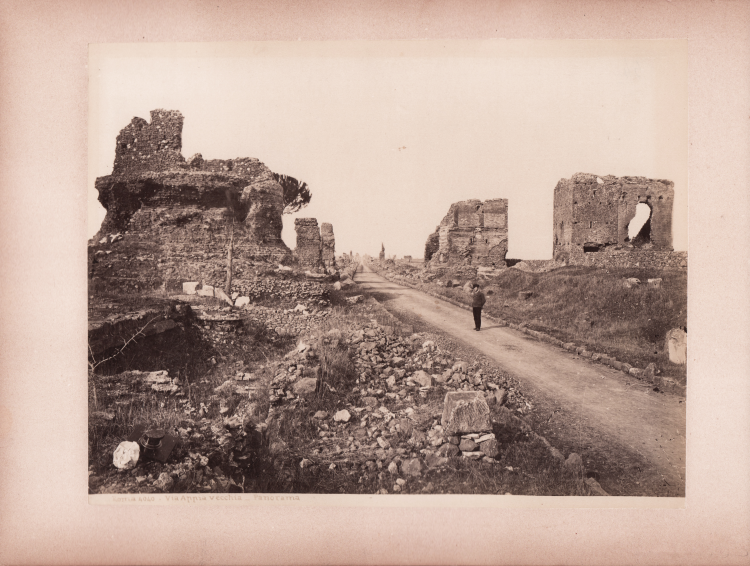
Unsigned, it is attributed to Gioacchino Altobelli, previously active as a painter of historical subjects and portraits, who here depicts a panorama of the Via Appia Antica in Rome, at a time when the road still appeared as an isolated rural road, flanked by ruins and open to the Roman countryside.
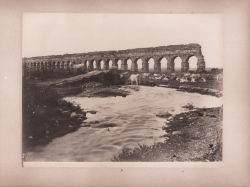
A photograph of the same area is attached to the verso of the cardboard, showing a rural landscape with the imposing arches of the Claudian Aqueduct and the Marrana dell'Acqua Mariana stream in the Parco degli Acquedotti, on the Appian Way.
Gioacchino Altobelli (Terni, 1814 – post 1878) was an Italian painter and photographer. Moving to Rome around 1830, Altobelli studied painting between 1833 and 1841 under the guidance of Tommaso Minardi, who then had a studio in the Palazzo Colonna in Piazza Santi Apostoli. However, it was already evident that the market for genre painting in Rome was becoming increasingly stingy; For this reason, around 1858, Altobelli joined forces with a friend of Spanish origin, also a painter, Pompeo Molins. Molins had married the daughter of Ludovico Fausti, a papal shipping agent who owned a small building at Via di Fontanella Borghese 46, and had opened a photography studio in his father-in-law's home. Fausti's connections within the papal administration allowed the two to become "official photographers of the Imperial Academy of France and of the works of art of the Roman Railway"—a particularly interesting assignment, as the railway was experiencing a major expansion at the end of the reign of Pius IX. Many photographic views of Rome date from those years. However, the partnership dissolved for unknown reasons at the end of 1865, and Altobelli then created a new company called "Stabilimento Fotografico Altobelli & C," and his own studio at 16 Passeggiata di Ripetta. - retains many of the stylistic features of traditional genre painting, in the construction of the image, in the setting, in the use of posed human figures intended to enliven the composition.
Gioacchino ALTOBELLI (Terni 1814 - Roma dopo il 1878)
|
Gioacchino Altobelli (Terni, 1814 – post 1878) was an Italian painter and photographer. Having moved to Rome (presumably with his family) around 1830, Gioacchino Altobelli studied painting between 1833 and 1841 under the guidance of Tommaso Minardi, who then had a studio in the Palazzo Colonna in Piazza Santi Apostoli. At the age of forty, he still appears in the category of painters, in the “Almanacco Romano” of 1855, as “Altobelli Gioacchino, [da] Terni, con a studio at Via] Margutta 48”. However, it was already evident that the market for genre painting in Rome was becoming increasingly stingy; For this reason, around 1858, Altobelli joined forces with a friend of Spanish origin, also a painter, Pompeo Molins. Molins had married the daughter of Ludovico Fausti, a papal shipping agent who owned a small building at Via di Fontanella Borghese 46, and had opened a photography studio in his father-in-law's home. Fausti's connections within the papal administration allowed the two to become "official photographers of the Imperial Academy of France and of the works of art of the Roman Railway"—a particularly interesting assignment, as the railway was experiencing a major expansion at the end of the reign of Pius IX. Many photographic views of Rome date from those years. However, the partnership dissolved for unknown reasons at the end of 1865, and Altobelli then created a new company called "Stabilimento Fotografico Altobelli & C," and his own studio at 16 Passeggiata di Ripetta. From this point on, Altobelli began experimenting with experimental photography, eventually conceiving a new invention for applying color to photographic proofs. Proud of the result, Altobelli decided to request a declaration of ownership; however, this was denied due to opposition from the director of the Pontifical Chromolithography, Michele Stefano de Rossi, who maintained that the invention had already been conceived by a certain Gregorio Mariani, a painter and designer at the establishment, who had never submitted a request for ownership due to the still-developed nature of the technique. Despite this bitter disappointment, Altobelli persevered in his research and conceived a new method for "photographing views of monuments with a sky effect," for which he was granted a patent in 1866. Many of the views he created using this invention were exhibited at the 1867 Paris Universal Exhibition, where they were met with great success. He subsequently appeared as director of the "Premiato Stabilimento Fotografico di Enrico Verzaschi." There is no news of him until the end of 1878. The exact date and place of his death are unknown. Altobelli's photographs are particularly interesting from a documentary perspective, even for the period in which he worked, as they illustrate the city of Rome in the final years of the Papal States and the transition to the Kingdom of Italy. Altobelli developed his work both as a portraitist and as a landscape painter. Interested in the technological development of his art, he applied for and obtained several patents, which increased his notoriety in Rome and supported his work as a portraitist. It is interesting to note how Altobelli's photography—especially in his depictions of archaeological sites and landscapes—retains many of the stylistic features of traditional genre painting, in the construction of the image, the setting, the use of posed human figures to enliven the composition, and so on.
|
Gioacchino ALTOBELLI (Terni 1814 - Roma dopo il 1878)
|
Gioacchino Altobelli (Terni, 1814 – post 1878) was an Italian painter and photographer. Having moved to Rome (presumably with his family) around 1830, Gioacchino Altobelli studied painting between 1833 and 1841 under the guidance of Tommaso Minardi, who then had a studio in the Palazzo Colonna in Piazza Santi Apostoli. At the age of forty, he still appears in the category of painters, in the “Almanacco Romano” of 1855, as “Altobelli Gioacchino, [da] Terni, con a studio at Via] Margutta 48”. However, it was already evident that the market for genre painting in Rome was becoming increasingly stingy; For this reason, around 1858, Altobelli joined forces with a friend of Spanish origin, also a painter, Pompeo Molins. Molins had married the daughter of Ludovico Fausti, a papal shipping agent who owned a small building at Via di Fontanella Borghese 46, and had opened a photography studio in his father-in-law's home. Fausti's connections within the papal administration allowed the two to become "official photographers of the Imperial Academy of France and of the works of art of the Roman Railway"—a particularly interesting assignment, as the railway was experiencing a major expansion at the end of the reign of Pius IX. Many photographic views of Rome date from those years. However, the partnership dissolved for unknown reasons at the end of 1865, and Altobelli then created a new company called "Stabilimento Fotografico Altobelli & C," and his own studio at 16 Passeggiata di Ripetta. From this point on, Altobelli began experimenting with experimental photography, eventually conceiving a new invention for applying color to photographic proofs. Proud of the result, Altobelli decided to request a declaration of ownership; however, this was denied due to opposition from the director of the Pontifical Chromolithography, Michele Stefano de Rossi, who maintained that the invention had already been conceived by a certain Gregorio Mariani, a painter and designer at the establishment, who had never submitted a request for ownership due to the still-developed nature of the technique. Despite this bitter disappointment, Altobelli persevered in his research and conceived a new method for "photographing views of monuments with a sky effect," for which he was granted a patent in 1866. Many of the views he created using this invention were exhibited at the 1867 Paris Universal Exhibition, where they were met with great success. He subsequently appeared as director of the "Premiato Stabilimento Fotografico di Enrico Verzaschi." There is no news of him until the end of 1878. The exact date and place of his death are unknown. Altobelli's photographs are particularly interesting from a documentary perspective, even for the period in which he worked, as they illustrate the city of Rome in the final years of the Papal States and the transition to the Kingdom of Italy. Altobelli developed his work both as a portraitist and as a landscape painter. Interested in the technological development of his art, he applied for and obtained several patents, which increased his notoriety in Rome and supported his work as a portraitist. It is interesting to note how Altobelli's photography—especially in his depictions of archaeological sites and landscapes—retains many of the stylistic features of traditional genre painting, in the construction of the image, the setting, the use of posed human figures to enliven the composition, and so on.
|