
| Reference: | A54239 |
| Author | William ROGERS |
| Year: | 1590 ca. |
| Measures: | 140 x 195 mm |
| Reference: | A54239 |
| Author | William ROGERS |
| Year: | 1590 ca. |
| Measures: | 140 x 195 mm |
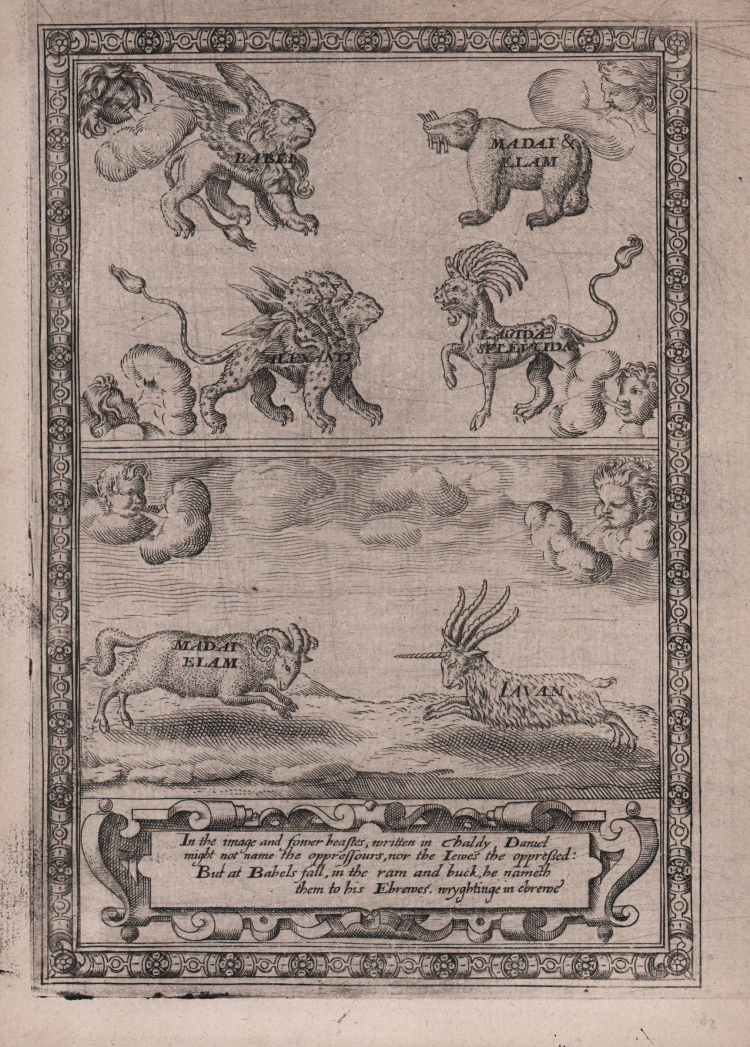
In the image and fower beastes, written in Chaldy, Daniel might not name the oppressours, nor the Jewes the oppressed: But at Babels fall, in the ram and buck, he nameth them to his Ebrewes, wryhtinge in ebrewe.
The Book of Daniel recounts the deportation to Babylon and the struggle of Daniel and his companions against oppressive empires (Babylonian, Medo-Persian, and Greek). Through faith, wisdom, and prophecies (such as the visions of the four beasts), the text offers a message of hope against tyranny.
Illustration with decorative border to Hugh Broughton, 'A Concent of Scripture' [London, 1590 or later].
Dedicated to queen Elizabeth, the work is a scripture chronology and genealogy, designed to show the chronological order of events from Adam to Christ, and harmonize the disagreeing passages. John Speed superintended the press. It was attacked at both universities, and the author was obliged to defend it in a series of lectures.
The plates were executed by William Rogers and are specimens of the earliest English copperplate engraving.
Engraving, 1590, lettered with title and inscriptions. Printed on contemporary laid paper, with margins, in good condition. Rare.
Bibliografia
Hind 1952-64, Engraving in England in the Sixteenth and Seventeenth Centuries, I.272.21, n. 3.
William ROGERS (attivo 1584 - 1604)
|
William Rogers (born c. 1545, active c. 1589–1604)[2] was an English engraver. A Citizen of the City of London – one of his surviving engravings is signed Anglus et Civis Lond(oniensis). – he is the first English craftsman known to have practised engraving and the greatest portrait engraver of the Tudor period. The English were extremely late in coming to printmaking, though several artists from the thriving Flemish industry had worked in England already; the engraved print had been invented over 150 years before Rogers began to produce them. Rogers was also a goldsmith, and presumably acquired his technique in that context. His portrait style reflects Flemish models, while his backgrounds are often "overloaded with ornament" that is "redolent of the goldsmith's shop". Rogers is known for his engraved portraits of Queen Elizabeth I of England, which are very scarce. Eliza Triumphans (1589), celebrating the defeat of the Spanish Armada in 1588, shows Elizabeth surrounded by the allegorical symbols of empire common to her portraiture at this time. Queen Elizabeth Standing in a Room with a Lattice Window, one of the best-known Tudor engravings, is based on a drawing of the queen by the miniaturist Isaac Oliver; the densely ornamented setting is probably the invention of Rogers. Elizabeth I as Rosa Electa, of which the two surviving impressions are in the Bodleian Library at Oxford University and the British Museum, is undated but can be assigned to the later years of Elizabeth's reign by the style of the costume. The portrait depicts the Queen surrounded by roses, symbolising the Tudor union of the houses of York and Lancaster. Rogers also engraved a version of the large allegorical picture of Henry VIII and his family attributed to Lucas de Heere, now at Sudeley Castle. Rogers' print, of which only three impressions are known, shows Elizabeth in the updated fashions of the 1590s and adds verses at the bottom making explicit the contrast between Mary I's marriage and its accompanying war on the left, and Elizabeth's virginity accompanied by Peace and Plenty on the right.
|
William ROGERS (attivo 1584 - 1604)
|
William Rogers (born c. 1545, active c. 1589–1604)[2] was an English engraver. A Citizen of the City of London – one of his surviving engravings is signed Anglus et Civis Lond(oniensis). – he is the first English craftsman known to have practised engraving and the greatest portrait engraver of the Tudor period. The English were extremely late in coming to printmaking, though several artists from the thriving Flemish industry had worked in England already; the engraved print had been invented over 150 years before Rogers began to produce them. Rogers was also a goldsmith, and presumably acquired his technique in that context. His portrait style reflects Flemish models, while his backgrounds are often "overloaded with ornament" that is "redolent of the goldsmith's shop". Rogers is known for his engraved portraits of Queen Elizabeth I of England, which are very scarce. Eliza Triumphans (1589), celebrating the defeat of the Spanish Armada in 1588, shows Elizabeth surrounded by the allegorical symbols of empire common to her portraiture at this time. Queen Elizabeth Standing in a Room with a Lattice Window, one of the best-known Tudor engravings, is based on a drawing of the queen by the miniaturist Isaac Oliver; the densely ornamented setting is probably the invention of Rogers. Elizabeth I as Rosa Electa, of which the two surviving impressions are in the Bodleian Library at Oxford University and the British Museum, is undated but can be assigned to the later years of Elizabeth's reign by the style of the costume. The portrait depicts the Queen surrounded by roses, symbolising the Tudor union of the houses of York and Lancaster. Rogers also engraved a version of the large allegorical picture of Henry VIII and his family attributed to Lucas de Heere, now at Sudeley Castle. Rogers' print, of which only three impressions are known, shows Elizabeth in the updated fashions of the 1590s and adds verses at the bottom making explicit the contrast between Mary I's marriage and its accompanying war on the left, and Elizabeth's virginity accompanied by Peace and Plenty on the right.
|