
| Reference: | A54141 |
| Author | Nicolas DORIGNY |
| Year: | 1704 |
| Printed: | Rome |
| Measures: | 215 x 350 mm |
| Reference: | A54141 |
| Author | Nicolas DORIGNY |
| Year: | 1704 |
| Printed: | Rome |
| Measures: | 215 x 350 mm |
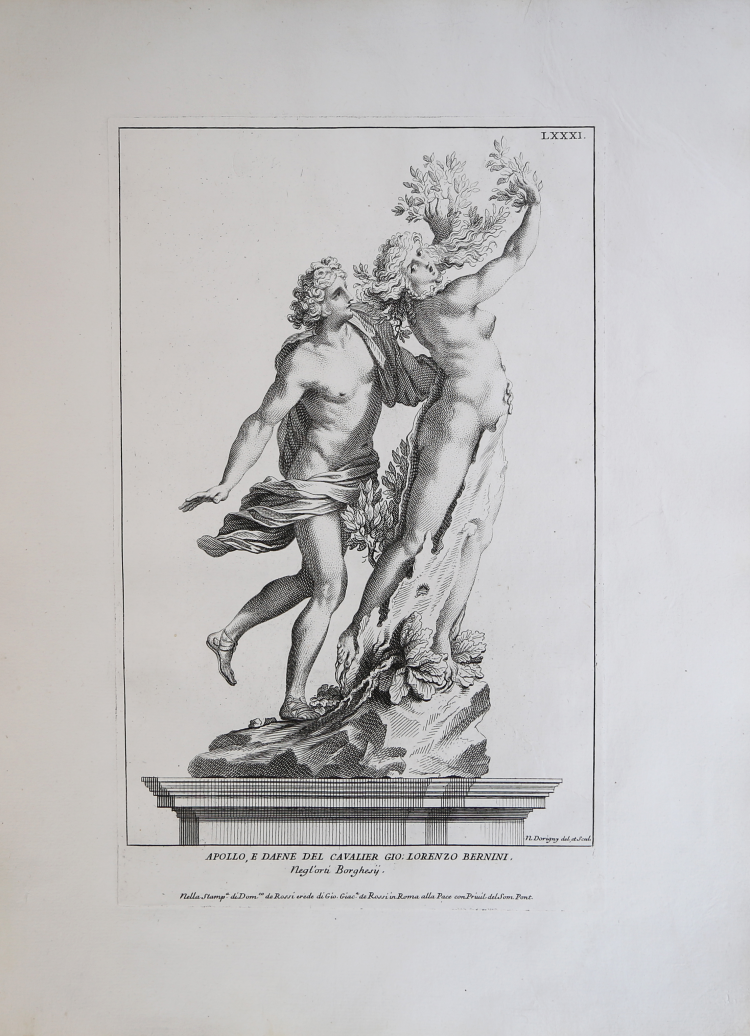
The engraving depicts the famous sculpture group of Apollo and Daphne created by Gian Lorenzo Bernini between 1623 and 1625, on display at the Galleria Borghese.
The subject of the sculpture group comes from Ovid’s Metamorphoses (I, 450-567): taking vengeance on Apollo, Cupid strikes him with an arrow of gold – the noblest of metals – which causes him to fall in love with the nymph Daphne, a follower of Diana. At the same time, Cupid shoots a dart of lead at her, inducing her to reject the love of the god. Daphne begs her father Peneus, a river god, to change her appearance, the cause of so much passion.
The sculpture captures the culminating moment of the maiden’s metamorphosis into a laurel tree. Bernini gives the subject the air of a theatrical performance, allowing the viewer to follow the transformation: having finally attained the goal of his chase, who is already undergoing the transformation of her feet into roots and her hands and hair into laurel branches and leaves. Apollo tries to grasp her, but his fingers find the bark of the tree rather than her body. From that moment, the tree became dear to the god, who wore a crown of its leaves around his head; the laurel wreath would in fact be considered an attribute of artists and poets.
Etching, printed on contemporary laid paper, with margins, in perfect condition.
Plate taken from the famous Raccolta di statue antiche e moderne: data in luce sotto i gloriosi auspicj della ... Papa Clemente XI. / da Domenico de Rossi; illustrata colle sposizioni a ciascheduna immagine di Pavolo Alessandro Maffei. In Roma nella Stamperia alla Pace con Privilegio del Sommo Pont. e licenza dè Superiori l'anno MDCCIV.
In 1704, the largest collection ever assembled of prints depicting ancient Roman statues was published in Rome, a work that would remain a milestone in the genre. Compared to its most important predecessor, the Segmenta nobilium signorium et statuarum by the French painter and engraver François Perrier (1638), the Raccolta, published by Domenico De Rossi, with an erudite commentary by Paolo Alessandro Maffei (1653-1716), was distinguished above all by the presence, alongside the Nobilia Opera, of famous modern sculptures from the 16th and 17th centuries, preserved both in Rome and Florence.
The engravers who worked on the copper engravings were almost all French, and the undertaking was considered a collective effort led primarily by the publisher, the most important in Baroque Rome. Not all the names involved, however, were of the same caliber and prestige, and above all, they were not all active in the same years: two of the lesser-known engravers, Claude Randon (died 1679) and François Andriot (d. 1704), had worked together, on behalf of Charles Errand, director of the Académie de France à Rome, on Giovanni Pietro Bellori's Vite de' pittori, scultori e architetti moderni, published in Rome in 1672. The involvement of these two engravers suggests that the Raccolta arose from an undertaking started, but then abandoned, in the 1670s by Charles Errard, with the collaboration, presumably, of Bellori himself.
Among the artists who worked for the De Rossi printing house for this luxurious repertoire of statuary, the name of François de Poilly also appears (six plates), who, unlike Andriot and Randon, was a highly successful and extraordinarily prolific engraver who died in Paris in 1693. Randon and Poilly, therefore, had certainly been dead for some time when Domenico De Rossi published the Raccolta, and it is possible that Andriot had also already died, or was no longer in Rome. Among the other engravers whose signatures appear on the plates of the Raccolta, are some of the protagonists of the printmaking active in Rome at the beginning of the century: Francesco Aquila (fifty-two plates), Nicolas Dorigny (thirty-one plates), the Flemish Robert van Audenaerde (1663-1743; twenty-four plates) and Giovanni Girolamo Frezza (1671-post 1748; two plates).
Bibliografia
Stefano Pierguidi, La Raccolta di statue antiche e moderne della calcografia De Rossi e un'impresa incompiuta di Charles Errard, in “Les cahiers d'histoire de l'art” 14, pp. 106-113.
Nicolas DORIGNY (Parigi 1652 - 1746)
|
Son of Michel Dorigny. He trained with his father but abandoned painting for engraving early in his career. In 1687 he went to Rome, summoned by his brother Louis Dorigny, producing there a series of reproductions of antique statues, published by Rossi in 1704. From Rome he went to London, where he worked for the British royal family. Between 1711 and 1719 he engraved Raphael’s cartoons of the Acts of the Apostles (London, V&A), for which he was knighted by George I in 1720. He returned to France suffering from eye trouble and was received (reçu) as a member of the Académie Royale in 1725. He exhibited at the Salons of 1739 and 1743. He made more than 140 prints, combining etching and engraving in an expansive, vigorous style close to that of Gérard Audran. Besides portraits, his works are mostly reproductive prints after the Italian masters, particularly Raphael, Carlo Maratti, Domenichino, Guercino and Giovanni Lanfranco. The Nationalmuseum, Stockholm, has a number of his drawings commissioned by Count Tessin, including Roman sculptures, coats of arms and catafalques.
|
Nicolas DORIGNY (Parigi 1652 - 1746)
|
Son of Michel Dorigny. He trained with his father but abandoned painting for engraving early in his career. In 1687 he went to Rome, summoned by his brother Louis Dorigny, producing there a series of reproductions of antique statues, published by Rossi in 1704. From Rome he went to London, where he worked for the British royal family. Between 1711 and 1719 he engraved Raphael’s cartoons of the Acts of the Apostles (London, V&A), for which he was knighted by George I in 1720. He returned to France suffering from eye trouble and was received (reçu) as a member of the Académie Royale in 1725. He exhibited at the Salons of 1739 and 1743. He made more than 140 prints, combining etching and engraving in an expansive, vigorous style close to that of Gérard Audran. Besides portraits, his works are mostly reproductive prints after the Italian masters, particularly Raphael, Carlo Maratti, Domenichino, Guercino and Giovanni Lanfranco. The Nationalmuseum, Stockholm, has a number of his drawings commissioned by Count Tessin, including Roman sculptures, coats of arms and catafalques.
|