
| Reference: | A54116 |
| Author | Robert van AUDENAERDE |
| Year: | 1704 |
| Printed: | Rome |
| Measures: | 215 x 345 mm |
| Reference: | A54116 |
| Author | Robert van AUDENAERDE |
| Year: | 1704 |
| Printed: | Rome |
| Measures: | 215 x 345 mm |
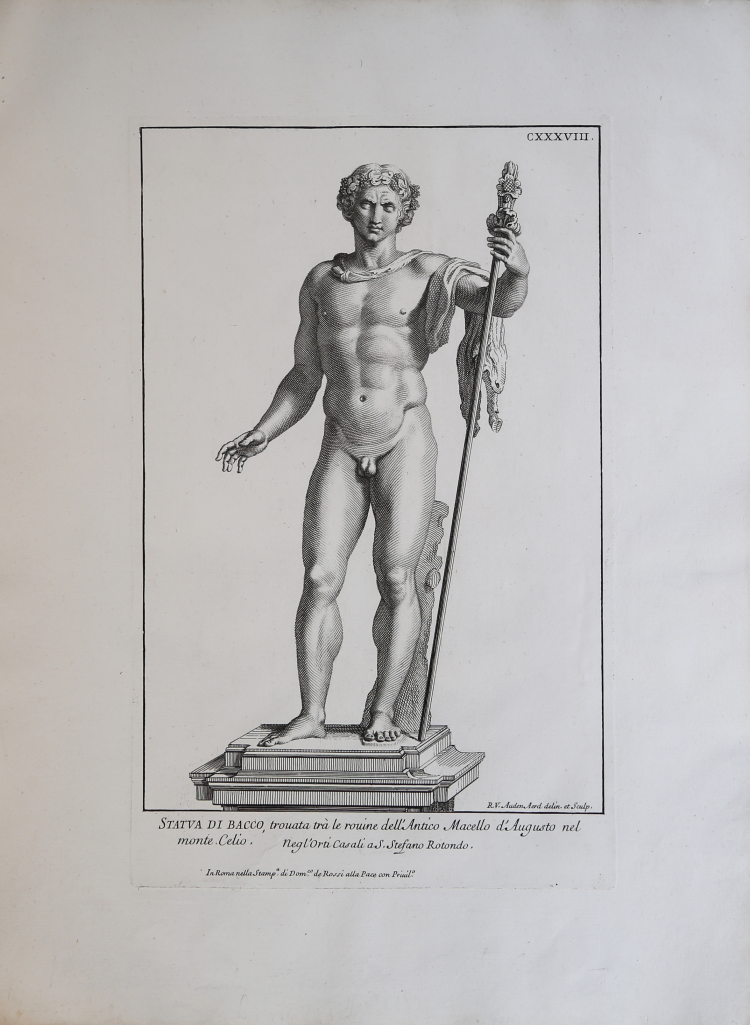
The statue depicts the young Antinous in the guise of the god Dionysus: his head is adorned with a lavish wreath of ivy leaves and blossoms, a typical attribute of the Dionysian cult. The sculpture dates to the 2nd century A.D. and is one of many commissioned by Emperor Hadrian to deify Antinous, his beloved freedman who died prematurely. The sculpture was discovered in the early 18th century by the noble Casali family during excavations in their gardens on the Caelian Hill in Rome (an area traditionally identified with the ancient Slaughterhouse of Augustus). After being part of the Casali family’s collection, the work was subsequently transferred to and acquired by the Danish museum Ny Carlsberg Glyptotek in Copenhagen, where it is currently housed (inv. 1960).
Etching, printed on contemporary laid paper, with margins, in perfect condition.
Plate taken from the famous Raccolta di statue antiche e moderne: data in luce sotto i gloriosi auspicj della ... Papa Clemente XI. / da Domenico de Rossi; illustrata colle sposizioni a ciascheduna immagine di Pavolo Alessandro Maffei. In Roma nella Stamperia alla Pace con Privilegio del Sommo Pont. e licenza dè Superiori l'anno MDCCIV.
In 1704, the largest collection ever assembled of prints depicting ancient Roman statues was published in Rome, a work that would remain a milestone in the genre. Compared to its most important predecessor, the Segmenta nobilium signorium et statuarum by the French painter and engraver François Perrier (1638), the Raccolta, published by Domenico De Rossi, with an erudite commentary by Paolo Alessandro Maffei (1653-1716), was distinguished above all by the presence, alongside the Nobilia Opera, of famous modern sculptures from the 16th and 17th centuries, preserved both in Rome and Florence.
The engravers who worked on the copper engravings were almost all French, and the undertaking was considered a collective effort led primarily by the publisher, the most important in Baroque Rome. Not all the names involved, however, were of the same caliber and prestige, and above all, they were not all active in the same years: two of the lesser-known engravers, Claude Randon (died 1679) and François Andriot (d. 1704), had worked together, on behalf of Charles Errand, director of the Académie de France à Rome, on Giovanni Pietro Bellori's Vite de' pittori, scultori e architetti moderni, published in Rome in 1672. The involvement of these two engravers suggests that the Raccolta arose from an undertaking started, but then abandoned, in the 1670s by Charles Errard, with the collaboration, presumably, of Bellori himself.
Among the artists who worked for the De Rossi printing house for this luxurious repertoire of statuary, the name of François de Poilly also appears (six plates), who, unlike Andriot and Randon, was a highly successful and extraordinarily prolific engraver who died in Paris in 1693. Randon and Poilly, therefore, had certainly been dead for some time when Domenico De Rossi published the Raccolta, and it is possible that Andriot had also already died, or was no longer in Rome. Among the other engravers whose signatures appear on the plates of the Raccolta, are some of the protagonists of the printmaking active in Rome at the beginning of the century: Francesco Aquila (fifty-two plates), Nicolas Dorigny (thirty-one plates), the Flemish Robert van Audenaerde (1663-1743; twenty-four plates) and Giovanni Girolamo Frezza (1671-post 1748; two plates).
Bibliografia
Stefano Pierguidi, La Raccolta di statue antiche e moderne della calcografia De Rossi e un'impresa incompiuta di Charles Errard, in “Les cahiers d'histoire de l'art” 14, pp. 106-113.
Robert van AUDENAERDE (Gand 1663 - 1743)
|
Painter and engraver. He was first a scholar of Francis van Mierhop, but he afterwards studied under Hans van Cleef. When he was twenty-two years of age he went to Rome, where he became a disciple of Carlo Maratti. Under this master he became a good painter of historical subjects. The principal part of his prints are after the pictures of Carlo Maratti.
|
Robert van AUDENAERDE (Gand 1663 - 1743)
|
Painter and engraver. He was first a scholar of Francis van Mierhop, but he afterwards studied under Hans van Cleef. When he was twenty-two years of age he went to Rome, where he became a disciple of Carlo Maratti. Under this master he became a good painter of historical subjects. The principal part of his prints are after the pictures of Carlo Maratti.
|