
| Reference: | A54161 |
| Author | Francesco Faraone AQUILA |
| Year: | 1704 ca. |
| Printed: | Rome |
| Measures: | 215 x 345 mm |
| Reference: | A54161 |
| Author | Francesco Faraone AQUILA |
| Year: | 1704 ca. |
| Printed: | Rome |
| Measures: | 215 x 345 mm |
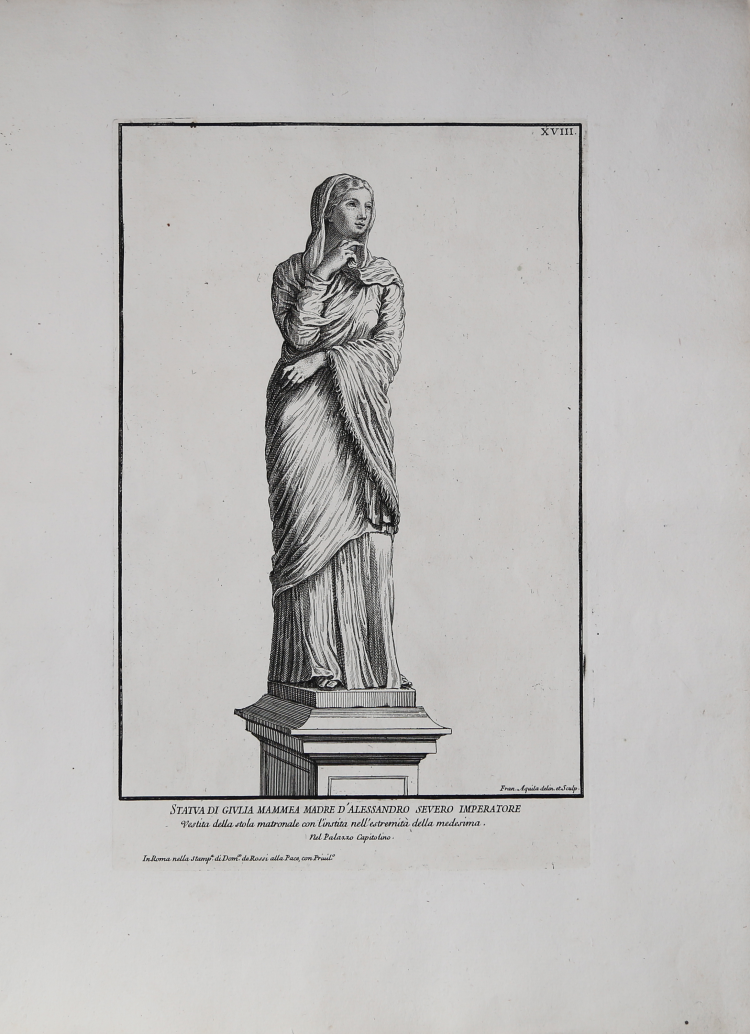
The plate depicts a female statue of the so-called Pudicitia type today is kept in Musei Capitolini (inv. Scu 636)
The woman wears a long tunic down to her ankles and a fringed cloak that covers her head and, falling from her shoulders, envelops her figure down to her knees. Statue of the so-called “Pudicitia” type, depiction of the goddess that personified the virtue of modesty.
The hairstyle of the woman is similar to the one typical of Julia Domna, wife of Lucius Septimius Severus.
The work dates to the early Severan period and it was probably found in Rome.
Etching, printed on contemporary laid paper, with margins, in perfect condition.
Plate taken from the famous Raccolta di statue antiche e moderne: data in luce sotto i gloriosi auspicj della ... Papa Clemente XI. / da Domenico de Rossi; illustrata colle sposizioni a ciascheduna immagine di Pavolo Alessandro Maffei. In Roma nella Stamperia alla Pace con Privilegio del Sommo Pont. e licenza dè Superiori l'anno MDCCIV.
In 1704, the largest collection ever assembled of prints depicting ancient Roman statues was published in Rome, a work that would remain a milestone in the genre. Compared to its most important predecessor, the Segmenta nobilium signorium et statuarum by the French painter and engraver François Perrier (1638), the Raccolta, published by Domenico De Rossi, with an erudite commentary by Paolo Alessandro Maffei (1653-1716), was distinguished above all by the presence, alongside the Nobilia Opera, of famous modern sculptures from the 16th and 17th centuries, preserved both in Rome and Florence.
The engravers who worked on the copper engravings were almost all French, and the undertaking was considered a collective effort led primarily by the publisher, the most important in Baroque Rome. Not all the names involved, however, were of the same caliber and prestige, and above all, they were not all active in the same years: two of the lesser-known engravers, Claude Randon (died 1679) and François Andriot (d. 1704), had worked together, on behalf of Charles Errand, director of the Académie de France à Rome, on Giovanni Pietro Bellori's Vite de' pittori, scultori e architetti moderni, published in Rome in 1672. The involvement of these two engravers suggests that the Raccolta arose from an undertaking started, but then abandoned, in the 1670s by Charles Errard, with the collaboration, presumably, of Bellori himself.
Among the artists who worked for the De Rossi printing house for this luxurious repertoire of statuary, the name of François de Poilly also appears (six plates), who, unlike Andriot and Randon, was a highly successful and extraordinarily prolific engraver who died in Paris in 1693. Randon and Poilly, therefore, had certainly been dead for some time when Domenico De Rossi published the Raccolta, and it is possible that Andriot had also already died, or was no longer in Rome. Among the other engravers whose signatures appear on the plates of the Raccolta, are some of the protagonists of the printmaking active in Rome at the beginning of the century: Francesco Aquila (fifty-two plates), Nicolas Dorigny (thirty-one plates), the Flemish Robert van Audenaerde (1663-1743; twenty-four plates) and Giovanni Girolamo Frezza (1671-post 1748; two plates).
Bibliografia
Stefano Pierguidi, La Raccolta di statue antiche e moderne della calcografia De Rossi e un'impresa incompiuta di Charles Errard, in “Les cahiers d'histoire de l'art” 14, pp. 106-113.
Francesco Faraone AQUILA (Palermo 1676 circa – Roma 1740 circa)
|
Francesco Faraone Aquila (or dell'Aquila) (Palermo, 1676 – Rome, 1740) was an Italian engraver who followed in the footsteps of his brother Pietro. Other sources suggest that Francesco was not Pietro Aquila's brother but rather his nephew, and chronological data may indeed confirm this second hypothesis, given that Pietro was of the previous generation and died in 1692. Little is known about his life. We know that in 1690 he moved to Rome, where his brother had already been known for decades for his work as an engraver for the capital's major engraving workshops. Pietro, who was a priest, opened the doors of Roman ecclesiastical patronage for him. Pope Clement XI commissioned him to carry out what would become his greatest achievement: the engraving of the bas-reliefs of the Column of Antoninus Pius and its pedestal. This work remains invaluable today, as the reliefs are subject to deterioration due to atmospheric agents and the loss of the column in a fire in 1759, of which only the base remains, preserved in the Vatican Museums. In 1713, Domenico de Rossi published Raccolta di vasi diversi formati da illvstri artefici antichi e di varie targhe soprapposte alle Fabbriche più insigni di Roma..". The plates of which were designed and engraved by Pharaoh Aquila. Another very important work by Francesco Aquila was the engraving of Correggio's fresco in the dome of Parma Cathedral and that of Raphael's Vatican apartments. But Gori Gandellini, in his book Notizie storici degli intagliatori (Historical News of the Engravers), leaves us a long list of engravings of paintings and frescoes, both Renaissance and Baroque, by Aquila, including those by Carlo Maratta, Francesco Albani, Lanfranco, Ciro Ferri, Pietro da Cortona, Pier Leone Ghezzi, and countless others. Following the antiquarian taste that was gaining traction during the eighteenth century, Francesco Aquila engraved various works from the Roman classical era: statues, vases, triumphal arches, thus meeting the demand, especially from foreign visitors, mostly German and English. His portraits of his contemporaries, both painters and clergy, were also very famous.
|
Francesco Faraone AQUILA (Palermo 1676 circa – Roma 1740 circa)
|
Francesco Faraone Aquila (or dell'Aquila) (Palermo, 1676 – Rome, 1740) was an Italian engraver who followed in the footsteps of his brother Pietro. Other sources suggest that Francesco was not Pietro Aquila's brother but rather his nephew, and chronological data may indeed confirm this second hypothesis, given that Pietro was of the previous generation and died in 1692. Little is known about his life. We know that in 1690 he moved to Rome, where his brother had already been known for decades for his work as an engraver for the capital's major engraving workshops. Pietro, who was a priest, opened the doors of Roman ecclesiastical patronage for him. Pope Clement XI commissioned him to carry out what would become his greatest achievement: the engraving of the bas-reliefs of the Column of Antoninus Pius and its pedestal. This work remains invaluable today, as the reliefs are subject to deterioration due to atmospheric agents and the loss of the column in a fire in 1759, of which only the base remains, preserved in the Vatican Museums. In 1713, Domenico de Rossi published Raccolta di vasi diversi formati da illvstri artefici antichi e di varie targhe soprapposte alle Fabbriche più insigni di Roma..". The plates of which were designed and engraved by Pharaoh Aquila. Another very important work by Francesco Aquila was the engraving of Correggio's fresco in the dome of Parma Cathedral and that of Raphael's Vatican apartments. But Gori Gandellini, in his book Notizie storici degli intagliatori (Historical News of the Engravers), leaves us a long list of engravings of paintings and frescoes, both Renaissance and Baroque, by Aquila, including those by Carlo Maratta, Francesco Albani, Lanfranco, Ciro Ferri, Pietro da Cortona, Pier Leone Ghezzi, and countless others. Following the antiquarian taste that was gaining traction during the eighteenth century, Francesco Aquila engraved various works from the Roman classical era: statues, vases, triumphal arches, thus meeting the demand, especially from foreign visitors, mostly German and English. His portraits of his contemporaries, both painters and clergy, were also very famous.
|