
| Reference: | S45203 |
| Author | Donato BERTELLI |
| Year: | 1569 |
| Zone: | Antwerp |
| Printed: | Venice |
| Measures: | 305 x 180 mm |
| Reference: | S45203 |
| Author | Donato BERTELLI |
| Year: | 1569 |
| Zone: | Antwerp |
| Printed: | Venice |
| Measures: | 305 x 180 mm |
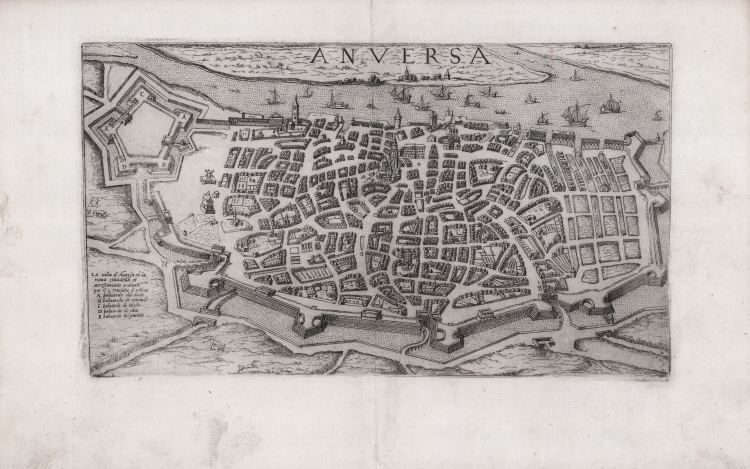
At the top center, along the upper edge, is the title: ANVERSA. At the bottom left, there is a short legend: La villa d’A[n]versa co[n] la nova cittadella et acrescimento ordinato per il C. Paciotto d’urbino. A baluardo de duca, B baluardo de arnando, C baluardo de toledo, D baluardo de alva, E baluardo del pacioto.
An anonymous work, undated and without editorial reference. The inscription under the citadel is based on the work of Hieronimus Cock (c. 1567), from which the map also derives, showing all the latest updates and including the entry for the town hall, which was absent in previous Italian versions. The shape of the citadel, however, derives from the map by Pauwels van Overbecke (1568).
Though considered anonymous by the literature, it can undoubtedly be attributed to the printing house of Donato Bertelli; in fact, some copies are included in Donato's collection of urban cartography, Le vere imagini et descritioni delle più nobili città del mondo, printed in Venice in 1569. It is also present in large-format “lafreri” collections.
“In assoluta concorrenza con le raccolte di Forlani e di Ferrando Bertelli, fu pubblicata a Venezia, sempre a cura di Donato Bertelli nel 1569, la raccolta Le vere imagini et descritioni delle piu nobilli città del mondo. Verae illustrissimae cuiusque urbis imagines nunc prim[um] typis impressae. Venetiis, Apud Donatum Bertellii ad signum divii Marci MDLXIX. Come quella di Ferrando, l’opera contiene un frontespizio allegorico inciso, con un titolo bilingue in italiano e latino, e con la dedica a Iohan Jacob Fugger von Kirhberg (1514-1575), banchiere tedesco mecenate delle arti: Illustri, ac generoso heroi d. Ioanni Iacobo Fuggero Kirchbergae, Weissenhorni, et c. domino caesareae maiestatis consiliario dicatae. La raccolta, che conobbe una ristampa nel 1574 e una nel 1578, comprende il titolo e 21 piante o vedute di città. Si tratta, dunque, solo di una selezione incentrata sulle città principali, rappresentate da tavole derivate dal “Primo Libro”, già replicate nel Civitatum aliquot insigniorum et locorum del 1568. Vengono escluse le immagini delle città fortificate ungheresi e dei luoghi minori, in una sorta di prodotto elitario, meno innovativo ma più curato dal punto di vista grafico. Valerio (cfr. Piante e vedute di Napoli dal 1486 al 1599, 1998, p. 45) descrive l’esemplare conservato alla Jerome & Ann Fisher Fine Arts Library della University of Pennsylvania [711.4 B486], datato 1569, e la ristampa del 1578 conservata alla Public Library di New York. Entrambi differiscono, per contenuto e ordinamento delle tavole, da quello conservato alla Biblioteca Angelica di Roma [BB-12-9] e da quello alla Stanford University, che recano entrambi la data 1578. L’unico elemento comune a tutte le edizioni è la presenza della pianta di Venezia (come prima tavola. Non è raro trovare le tavole di Bertelli conservate in raccolte fattizie di grande formato: in quella della Universiteto Biblioteka di Vilnius (cfr. Dzikowski, Katalog atlasów Biblioteki Uniwersyteckiej Stefana Batorego, 1940) sono presenti la quasi totalità delle tavole che compongono la raccolta, come pure nel cosiddetto “Atlante Aragona” (conservato in un’anonima collezione privata americana e del quale siamo riusciti ad avere le immagini). Numerose le tavole presenti nella collezione della Raccolta Bertarelli [VOL EE 46 (1-240)], conservata al Castello Sforzesco di Milano” (cfr. Stefano Bifolco, Città e Fortezze Principali del Mondo. Le prime raccolte italiane di cartografia urbana e gli isolari del XVI secolo in “Cartografia e topografia italiana del XVI secolo”, 2018, pp. 124-125).
Donato Bertelli is a printer and publisher active in Venice in Merzaria all'insegna di S. Marco. He was probably born in Padua, as we can deduce from his signature on some branches, Donatus Bertellius Patavinus, his activity, on the basis of the works he published, can be circumscribed to the years between 1558 and 1592. In 1559 he was in the workshop of Ferrando Bertelli and signed In Venetia appresso Donato Bertelli libraro al segno del S. Marco. Upon Ferrando's death, Donato inherited or purchased his branches and published them, as he did also for plates by Forlani and Camocio, affixing his name.
Etching and engraving, impressed on contempoary laid paper, with margins, in perfect condition. Very rare.
Bibliografia
Bifolco-Ronca, Cartografia e topografia italiana del XVI secolo, p. 868, tav. 313; Martens (2016): p. 14, nota 44 e tav. 16.
Donato BERTELLI (Attivo a Venezia seconda metà del XVI secolo)
|
Bertelli family represents the largest group of publishers, engravers, cartographers and merchants of prints of the sixteenth century. Ferrando Bertelli was the most productive, active between 1570, the 1560th, but maps of the last quarter of the century are known by the names of Andrea, Donato, Lucca, Nicholas and Peter. This was mainly active in Padua, where he led a workshop in letterpress and engravings. The earliest records show the asset at the date of 1589 as an engraver of several plates for an edition entitled Diversarum nationum habitus which was published in collaboration with Alciato Alciati. Pietro Bertelli had a library in Padua "the banner of the Angel". At his death the business was inherited by his son Francis. Donato Bertelli was printer, publisher and print dealer, was probably born in Padua, as is made clear by some of its branches ("Donatus Bertellius Patavinus") but active in Venice between 1563 and 1574, although it tends to expand its activities 1558 to 1592 on the basis of cartographic material marketed by him in those years. He worked in the workshop of Ferdinando Bertelli - with which it is not yet clear to the family relationship - from whom he inherited the branches etching, substituting his own name. As a publisher chalcographer emerged from his workshop papers invention or derivation Christmas Bonifacio, Giacomo Gastaldi, Ortelius etc.. In view of the large number of cards he initialed the Almagia him as "the principal heir and successor of the most active producers in the second half of the sixteenth century" in Venice. His successor "to the book publishing of St. Mark" was Andrea, who always used the old branches of Donato. Bibliography: Valerio, Cartographers Veneti, p. 149.
|
Donato BERTELLI (Attivo a Venezia seconda metà del XVI secolo)
|
Bertelli family represents the largest group of publishers, engravers, cartographers and merchants of prints of the sixteenth century. Ferrando Bertelli was the most productive, active between 1570, the 1560th, but maps of the last quarter of the century are known by the names of Andrea, Donato, Lucca, Nicholas and Peter. This was mainly active in Padua, where he led a workshop in letterpress and engravings. The earliest records show the asset at the date of 1589 as an engraver of several plates for an edition entitled Diversarum nationum habitus which was published in collaboration with Alciato Alciati. Pietro Bertelli had a library in Padua "the banner of the Angel". At his death the business was inherited by his son Francis. Donato Bertelli was printer, publisher and print dealer, was probably born in Padua, as is made clear by some of its branches ("Donatus Bertellius Patavinus") but active in Venice between 1563 and 1574, although it tends to expand its activities 1558 to 1592 on the basis of cartographic material marketed by him in those years. He worked in the workshop of Ferdinando Bertelli - with which it is not yet clear to the family relationship - from whom he inherited the branches etching, substituting his own name. As a publisher chalcographer emerged from his workshop papers invention or derivation Christmas Bonifacio, Giacomo Gastaldi, Ortelius etc.. In view of the large number of cards he initialed the Almagia him as "the principal heir and successor of the most active producers in the second half of the sixteenth century" in Venice. His successor "to the book publishing of St. Mark" was Andrea, who always used the old branches of Donato. Bibliography: Valerio, Cartographers Veneti, p. 149.
|