
- New
| Reference: | S42733.16 |
| Author | August Alfred Noack |
| Year: | 1875 ca. |
| Zone: | Genova |
| Measures: | 275 x 215 mm |
| Reference: | S42733.16 |
| Author | August Alfred Noack |
| Year: | 1875 ca. |
| Zone: | Genova |
| Measures: | 275 x 215 mm |
Albumen on paper, mounted on a contemporary support, circa 1875/80.
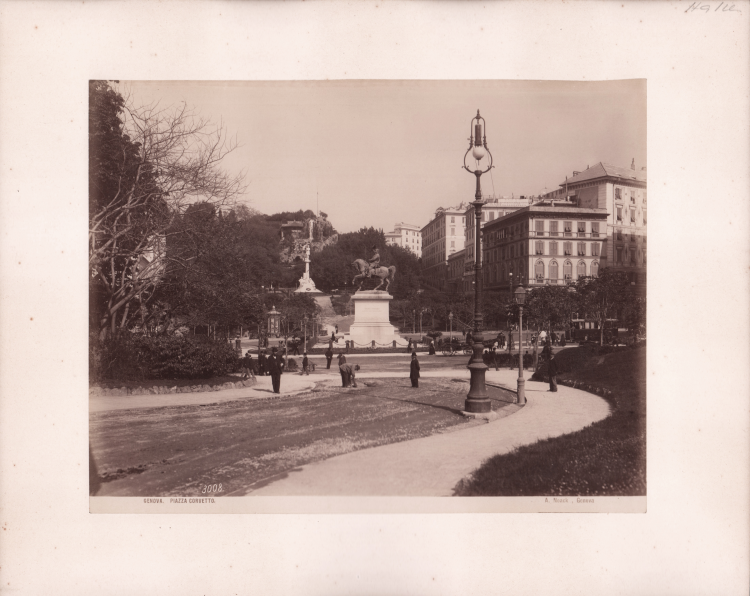
The photograph shows Piazza Corvetto in Genoa, with the equestrian monument to Vittorio Emanuele II in the center, the surrounding 19th-century buildings, the historic street lamps of the time, the pedestrian path and the gardens before the subsequent urban planning changes of the 20th century.
August Alfred Noack, also known by his Italianized name Augusto Alfredo Noack (Dresden, May 25, 1833 – Genoa, November 21, 1895), was a German photographer who became a naturalized Italian. He was one of the pioneers of photography. He received his first training at the Dresden Academy under the guidance of Hugo Burkner, studying woodcuts, illustration, and engraving. In his early twenties, he left his native country for Italy. He arrived in Rome in November 1856 and remained there until April 1860, where he worked at the German Archaeological Institute. There is no record of whether he practiced photography during this period, but he likely perfected his photographic techniques and certainly had contact with exponents of the so-called Roman school of photography. Upon arriving in Genoa, he opened his own studio at Vico del Filo 1, 7th floor, apartment 17, in the historic center of Genoa. From there, he organized a meticulous series of precise and passionate works destined to endure: sepia-toned images that later toured the world, bringing abroad a distinctive and poetic testimony of a city in constant transformation, its urban and social fabric, and the people who inhabited it. The photographic plates thus capture fishing scenes in seaside resorts on the Ligurian Riviera or aspects of Alpine life in the hinterland, with farmers at work and grazing animals; all subjects that until then had been the exclusive domain of painting.
August Alfred Noack (Dresda 1833 - Genova 1895)
|
August Alfred Noack, also known by his Italianized name Augusto Alfredo Noack (Dresden, May 25, 1833 – Genoa, November 21, 1895), was a German-born Italian photographer. He was one of the pioneers of photography. His work is considered a response to the pictorial and artistic realism that was particularly popular in the late 19th century. He is buried in the Protestant sector of the Staglieno cemetery, whose funerary monuments were one of his favorite subjects. Originally from Germany, from a Lutheran family of lower-middle-class extraction (his father, Carl August, was a local doctor), he lived for a long time in Genoa, a city he portrayed in numerous panoramic views, first in daguerreotypes and then in printed plates. He was active, under his Italianized first name Alfredo, in Genoa as well as in many other towns in Liguria. Of particular historical and artistic significance are some of his images depicting Piazza Caricamento crowded with passersby and workers, and some photographs of funerary monuments at the Staglieno Monumental Cemetery. Little is known about his artistic training. He received his first rudiments at the Dresden Academy under the guidance of Hugo Burkner, studying woodcuts, illustration, and engraving. In his early twenties, he left his native town for Italy. He arrived in Rome in November 1856 and remained there until April 1860, where he worked at the German Archaeological Institute. There is no record of whether he practiced photography during this period, but he likely perfected his photographic techniques and certainly had contact with exponents of the so-called Roman school of photography. Upon arriving in Genoa, he opened his own studio at Vico del Filo 1, 7th floor, apartment 17, in the historic center of Genoa. From here, he organized a meticulous series of precise and passionate works destined to endure: sepia-toned images that later toured the world, bringing abroad a diverse and poetic testimony of a city in constant transformation, of its urban and social fabric, and of the people who inhabited it. The photographic plates thus capture fishing scenes in seaside resorts on the Ligurian Riviera or aspects of inland alpine life, with farmers at work and grazing animals; all subjects that until then had been the exclusive domain of painting. Alfred Noack's death certificate of November 21, 1895, includes his son Gualtiero Ernesto, a photographer, and his brother-in-law Maurilio Lenti, a pharmacist, as declarants, while witnesses include Francesco Vaccari, a carpenter, and Carlo Paganini, a photographer. Carlo Paganini himself appears as a witness on the death certificate of Gualtiero Ernesto Noack on September 25, 1903. His father's studio was continued by his son Ernesto until his premature death. The studio was subsequently managed by Paganini, who published the catalogue of the collection in 1905. Some new photographs were published under Noack's name, while others were reprinted either under Paganini's name or stamped with the two names Noack and Paganini. In the early 1910s (1905-1910), another branch of Paganini's photography studio was located on Via Caffaro. The relationship between Paganini and the Noack family is unknown, but it's reasonable to assume that it was after Noack's (or his son's) death that the Studio Noack archive passed to Carlo Paganini, considering that the numbering of the negatives continued after that date and that from 1896 onwards, Paganini's name began to appear on reprints of Noack's photographic material (in addition to original material by Paganini himself). In 1926, upon Paganini's death, his widow Maria sold the artist's archive, comprising over four thousand original glass plate negatives, to the City of Genoa for 20,000 lire. This unique collection of Noack's works thus became public property, a testament to the work of one of the greatest exponents of the early days of photography. Some of Noack's works preserved by the City of Genoa were destroyed during one of the bombings of Genoa during World War II.
|
August Alfred Noack (Dresda 1833 - Genova 1895)
|
August Alfred Noack, also known by his Italianized name Augusto Alfredo Noack (Dresden, May 25, 1833 – Genoa, November 21, 1895), was a German-born Italian photographer. He was one of the pioneers of photography. His work is considered a response to the pictorial and artistic realism that was particularly popular in the late 19th century. He is buried in the Protestant sector of the Staglieno cemetery, whose funerary monuments were one of his favorite subjects. Originally from Germany, from a Lutheran family of lower-middle-class extraction (his father, Carl August, was a local doctor), he lived for a long time in Genoa, a city he portrayed in numerous panoramic views, first in daguerreotypes and then in printed plates. He was active, under his Italianized first name Alfredo, in Genoa as well as in many other towns in Liguria. Of particular historical and artistic significance are some of his images depicting Piazza Caricamento crowded with passersby and workers, and some photographs of funerary monuments at the Staglieno Monumental Cemetery. Little is known about his artistic training. He received his first rudiments at the Dresden Academy under the guidance of Hugo Burkner, studying woodcuts, illustration, and engraving. In his early twenties, he left his native town for Italy. He arrived in Rome in November 1856 and remained there until April 1860, where he worked at the German Archaeological Institute. There is no record of whether he practiced photography during this period, but he likely perfected his photographic techniques and certainly had contact with exponents of the so-called Roman school of photography. Upon arriving in Genoa, he opened his own studio at Vico del Filo 1, 7th floor, apartment 17, in the historic center of Genoa. From here, he organized a meticulous series of precise and passionate works destined to endure: sepia-toned images that later toured the world, bringing abroad a diverse and poetic testimony of a city in constant transformation, of its urban and social fabric, and of the people who inhabited it. The photographic plates thus capture fishing scenes in seaside resorts on the Ligurian Riviera or aspects of inland alpine life, with farmers at work and grazing animals; all subjects that until then had been the exclusive domain of painting. Alfred Noack's death certificate of November 21, 1895, includes his son Gualtiero Ernesto, a photographer, and his brother-in-law Maurilio Lenti, a pharmacist, as declarants, while witnesses include Francesco Vaccari, a carpenter, and Carlo Paganini, a photographer. Carlo Paganini himself appears as a witness on the death certificate of Gualtiero Ernesto Noack on September 25, 1903. His father's studio was continued by his son Ernesto until his premature death. The studio was subsequently managed by Paganini, who published the catalogue of the collection in 1905. Some new photographs were published under Noack's name, while others were reprinted either under Paganini's name or stamped with the two names Noack and Paganini. In the early 1910s (1905-1910), another branch of Paganini's photography studio was located on Via Caffaro. The relationship between Paganini and the Noack family is unknown, but it's reasonable to assume that it was after Noack's (or his son's) death that the Studio Noack archive passed to Carlo Paganini, considering that the numbering of the negatives continued after that date and that from 1896 onwards, Paganini's name began to appear on reprints of Noack's photographic material (in addition to original material by Paganini himself). In 1926, upon Paganini's death, his widow Maria sold the artist's archive, comprising over four thousand original glass plate negatives, to the City of Genoa for 20,000 lire. This unique collection of Noack's works thus became public property, a testament to the work of one of the greatest exponents of the early days of photography. Some of Noack's works preserved by the City of Genoa were destroyed during one of the bombings of Genoa during World War II.
|