
| Reference: | S41975 |
| Author | Matteo Gregorio De ROSSI |
| Year: | 1682 |
| Zone: | San Pietro |
| Printed: | Rome |
| Measures: | 690 x 425 mm |
| Reference: | S41975 |
| Author | Matteo Gregorio De ROSSI |
| Year: | 1682 |
| Zone: | San Pietro |
| Printed: | Rome |
| Measures: | 690 x 425 mm |
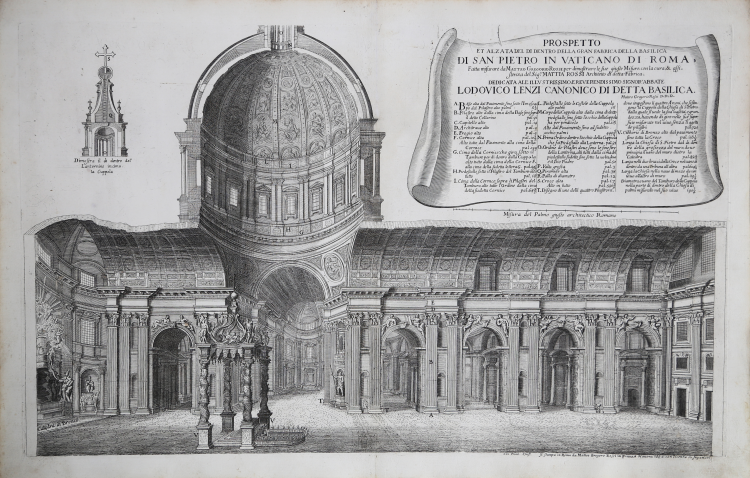
Interior section of St. Peter's Basilica in Rome, published in 1682 by Matteo Gregorio Rossi.
The print shows a detailed longitudinal view of the interior of the basilica, including the dome and baldachin. It includes a cartouche with technical measurements of the building and a dedication to Lodovico Lenzi, canon of the Basilica. The work was produced under the supervision of Mattia de' Rossi to document the exact measurements of the building.
Etching, 1682, with editorial details at the bottom right: si stampa in Roma da Matteo Gregorio Rossi in Piazza Nauona 1682. con licentia de superiori.
At the top right, the cartouche reads: PROSPETTO/ ET ALZATA DEL DI DENTRO DELLA GRAN FABRICA DELLA BASILICA/ DI SAN PIETRO IN VATICANO DI ROMA Fatta misurare da MATTEO GREGORIO ROSSI. per dimostrare con le sue giuste Misure, con la cura, & assi./ stenza del Sig.re MATTIA ROSSI Architetto didetta Fabrica. The dedication follows: DEDICATA ALL’ILLVSTRISSIMO, E REVERENDISSIMO SIGNOR’ ABBATE/ LODOVICO LENZI CANONICO DI DETTA BASILICA./ Matteo Gregorio Rossi D. D: D. Also in the cartouche is the alphanumeric legend (A-V).
Matteo Gregorio De Rossi is an exponent of one of the branches of the famous Roman printing house. Towards the end of the sixteenth century began the editorial activity of Antonio De Rossi, who with his sons Giuseppe the Elder and Giulio, founded the printing house that, over the next two centuries and through four generations, held the monopoly of chalcographic production in the city. The workshop had the sign “De Rossi alla Pace”. The history of the De Rossi family is characterized by internal disputes and contrasts that lead to the opening of individual printing houses in competition with each other. Giulio De Rossi's sons, Giuseppe the Younger and Giovanni Battista, nephews of Giuseppe De Rossi the Elder, had founded in 1628 their own workshop in the vicinity - at the corner of Via di Parione and Via della Pace near the church of S. Biagio della Fossa - but in 1635 Giovanni Battista in turn separated from his brother and opened a workshop in Piazza Navona, the third of the family. In 1644, after the death of Giuseppe the Younger, his brother Giovanni Battista became the most direct competitor of his uncle's workshop, the De Rossi alla Pace, now run by his widow along with their children who were then partly still minors. Giovanni Battista's son, Matteo Gregorio De Rossi, continued his father's publishing activity, dedicating himself with success also to the activity of engraver. The main collaborator of the typography of Giovanni Battista and Matteo Gregorio was a great artist of the caliber of Lievin Cruyl, who used the typography for the translation into print of many of his drawings on Rome. Matteo Gregorio, in constant rivalry with his cousin Giovanni Giacomo (1627-1691) of the printing house alla Pace, had Tiburzio Vergelli carve a collection of the main monuments of Rome inspired - if not copied - by Giovan Battista Falda.
Work edited and probably engraved by Matteo Gregorio de Rossi.
A fine impression, on contemporary laid paper, with margins, in excellent condition.
Matteo Gregorio De ROSSI (Roma 1638 - 1702)
|
Matteo Gregorio De Rossi is an exponent of one of the branches of the famous Roman printing house. Towards the end of the sixteenth century began the editorial activity of Antonio De Rossi, who with his sons Giuseppe the Elder and Giulio, founded the printing house that, over the next two centuries and through four generations, held the monopoly of chalcographic production in the city. The workshop had the sign “De Rossi alla Pace”. The history of the De Rossi family is characterized by internal disputes and contrasts that lead to the opening of individual printing houses in competition with each other. Giulio De Rossi's sons, Giuseppe the Younger and Giovanni Battista, nephews of Giuseppe De Rossi the Elder, had founded in 1628 their own workshop in the vicinity - at the corner of Via di Parione and Via della Pace near the church of S. Biagio della Fossa - but in 1635 Giovanni Battista in turn separated from his brother and opened a workshop in Piazza Navona, the third of the family. In 1644, after the death of Giuseppe the Younger, his brother Giovanni Battista became the most direct competitor of his uncle's workshop, the De Rossi alla Pace, now run by his widow along with their children who were then partly still minors. Giovanni Battista's son, Matteo Gregorio De Rossi, continued his father's publishing activity, dedicating himself with success also to the activity of engraver. The main collaborator of the typography of Giovanni Battista and Matteo Gregorio was a great artist of the caliber of Lievin Cruyl, who used the typography for the translation into print of many of his drawings on Rome. Matteo Gregorio, in constant rivalry with his cousin Giovanni Giacomo (1627-1691) of the printing house alla Pace, had Tiburzio Vergelli carve a collection of the main monuments of Rome inspired - if not copied - by Giovan Battista Falda.
|
Matteo Gregorio De ROSSI (Roma 1638 - 1702)
|
Matteo Gregorio De Rossi is an exponent of one of the branches of the famous Roman printing house. Towards the end of the sixteenth century began the editorial activity of Antonio De Rossi, who with his sons Giuseppe the Elder and Giulio, founded the printing house that, over the next two centuries and through four generations, held the monopoly of chalcographic production in the city. The workshop had the sign “De Rossi alla Pace”. The history of the De Rossi family is characterized by internal disputes and contrasts that lead to the opening of individual printing houses in competition with each other. Giulio De Rossi's sons, Giuseppe the Younger and Giovanni Battista, nephews of Giuseppe De Rossi the Elder, had founded in 1628 their own workshop in the vicinity - at the corner of Via di Parione and Via della Pace near the church of S. Biagio della Fossa - but in 1635 Giovanni Battista in turn separated from his brother and opened a workshop in Piazza Navona, the third of the family. In 1644, after the death of Giuseppe the Younger, his brother Giovanni Battista became the most direct competitor of his uncle's workshop, the De Rossi alla Pace, now run by his widow along with their children who were then partly still minors. Giovanni Battista's son, Matteo Gregorio De Rossi, continued his father's publishing activity, dedicating himself with success also to the activity of engraver. The main collaborator of the typography of Giovanni Battista and Matteo Gregorio was a great artist of the caliber of Lievin Cruyl, who used the typography for the translation into print of many of his drawings on Rome. Matteo Gregorio, in constant rivalry with his cousin Giovanni Giacomo (1627-1691) of the printing house alla Pace, had Tiburzio Vergelli carve a collection of the main monuments of Rome inspired - if not copied - by Giovan Battista Falda.
|