
| Reference: | S51441 |
| Author | Laurenz Janscha |
| Year: | 1802 ca. |
| Zone: | Naples |
| Printed: | Vienne |
| Measures: | 600 x 450 mm |
| Reference: | S51441 |
| Author | Laurenz Janscha |
| Year: | 1802 ca. |
| Zone: | Naples |
| Printed: | Vienne |
| Measures: | 600 x 450 mm |
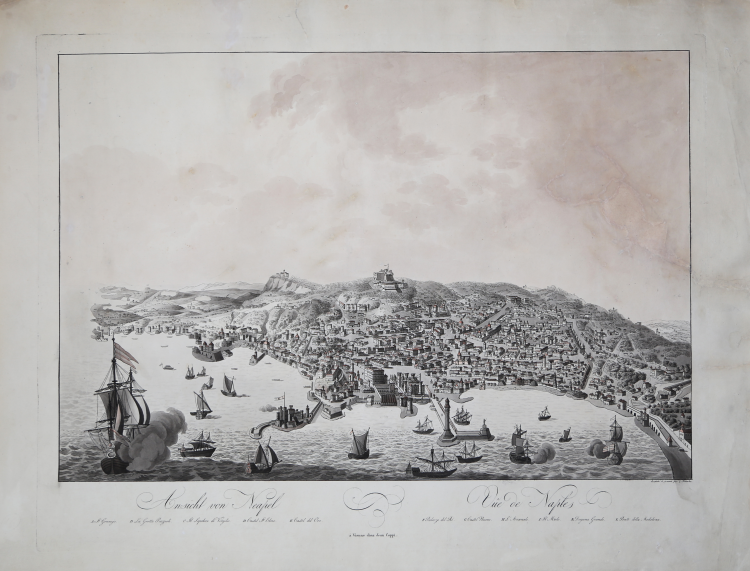
Perspective view of Naples from the sea, drawn and engraved by Lorenz Janscha and published in Vienna by Giovanni Cappi.
Lorenz Janscha was a painter and engraver, born in 1749 in the district of Radmannsdorf in Carniola, and died on April 1, 1812, in Vienna. A student at the Vienna Academy, he worked there with F.E. Weirotter and J.C. Brand. Having won numerous prizes in 1771, in 1806 he succeeded Brand as professor of landscape drawing at the Academy. From 1785 to 1795, he collaborated with K. Schütz on the landscape section of the famous series of Viennese views engraved by J. Ziegler. The Albertina in Vienna houses more than two hundred of his watercolors of Austrian, Bohemian, and Rhineland landscapes.
Giovanni (Johann) Cappi (November 30, 1765, Blevio – January 23, 1815, Vienna). He was a publisher in Vienna, specializing in music. In 1773, he moved to Vienna to work for his brother-in-law, Carlo Artaria (married to Maria Cappi), where he first became a clerk and, from 1792, a partner. On May 16, 1801, Cappi left the Artaria publishing house and founded his own publishing house with his nephew, Pietro (Peter), in Michaelerplatz (January 30, 1802). After Giovanni's death, his widow and son Carlo continued to run the publishing house; however, Carlo later entered civil service. On September 27, 1824, Carlo Cappi and Pietro Cappi founded the company Cappi & Co., but Pietro left on April 29, 1826, and J. Czerný became the new partner (Cappi & Czerný); This company existed until 1828, when, on April 11, 1828, Czerný became its sole owner (Joseph Czerný).
Color aquatint, circa 1802-1810, printed on contemporary paper, with restored margins in the upper right corner, otherwise in good condition. Very rare.
Laurenz Janscha (30 June 1749 – 1 April 1812)
|
Was a Slovenian-born Austrian landscape painter and engraver.
He was born in Bresnitz to farmers Matija Janša (1683–1752) and Lucija Debellak (1705–1781). Around 1770, he was accepted as a student at a copper engraving school in Vienna, where he was trained in landscape drawing by Johann Christian Brand. Later, he studied with Franz Edmund Weirotter. After 1780, he also worked with etching.
In 1785, he worked for the Viennese publishing company, Artaria; producing seven watercolors for their Collection de 50 vues de la ville de Vienne. As a result, he came to focus on producing vedute of Vienna and its surroundings, many of which were engraved by Johann Ziegler. He created a massive panorama of the city in 1803. It was initially shown at the Wurstelprater, then toured to several cities.
In 1797, he had succeeded Carl Philipp Schallhas as the teacher of landscape drawing at the Academy of Fine Arts. In 1806, following the death of Friedrich August Brand, he was appointed head of the Master Class. He was named a professor in 1811. He died in 1812 in Vienna.
|
Laurenz Janscha (30 June 1749 – 1 April 1812)
|
Was a Slovenian-born Austrian landscape painter and engraver.
He was born in Bresnitz to farmers Matija Janša (1683–1752) and Lucija Debellak (1705–1781). Around 1770, he was accepted as a student at a copper engraving school in Vienna, where he was trained in landscape drawing by Johann Christian Brand. Later, he studied with Franz Edmund Weirotter. After 1780, he also worked with etching.
In 1785, he worked for the Viennese publishing company, Artaria; producing seven watercolors for their Collection de 50 vues de la ville de Vienne. As a result, he came to focus on producing vedute of Vienna and its surroundings, many of which were engraved by Johann Ziegler. He created a massive panorama of the city in 1803. It was initially shown at the Wurstelprater, then toured to several cities.
In 1797, he had succeeded Carl Philipp Schallhas as the teacher of landscape drawing at the Academy of Fine Arts. In 1806, following the death of Friedrich August Brand, he was appointed head of the Master Class. He was named a professor in 1811. He died in 1812 in Vienna.
|