
- New
| Reference: | A54003 |
| Author | Scuola di Marcantonio Raimondi |
| Year: | 1515 ca. |
| Measures: | 100 x 130 mm |
| Reference: | A54003 |
| Author | Scuola di Marcantonio Raimondi |
| Year: | 1515 ca. |
| Measures: | 100 x 130 mm |
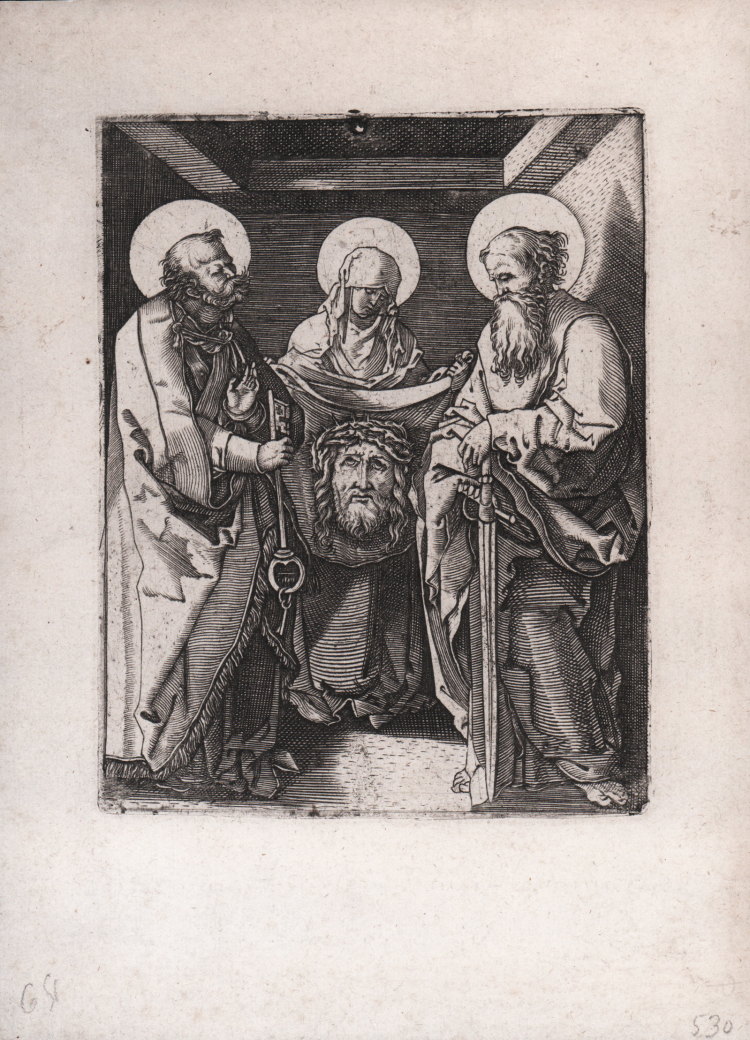
Engraving, circa 1515, unsigned and unmarked.
A fascinating and rare engraving, faithfully reproduced from Albrecht Dürer's famous woodcut (1510) entitled Saint Veronica Showing the Veil of the Holy Face between the Apostles Peter and Paul.
The print belongs to a series of 37 engravings on copper dedicated to the Passion of Christ by Marcantonio Raimondi, copies of Albrecht Dürer's well-known "Small Passion on wood" series. Raimondi copies all the episodes, including the title page, on the same verso, clearly with a reproducing intent and even imitating the woodcut technique with the engraving. However, in this case he omits Dürer's monogram, unlike other copies by the German artist, which are suspected of being outright forgery. These replicas, often even reproducing the monogram "AD" led to one of the first famous cases of forgery and debate over plagiarism in art history.
Raimondi's copies from this series are thought to date to the mid-1520s (in any case, the 1511 edition constitutes a terminus post quem), when Marcantonio was in Rome at the head of a thriving workshop that became famous above all for its copies of Raphael. It is hypothesized that this series of copperplates was actually engraved by Agostino dei Musi in Marcantonio's workshop.
However, this example, lacking the classic handle-shaped tablet used by Marcantonio as a signature, is a faithful replica of the engraving known from the bibliography.
https://www.calcografica.it/stampe/ingrosso.php?id=S-FC5114
It is likely a replica from the same workshop as Raimondi, where, among others, Agostino Veneziano and Marco Dente worked.
A magnificent work, rich in tone, printed on contemporary laid paper, with margins, in excellent condition. This work is not described in the repertoire and is extremely rare.
Scuola di Marcantonio Raimondi
|
Marcantonio Raimondi is considered the greatest engraver of early Renaissance and the first to spread the work of Raphael. He was born in San’Andrea in Argine, near Bologna. His first artistic apprenticeship took place in Bologna, around 1504, in the workshop of Francesco Francia, painter and goldsmith.
His first known engraving is dated 1505. In 1506 he went to Venice to live and work; in this year, he started developing his own personal style for, in his production that period, is quite evident the influence of Mantegna and Dürer. According to Vasari, Raimondi met Dürer in Venice, for they were both living there at the same time, but they had a quarrel over the reproductions, on copper, of Dürer’s seventeen woodcuts of the Vita della Vergine. After 1507, he turned to different models, especially those coming from Rome and Florence. He was in Rome in 1509, where he was introduced into the circle of the most important artists working in the City, such as Jacopo Rimanda from Bologna. In the same year he met Rapahel in the workshop of Baviera; the following year Raimondi became popular as the main interpreter of Raphael’s paintings. The Lucrezia can be considered the starting point of their cooperation and a sort of second beginning for Raimondi’s new style. In any case, together with the engravings representing Raphael’s works, Raimondi went on with the publication of his own subjects, especially antiquity, whose influence can be seen in his whole production (cfr. Dubois-Reymond 1978).
Between 1515-1516 Marcantonio started showing a keen interest for chiaroscuro, maybe under the influence fo Agostino Veneziano and Marco Dente, from Baviera’s workshop.
Till Raphael’s death, in 1520, Raimondi worked and lived in the background of the great artist from Urbino and engraved his works and those of his scholars.
His business went down after the Sacco (sack) Di Roma in 1527, when he was obliged to pay a huge amount of money to the invaders of the City to save his life.
He died in Bologna before 1534, in complete misery.
|
Scuola di Marcantonio Raimondi
|
Marcantonio Raimondi is considered the greatest engraver of early Renaissance and the first to spread the work of Raphael. He was born in San’Andrea in Argine, near Bologna. His first artistic apprenticeship took place in Bologna, around 1504, in the workshop of Francesco Francia, painter and goldsmith.
His first known engraving is dated 1505. In 1506 he went to Venice to live and work; in this year, he started developing his own personal style for, in his production that period, is quite evident the influence of Mantegna and Dürer. According to Vasari, Raimondi met Dürer in Venice, for they were both living there at the same time, but they had a quarrel over the reproductions, on copper, of Dürer’s seventeen woodcuts of the Vita della Vergine. After 1507, he turned to different models, especially those coming from Rome and Florence. He was in Rome in 1509, where he was introduced into the circle of the most important artists working in the City, such as Jacopo Rimanda from Bologna. In the same year he met Rapahel in the workshop of Baviera; the following year Raimondi became popular as the main interpreter of Raphael’s paintings. The Lucrezia can be considered the starting point of their cooperation and a sort of second beginning for Raimondi’s new style. In any case, together with the engravings representing Raphael’s works, Raimondi went on with the publication of his own subjects, especially antiquity, whose influence can be seen in his whole production (cfr. Dubois-Reymond 1978).
Between 1515-1516 Marcantonio started showing a keen interest for chiaroscuro, maybe under the influence fo Agostino Veneziano and Marco Dente, from Baviera’s workshop.
Till Raphael’s death, in 1520, Raimondi worked and lived in the background of the great artist from Urbino and engraved his works and those of his scholars.
His business went down after the Sacco (sack) Di Roma in 1527, when he was obliged to pay a huge amount of money to the invaders of the City to save his life.
He died in Bologna before 1534, in complete misery.
|