
| Reference: | A53545 |
| Author | Friedrich Eugen PEIPERS |
| Year: | 1834 |
| Zone: | Ischia |
| Measures: | 360 x 250 mm |
| Reference: | A53545 |
| Author | Friedrich Eugen PEIPERS |
| Year: | 1834 |
| Zone: | Ischia |
| Measures: | 360 x 250 mm |
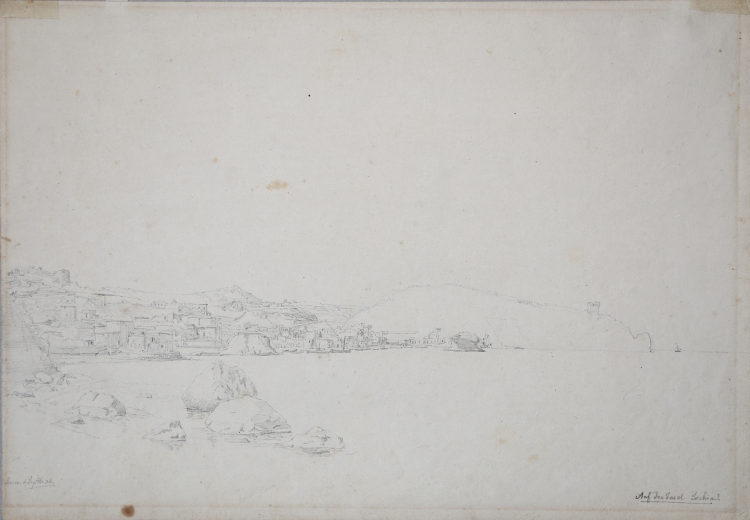
Finely executed pencil drawing on paper, dated lower left "Lacco, 4 Septh 34".
The sheet, typical of the style of 19th-century Grand Tour travelers, was originally part of a travel notebook.
The drawing is by the German painter and architect Friedrich Eugen Peipers (Stolberg, 1805 – Frankfurt am Main, 1885). The handwritten inscription visible at the lower right reads: "Auf der Fahrt n. Ischia" [On the journey to Ischia]. It depicts the coastline of Lacco Ameno, clearly showing the typical features of a seaside village. The thin pencil line faithfully depicts the characteristic semicircular inlet that surrounds the town's beach. The center of the sheet hints at the small white houses overlooking the sea and the historic structures located near the shore. The large rocks in the left foreground recall the volcanic nature of the place, dominated by green tuff. A little further to the right is the area containing the famous Fungo rock, the undisputed symbol of Lacco Ameno.
Friedrich Eugen Peipers was a refined landscape painter and drawing teacher at the Städel Art Institute in Frankfurt. During his travels in Italy in the 19th century, he produced numerous sketches and views from life of the coastal towns and ancient ruins of Southern Italy.
He is one of the many cultured artists, travelers, or talented amateur draftsmen who visited Italy in the mid-19th century to immortalize its most picturesque landscapes. Works of this type - animated views signed by artists on the Grand Tour or in the early post-unification period - possess considerable historical and documentary value, as they depict the urban layout before the major building transformations and restorations of the 20th century.
In excellent condition.
Friedrich Eugen PEIPERS (Stolberg 1805 - Francoforte 1885)
|
Friedrich Eugen Peipers (born November 10, 1805, in Stolberg, Rhineland; died February 17, 1885, in Frankfurt am Main) was a German landscape and vedute painter, drawing teacher, and architect. Peipers was the son of the dyer and knifemaker Johann Peter Jacob Peipers (1773–1811) and his wife Catharina Gertrudis, née Peltzer (1779–1862). Among the couple's two sons and three daughters, born between 1802 and 1811, was the future illustrator and painter Hermine Stilke, wife of the Düsseldorf history painter Hermann Stilke. From 1825 to 1828, Peipers studied philology and mathematics at the University of Bonn. In 1828, he moved to Frankfurt am Main. There he worked as a drawing teacher at various schools (the Model School, the School for the Deaf and Mute) and, from 1842 to 1860, also at the Städel Art Institute. His students included Carl Friedrich Harveng and Otto Scholderer. Peipers drew inspiration for his paintings and drawings from Frankfurt and its surroundings, from the Taunus mountains and the regions of the Rhine, Nahe, Lahn, and Moselle. He also traveled to southern Italy and along the Elbe River, near Dresden. He was one of the first artists of the Kronberg artists' colony. As supervising architect, he built the Old Frankfurt Stock Exchange between 1840 and 1843, designed by Friedrich August Stüler.
|
Friedrich Eugen PEIPERS (Stolberg 1805 - Francoforte 1885)
|
Friedrich Eugen Peipers (born November 10, 1805, in Stolberg, Rhineland; died February 17, 1885, in Frankfurt am Main) was a German landscape and vedute painter, drawing teacher, and architect. Peipers was the son of the dyer and knifemaker Johann Peter Jacob Peipers (1773–1811) and his wife Catharina Gertrudis, née Peltzer (1779–1862). Among the couple's two sons and three daughters, born between 1802 and 1811, was the future illustrator and painter Hermine Stilke, wife of the Düsseldorf history painter Hermann Stilke. From 1825 to 1828, Peipers studied philology and mathematics at the University of Bonn. In 1828, he moved to Frankfurt am Main. There he worked as a drawing teacher at various schools (the Model School, the School for the Deaf and Mute) and, from 1842 to 1860, also at the Städel Art Institute. His students included Carl Friedrich Harveng and Otto Scholderer. Peipers drew inspiration for his paintings and drawings from Frankfurt and its surroundings, from the Taunus mountains and the regions of the Rhine, Nahe, Lahn, and Moselle. He also traveled to southern Italy and along the Elbe River, near Dresden. He was one of the first artists of the Kronberg artists' colony. As supervising architect, he built the Old Frankfurt Stock Exchange between 1840 and 1843, designed by Friedrich August Stüler.
|