
- New
| Reference: | A54377 |
| Author | Ugo da CARPI |
| Year: | 1518 ca. |
| Measures: | 285 x 360 mm |
| Reference: | A54377 |
| Author | Ugo da CARPI |
| Year: | 1518 ca. |
| Measures: | 285 x 360 mm |
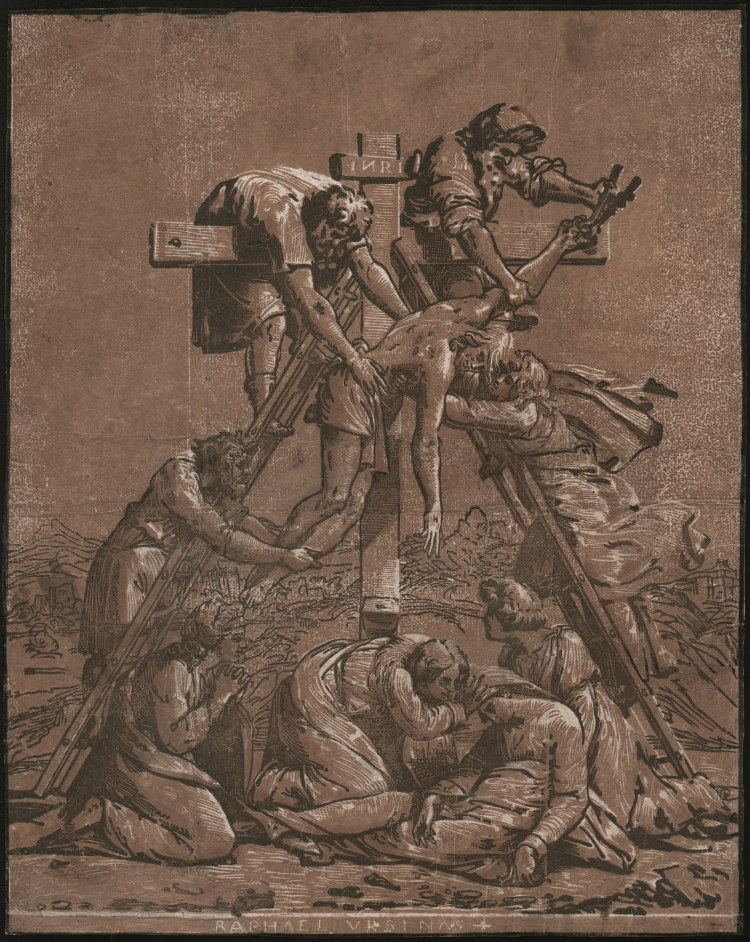
A three-block chiaroscuro woodcut, printed in tones of oily brown, greenish-brown, and black; signed in the lower right in impressions of the first state.
Based on a lost drawing by Raphael (Raffaello Sanzio).
This impression is in the second state, with the addition of Raphael’s name at the bottom.
Ugo da Carpi’s Deposition from the Cross, which bears the artist’s signature, attributes the conception of the work to Raphael. The absence of a definitive model or a related painting has given rise to numerous conjectures regarding the origin of the design. It has been hypothesized that Raphael’s original drawing dates to around 1506–1507 and that the composition was subsequently adapted for print by an artist from his workshop. Achille Gnann, however, has noted a stronger stylistic affinity with preparatory drawings by Raphael created around 1516–1518 for the Vatican Logge. Marcantonio Raimondi produced an engraving of the same subject, which differs from this chiaroscuro woodcut in several details - most notably in the height of the cross and the landscape setting. Although Ugo based three of his chiaroscuro woodcuts on engravings by Marcantonio, in this instance, the two printmakers may have worked independently, drawing upon the same original design.
Ugo’s Deposition from the Cross is known in at least two states. In the rare first state - of which six impressions survive - Ugo’s name appears within a plaque located in the lower right, on the block corresponding to the lighter tones, while the margin below the illusionistic frame remains blank. In the second state, which is more common, Ugo added the inscription “∙RAPHAEL∙VRBINAS+”. Three variants of this second version of Ugo’s work are known, though they are not easily distinguished from one another.
A magnificent impression, rich in tonal range, printed on contemporary laid paper without a watermark; there are paper creases and small, restored tears, as well as touches of color in areas where the woodblock had deteriorated - overall, in a good state of preservation.
Bibliografia
Bartsch A., Le peintre graveur, 1803-1821, v. XII, p. 43, n. 22; Johnson J., "I chiaroscuri di Ugo da Carpi", in Print Collector - Il conoscitore di stampe, Milano, 1982; Gnann A., In Farbe! Clair-obscur-Holzschnitte der Renaissance - Meisterwerke aus der Sammlung Georg Baselitz und der Albertina in Wien, Monaco, 2013, p. 116, n. 42; Takahatake N., "Raphael and the chiaroscuro woodcut", Raffael als Zeichner. Die Beiträge des Frankfurter Kolloquiums, 2015, pp. 167-186, pp. 167–86; Takahatake N., The Chiaroscuro Woodcut in Renaissance Italy, Los Angeles, 2018, pp. 83-85.
Ugo da CARPI (Carpi 1480 circa – Bologna 1532)
|
Vasari, the sixteenth-century biographer of Italian artists, claimed that Ugo (about 1450-1525) invented the chiaroscuro (light and shade) woodcut. His claim to the invention of this process has long been contested. Hans Burgkmair and Lucas Cranach were known to have made chiaroscuro prints in the north before 1510, whereas there is no definite evidence of Ugo’s work in this technique until 1516, when he appealed to the Venetian senate for protection from his imitators. Carpi was active in Venice and Rome. Many of his chiaroscuro prints are after drawings by Raphael and Parmigianino. None of his paintings survives.
|