- New
| Reference: | S7244 |
| Author | Bartolomeo CORIOLANO |
| Year: | 1640 ca. |
| Measures: | 195 x 280 mm |
| Reference: | S7244 |
| Author | Bartolomeo CORIOLANO |
| Year: | 1640 ca. |
| Measures: | 195 x 280 mm |
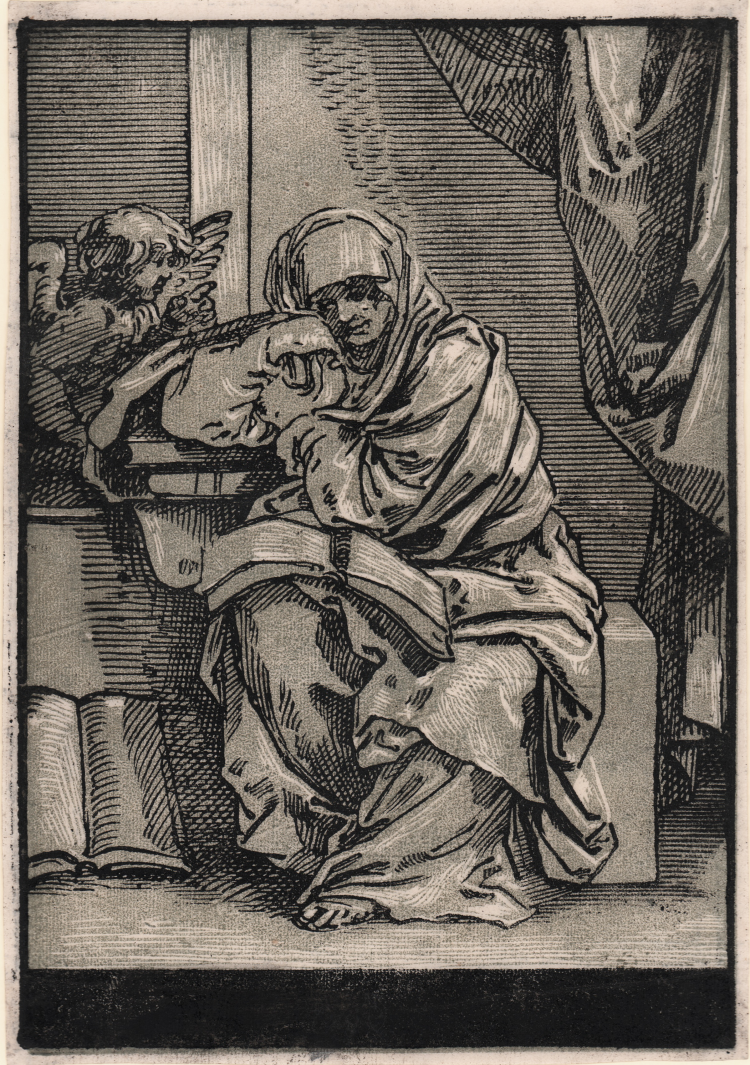
A two-block chiaroscuro woodcut, printed in black and green tones; unsigned by the artist.
Based on a subject by Guido Reni, the composition represents an allegory of Study.
This impression corresponds to the only known state described by Naoko Takahatake, who lists six different color variants for the print.
Guido Reni's preparatory drawing is housed at Windsor Castle [inv. no. 3474; cf. H. McBurney and N. Turner, 'Drawings by Guido Reni for woodcuts by Bartolomeo Coriolano', in “Print Quarterly”, vol. 5, Sept. 1988, p. 231].
Bartolomeo Coriolano (Bologna, 1590 or 1599–1676) was an Italian Baroque printmaker. His father, Cristoforo Coriolano, and his brother, Giovanni Battista Coriolano, were also printmakers. Coriolano was a pupil of the painter Guido Reni and modeled many of his woodcuts on his master's works, a common practice at the time. He was a traditional woodcut and chiaroscuro printer who followed the German printing style. His approach closely resembled the German method of using black for outlines and brown for tonal areas. He typically employed two blocks for his prints: one for the outlines and dark shadows - resembling pen hatching - and the other for the mid-tones. Coriolano's prints garnered great acclaim, even though his technique introduced no innovations. In recognition of his achievements, Pope Urban VII awarded him the knighthood of the Order of the Golden Spur and granted him a pension.
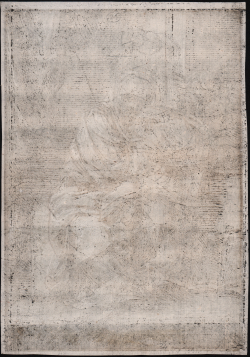
An exceptional impression - particularly sharp and rich in contrast and tonal range - printed on contemporary laid paper with a "scales" watermark; featuring unusually narrow margins beyond the borderline and a flawlessly executed, very minor restoration to the black border; in excellent condition. A complete example retaining the lower black border, which is usually missing. A sheet of outstanding quality.
Bibliografia
Bartsch vol. XII pag. 87, 2; Karpinski in “TIB” 48.2 (87); N. Takahatake, `Coriolano`, in “Print Quarterly”, vol.27, n. 2, p.126, n.13; Bertelà n. 353.
Bartolomeo CORIOLANO (Bologna 1599 - 1676)
|
Bartolomeo Coriolano was an Italian engraver during the Baroque period. His father, Cristoforo Coriolano, and brother, Giovanni Battista Coriolano were also woodblock printers, although there is some doubt over the actual relationship between Cristoforo and Bartolommeo Coriolano. Coriolano had a daughter, Teresa Maria Coriolano, who later became a painter and engraver.
Coriolano trained under the painter Guido Reni and modeled many of his woodblock prints on the work of his teacher, as was common. Coriolano was a traditional woodblock printer who followed the German style in printing. He was successful and popular, though not an innovator in the technique of woodblock printing. Eventually, he came to the attention of Pope Urban VII who granted Coriolano knighthood, as a "Roman count", and a pension. Coriolano's works are the most celebrated of the works produced by the Coriolano family.
|