
- New
| Reference: | A53740.1 |
| Author | Antonio da TRENTO |
| Year: | 1530 ca. |
| Measures: | 220 x 230 mm |
| Reference: | A53740.1 |
| Author | Antonio da TRENTO |
| Year: | 1530 ca. |
| Measures: | 220 x 230 mm |
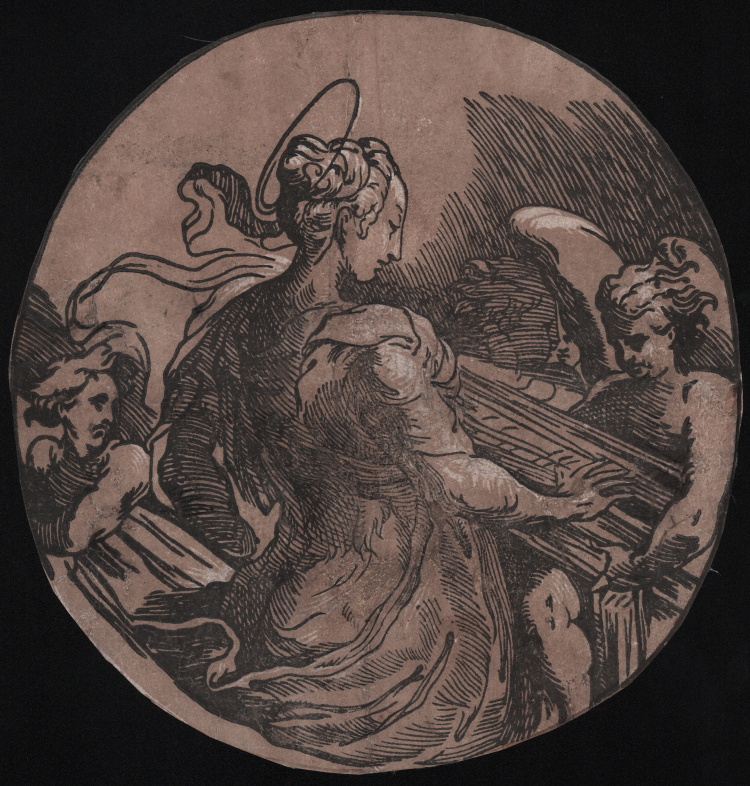
A two-block chiaroscuro woodcut, printed in black and olive, traditionally attributed to the printmaker Antonio da Trento (c. 1508–1550) and based on a design or invention by Parmigianino (1503–1540), dating to the first half of the 16th century.
An impression in the rare first state of two, before the addition of Andreani's monogram.
The work depicts Saint Cecilia seen from behind in profile, playing a harpsichord and surrounded by four angels. Two angels on the right support the musical instrument, while the angel on the left holds the train of the saint's mantle.
A black chalk drawing by Parmigianino [Inv. no. 1721], held at the Pushkin Museum in Moscow, shows the composition at a very advanced stage. According to Takahatake, the black chalk medium is not ideal as a model for a woodcut; she therefore believes that Parmigianino did not create the drawing specifically for the print. Trotter (1971) and Kurt Zeitler (2007) cite another compositional study in black chalk at the National Gallery in Oslo [Inv. no. NG.K&H.B.15274], in which two angels support the instrument - as in the chiaroscuro print - but the saint is depicted in a three-quarter view. Art historical scholarship attributes the chiaroscuro print to Antonio da Trento; however, Takahatake has identified printing characteristics typical of the workshop of Niccolò Vicentino.
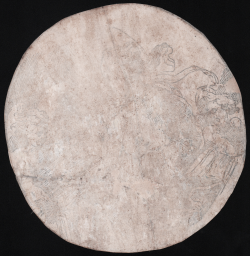
A magnificent impression, rich in tonal depth, printed on contemporary laid paper without a watermark; features perfectly executed restorations in the central area, as well as paper creases and traces of glue visible on the verso; overall in good condition. The chiaroscuro print has been cut into an oval shape; many examples in museum collections are trimmed to the borderline, just like this one.
Bibliografia
Bartsch A., Le peintre graveur, 1803-1821, v. XII, p. 85, n. 37; Naoko Takahatake, 'The chiaroscuro woodcut in Renaisssance Italy', Los Angeles 2018, p. 22; Naoko Takahatake, Atlante delle xilografie italiane del Rinascimento, ALU.0984.1, https://archivi.cini.it/storiaarte/detail/48908/stampa-48908.html; A. E. Popham, Catalogue of Drawings by Parmigianino, 1971, p. 117, n. 287; B. Barryte, Myth, Allegory and Faith, n. 447.
Antonio da TRENTO (Attivo a Bologna 1527 - 1530)
|
Italian printmaker. Five out of six documented chiaroscuro woodcuts by the artist (two signed, four mentioned by Vasari), are skilfully cut in a very controlled two-block style, for example Nude Man in a Landscape (B. p. 148, no. 13). The sixth, the Martyrdom of Two Saints (B. p. 79, no. 28; for illustration see WOODCUT, CHIAROSCURO), is among the best of Italian multiple-block chiaroscuros. All are after designs by Parmigianino. According to Vasari, Parmigianino, arriving in Bologna after the Sack of Rome in 1527, stayed with a friend for several months and retained Antonio to instruct him in the cutting of two- and three-block prints. Although Vasari stated elsewhere that Parmigianino prepared many other drawings to be incised in copper and printed, he implied that Antonio was employed for this purpose. The project failed because of Parmigianino’s painting obligations, whereupon Antonio stole all the prints (or possibly matrixes—Vasari is not clear) in copper and wood and as many drawings as possible and disappeared. Since the 18th century attempts have been made to rediscover him in the person of the etcher and painter Antonio Fantuzzi, active at Fontainebleau between 1537 and 1550. Four etchings (out of over 100) by Fantuzzi copy Parmigianino drawings and correspond to chiaroscuro designs. This overlap, the hiatus in Antonio da Trento’s career, the mention of copperplates by Vasari and the likelihood that such highly prized designs would find a further use enhance the theory, which, however, lacks firm substantiation. All of Antonio’s chiaroscuros were recut for later editions, though not those issued by Andreani
|