
- New
| Reference: | A54378 |
| Author | Antonio da TRENTO |
| Year: | 1527 ca. |
| Measures: | 230 x 177 mm |
| Reference: | A54378 |
| Author | Antonio da TRENTO |
| Year: | 1527 ca. |
| Measures: | 230 x 177 mm |
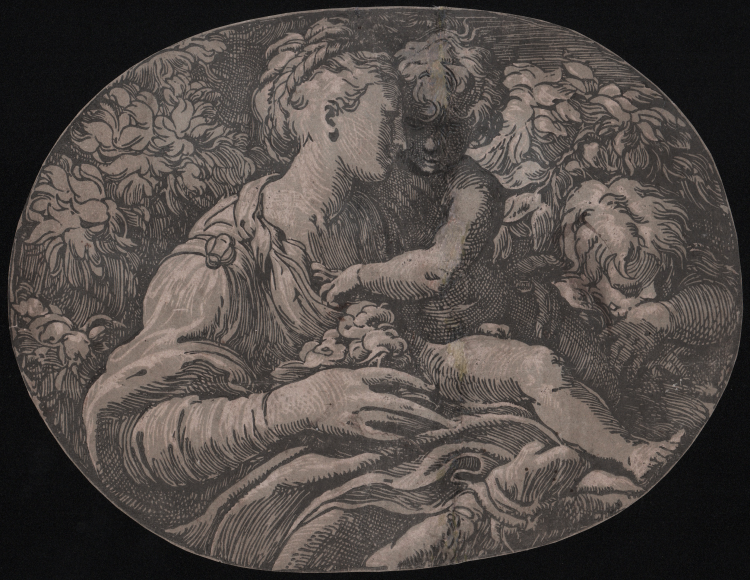
Chiaroscuro woodcut from two blocks, in shades of light green and gray, c. 1527–30.
The attribution of this unsigned print was first proposed by Giorgio Vasari, who included it among the four works created by Antonio da Trento in close collaboration with Parmigianino between 1527 and 1530.
The woodcut depicts an intimate group consisting of the Madonna holding the Christ Child, with the young Saint John the Baptist at her side. The figures are arranged in a shallow space, enclosed within an oval surrounded by a rectangular frame. Parmigianino’s preparatory drawing for the composition shows the figures without the background of lush foliage (Gnann 2008). A more freely executed drawing held at the Hermitage in St. Petersburg - which closely resembles the final composition and is also enclosed in an oval - was published by Harprath (1974; cf. Ekserdjian 2006). As with the other chiaroscuro woodcuts produced by Antonio in Bologna, no model for the complete design is known to exist; this supports the hypothesis that Parmigianino drew the composition directly onto the woodblocks.
The Virgin and Child with Saint John the Baptist exemplifies the carving skill and controlled printing technique typical of the early impressions of the chiaroscuro woodcuts produced by Antonio in collaboration with Parmigianino. The impression in question features a pastel color palette with relatively low contrast, achieved by superimposing the print from the outline block (in gray) over that of the tone block (in light green).
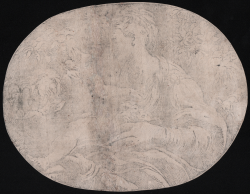
A magnificent impression, rich in tonal range, printed on contemporary laid paper without a watermark; trimmed to the borderline, with a restored vertical tear and minor abrasions, but otherwise in good condition.
Bibliografia
Bartsch A., Le peintre graveur, 1803-1821, v. XII, p. 56, n. 12; Naoko Takahatake, 'The chiaroscuro woodcut in Renaisssance Italy', Los Angeles 2018, n. 26; Stiber Morenus L., Atlante delle xilografie italiane del Rinascimento, ALU.0961.1, https://archivi.cini.it/storiaarte/detail/47065/stampa-47065.html
Antonio da TRENTO (Attivo a Bologna 1527 - 1530)
|
Italian printmaker. Five out of six documented chiaroscuro woodcuts by the artist (two signed, four mentioned by Vasari), are skilfully cut in a very controlled two-block style, for example Nude Man in a Landscape (B. p. 148, no. 13). The sixth, the Martyrdom of Two Saints (B. p. 79, no. 28; for illustration see WOODCUT, CHIAROSCURO), is among the best of Italian multiple-block chiaroscuros. All are after designs by Parmigianino. According to Vasari, Parmigianino, arriving in Bologna after the Sack of Rome in 1527, stayed with a friend for several months and retained Antonio to instruct him in the cutting of two- and three-block prints. Although Vasari stated elsewhere that Parmigianino prepared many other drawings to be incised in copper and printed, he implied that Antonio was employed for this purpose. The project failed because of Parmigianino’s painting obligations, whereupon Antonio stole all the prints (or possibly matrixes—Vasari is not clear) in copper and wood and as many drawings as possible and disappeared. Since the 18th century attempts have been made to rediscover him in the person of the etcher and painter Antonio Fantuzzi, active at Fontainebleau between 1537 and 1550. Four etchings (out of over 100) by Fantuzzi copy Parmigianino drawings and correspond to chiaroscuro designs. This overlap, the hiatus in Antonio da Trento’s career, the mention of copperplates by Vasari and the likelihood that such highly prized designs would find a further use enhance the theory, which, however, lacks firm substantiation. All of Antonio’s chiaroscuros were recut for later editions, though not those issued by Andreani
|