
- New
| Reference: | A54379 |
| Author | Antonio da TRENTO |
| Year: | 1540 ca. |
| Measures: | 148 x 102 mm |
| Reference: | A54379 |
| Author | Antonio da TRENTO |
| Year: | 1540 ca. |
| Measures: | 148 x 102 mm |
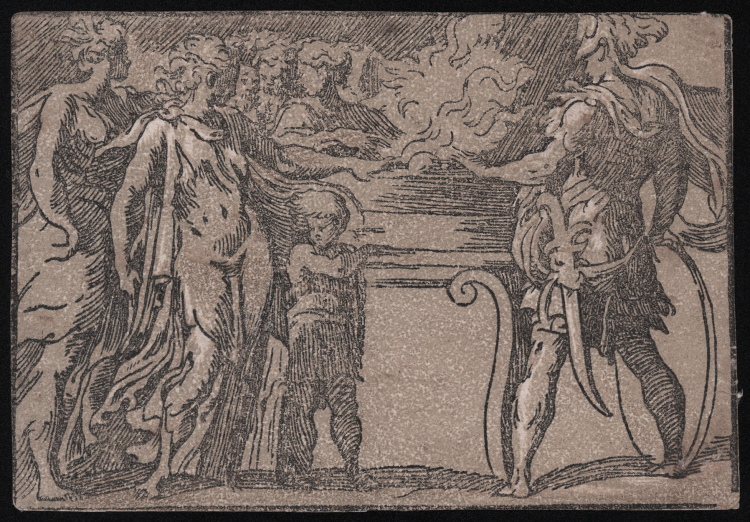
Chiaroscuro woodcut from two blocks, light brown and black tones, c. 1540–50.
After a subject by Parmigianino.
The chiaroscuro woodcut depicts a group of seven figures - men, women and children - gathered around an altar. The fire burning atop the altar, towards which most of the figures direct their gazes and gestures, suggests that the scene represents a sacrifice. The figures' classical attire evokes Roman antiquity.
The scene has been identified as the sacrifice of Mucius Scaevola. Legend has it that during the siege of Rome by the Etruscan king Porsenna, Mucius Scaevola was captured while attempting to assassinate the enemy leader under the cover of night. Subjected to an ordeal by fire, he held his hand in the flames without showing any sign of distress. Porsenna was so struck by his adversary's courage that he released him and lifted the siege of Rome.
The composition derives from a design by Parmigianino known through sheets that are now lost but were published by Popham; a metalpoint study of the figure of Mucius Scaevola is preserved at Chatsworth [Inv. no. 795C; cf. A. E. Popham, Catalogue of Drawings by Parmigianino, 1971, vol. I, p. 211, no. 726]. The left half is based on a drawing by the artist held at the École des Beaux-Arts in Paris [EBA 228].
Naoko Takahatake notes that the print's characteristics point to the workshop of Niccolò Vicentino and that the blocks were likely cut by Antonio da Trento or by Vicentino himself.
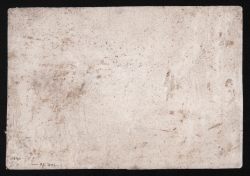
A fine impression, on contemporary unwatermarked laid paper; small restoration at the upper right corner, otherwise in excellent condition.
Bibliografia
Bartsch A., Le peintre graveur, 1803-1821, v. XII, p. 152, n. 21; Takahatake N., Atlante delle xilografie italiane del Rinascimento, ALU.0982.1, https://archivi.cini.it/storiaarte/detail/48455/stampa-48455.html
Antonio da TRENTO (Attivo a Bologna 1527 - 1530)
|
Italian printmaker. Five out of six documented chiaroscuro woodcuts by the artist (two signed, four mentioned by Vasari), are skilfully cut in a very controlled two-block style, for example Nude Man in a Landscape (B. p. 148, no. 13). The sixth, the Martyrdom of Two Saints (B. p. 79, no. 28; for illustration see WOODCUT, CHIAROSCURO), is among the best of Italian multiple-block chiaroscuros. All are after designs by Parmigianino. According to Vasari, Parmigianino, arriving in Bologna after the Sack of Rome in 1527, stayed with a friend for several months and retained Antonio to instruct him in the cutting of two- and three-block prints. Although Vasari stated elsewhere that Parmigianino prepared many other drawings to be incised in copper and printed, he implied that Antonio was employed for this purpose. The project failed because of Parmigianino’s painting obligations, whereupon Antonio stole all the prints (or possibly matrixes—Vasari is not clear) in copper and wood and as many drawings as possible and disappeared. Since the 18th century attempts have been made to rediscover him in the person of the etcher and painter Antonio Fantuzzi, active at Fontainebleau between 1537 and 1550. Four etchings (out of over 100) by Fantuzzi copy Parmigianino drawings and correspond to chiaroscuro designs. This overlap, the hiatus in Antonio da Trento’s career, the mention of copperplates by Vasari and the likelihood that such highly prized designs would find a further use enhance the theory, which, however, lacks firm substantiation. All of Antonio’s chiaroscuros were recut for later editions, though not those issued by Andreani
|