
| Reference: | CO-282 |
| Author | Giovanni Pietro BIGONCI |
| Year: | 1665 |
| Zone: | Fondi |
| Printed: | Venice |
| Measures: | 120 x 120 mm |
| Reference: | CO-282 |
| Author | Giovanni Pietro BIGONCI |
| Year: | 1665 |
| Zone: | Fondi |
| Printed: | Venice |
| Measures: | 120 x 120 mm |
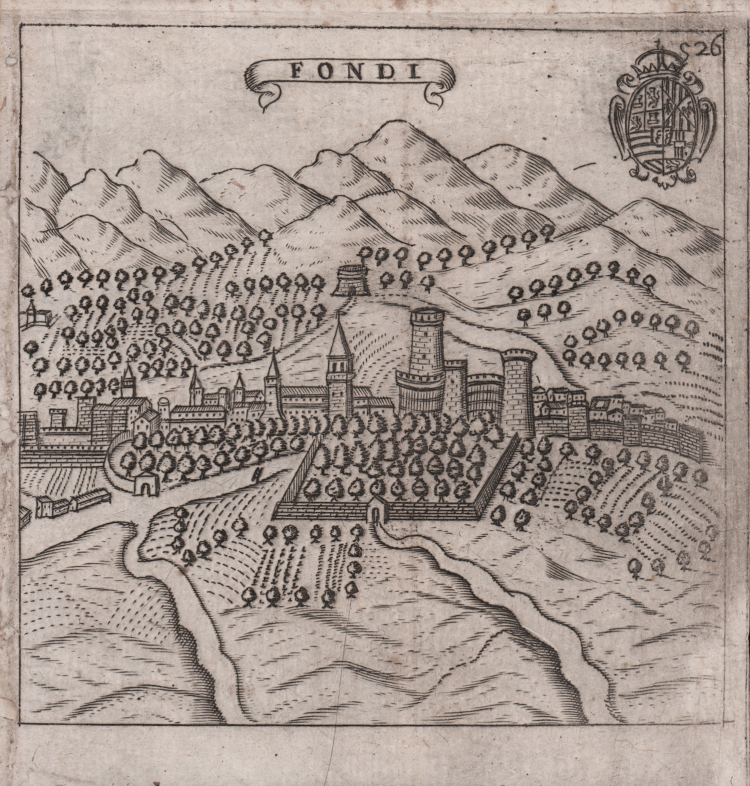
Plate taken from "Itinerario, overo nova descrittione de' viaggi principali d'Italia [...] di Francesco Scoto" published in Venice by Pietro Brigonci in 1665.
His first edition of the Itinerario was in 1665 and had the text taken from Cadorin's publication of 1659, which extended the story to Friuli, Sicily, Malta, Latium and the Holy Land, and in the same year a reprint also included plates on these territories.
In 1670, 1673, 1676 and 1679 there were other editions by Brigonci, all Venetian, all with the unchanged title "Itinerario, overo nova descrittione de' viaggi principali d'Italia [...] di Francesco Scoto", all enriched with just under forty antique prints with views of cities.
Franz Schott (1548-1622), Italianized as Francesco Scoto, was a native of Antwerp. A jurist and great traveler, brother of the better known Andreas, a Jesuit, philologist and antiquarian, he compiled "Itinerario overo decrittione de' viaggi principali in Italia." The work first appeared in Antwerp on the occasion of the Jubilee of 1600, under the title Itinerari Italiae rerumq[ue] romanarum libri tres, printed in the Officina Plantiniana by Joannes Moretus. Devoid of the iconographic apparatus, it was intended as a service to pilgrims traveling to Italy and an expression of a particular form of odeporic writing that embraced all those texts that take on the character of a travel guide and offer themselves as a tool aimed at orienting the traveler in his journey. It was a great success and was then published in numerous subsequent editions in Latin, Italian, French and English.
The Itinerary of Italy had its full development in the numerous Italian editions, which were richly illustrated with perspective views and city plans. The first illustrated Italian edition was edited by Pietro Bertelli and Francesco Bolzetta (Vicenza or Venice 1601); several editions by Bolzetta followed with an increasing number of cartographic illustrations. Schott's text was also used for their own editions of the Itinerario d'Italia by Matteo Cadorin (Padua 1654 and later) and Pietro Bigonci (Venice 1665).
Also in Rome, in the Jubilee year 1650, the publisher Filippo de Rossi printed Itinerario overo Nuova Descrittione de' Viaggi Principali d'Italia. There are 19 prints to which the map of Italy is added, and they are slightly more accurate.
The plates of the Roman edition (made by means of new copper plates) were reprinted in later editions - augmented - by the publishers Michelangelo and Pier Vincenzo de Rossi (1669, 1700 and 1717) and then in those edited by Fausto Amidei, a book dealer on the Corso, who had Antonio de Rossi print the first of his three editions of Francesco Scoto's Itinerario d'Italia in 1737. The others were in 1747 in the printing house of Bernabò and Lazzarini and in 1761 in the printing house of Generoso Salomoni.
Etching, usual editorial paper folds, in very good condition.
Giovanni Pietro BIGONCI (attivo a Venezia tra il 1658 - 1680)
|
Few biographical details—such as exact dates of birth and death—have survived regarding the private life of Giovanni Pietro Brigonci. This is common for many artisans and printers of the early modern period, whose biographies must be reconstructed almost entirely through the history of their workshops. Brigonci was active in the Republic of Venice during a century of profound transformation for the book market. Following the splendor of the Renaissance, the Venetian printing industry faced intense foreign competition and a production crisis, leading it to focus on reprinting classics, religious texts, popular historical works, and practical manuals. The first documented editions bearing his name date back to 1658. To open and operate a printing house in Venice, one had to be a member of the *Arte degli Stampatori e Librai* (Guild of Printers and Booksellers), the corporation that regulated the trade and oversaw quality standards and licensing. For about twenty years, Giovanni Pietro Brigonci personally managed his printing house with great consistency, integrating himself into the city’s commercial networks and collaborating with other contemporary Venetian booksellers and publishers—as evidenced, for instance, in the workshop inventories of the printer Antonio Bosio. Brigonci specialized in volumes aimed at a broad yet educated readership, including compendia of universal history, treatises on rhetoric, travel narratives (such as his 1676 edition of Fernando Colombo’s *Historie* concerning the life of Christopher Columbus), and devotional texts. He frequently paid close attention to the aesthetic design of his title pages, embellishing them with copperplate engravings and views of Venice. Like many of his peers, he employed various printer’s marks—ranging from depictions of the lagoon city to classical allegories—accompanied by the customary phrase, "Con Licenza de' Superiori, e Privilegio" ("With the License of the Superiors and Privilege"), which served as essential proof that the works had passed both ecclesiastical and state censorship. Around the end of the 1670s, Giovanni Pietro’s direct involvement in the business gave way to his successors. From the 1680s onwards, Pietro Antonio Brigonci took over the management, operating under the business name "Eredi di Gio. Pietro Brigonci" (Heirs of Gio. Pietro Brigonci). International bibliographic records indicate that the activity associated with his name came to an end in 1696.
|