


| Reference: | S47042 |
| Author | Giovanni DAVID |
| Year: | 1776 |
| Measures: | 230 x 350 mm |
| Reference: | S47042 |
| Author | Giovanni DAVID |
| Year: | 1776 |
| Measures: | 230 x 350 mm |
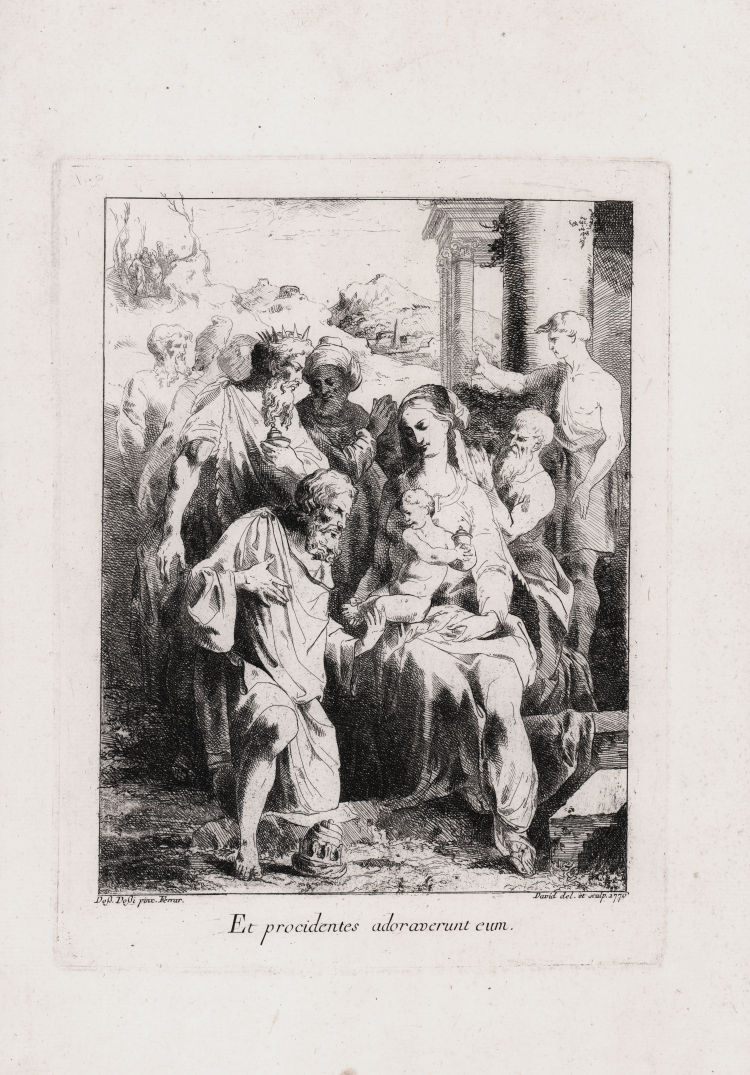
The Adoration of the Magi, with a kneeling Magus holding Christ's foot.
Etching, signed and dated "David del. et Sculp. 1776" on the plate, lower right.
After a subject by Battista Dossi.
This example is in the second state of three described in Newcome Schleier-Grasso.
Giovanni David was an Italian painter and printmaker active in the 18th century. His work, influenced by the Venetian and Roman schools, is distinguished by his refined use of etching and aquatint techniques, as well as a pictorial language that anticipates pre-Romantic sensibilities. Here he devoted himself intensely to printmaking: he created a series of etchings with portraits and popular figures, dated 1775, some of which are dedicated to Corvi, who identifies him as his pupil. In Venice, David studied Venetian painting in depth, assimilating compositional and chromatic elements that distanced him from Roman classicism. He experimented effectively with aquatint, which allowed him to combine graphic immediacy with pictorial rendering.
Magnificent work on contemporary laid paper with a "large letter W" watermark and a cloverleaf crown, wide margins, in perfect condition.
Bibliografia
Newcome Schleier-Grasso, Giovanni David. Pittore e incisore della famiglia Durazzo, n. 130, ii/iii.
Giovanni DAVID (Cabella, 1743 – Genova, 1790)
|
Giovanni David was an Italian painter and engraver active in the 18th century. His work, influenced by the Venetian and Roman schools, is distinguished by his refined use of etching and aquatint techniques, as well as a pictorial language that anticipates pre-Romantic sensibilities. He was born in Cabella Ligure (Alessandria) in 1743 to Paolo David, a textile decorator, and Maria Antonia Radavero. After his father's death in Sampierdarena in 1785, David embarked on an artistic journey, fostered by the patronage of the Durazzo family, which played a crucial role in his travels and cultural education. Around 1770, he moved to Rome, where he met Domenico Corvi, who greatly influenced him. In 1775, he won the Balestra Prize for painting from the Accademia di San Luca. The Underground with Tombs, a watercolor drawing that reflects the "ruinistic" taste then in vogue in the capital, may date from this sojourn. In 1775, he settled in Venice, under the protection of Giacomo Durazzo, the imperial ambassador. Here, he devoted himself intensely to engraving: he created a series of etchings with portraits and popular figures, dated 1775, some of which are dedicated to Corvi, who identifies him as his pupil. In Venice, David studied Venetian painting in depth, assimilating compositional and chromatic elements that distanced him from Roman classicism. He experimented effectively with aquatint, which allowed him to combine graphic immediacy with pictorial rendering. Returning to Genoa in the final years of the decade, he continued an intense painting activity there while continuing to travel abroad, to France, England, and the Netherlands. He died suddenly of apoplexy on January 25, 1790, in Genoa, and was buried in the church of San Sisto.
|
Giovanni DAVID (Cabella, 1743 – Genova, 1790)
|
Giovanni David was an Italian painter and engraver active in the 18th century. His work, influenced by the Venetian and Roman schools, is distinguished by his refined use of etching and aquatint techniques, as well as a pictorial language that anticipates pre-Romantic sensibilities. He was born in Cabella Ligure (Alessandria) in 1743 to Paolo David, a textile decorator, and Maria Antonia Radavero. After his father's death in Sampierdarena in 1785, David embarked on an artistic journey, fostered by the patronage of the Durazzo family, which played a crucial role in his travels and cultural education. Around 1770, he moved to Rome, where he met Domenico Corvi, who greatly influenced him. In 1775, he won the Balestra Prize for painting from the Accademia di San Luca. The Underground with Tombs, a watercolor drawing that reflects the "ruinistic" taste then in vogue in the capital, may date from this sojourn. In 1775, he settled in Venice, under the protection of Giacomo Durazzo, the imperial ambassador. Here, he devoted himself intensely to engraving: he created a series of etchings with portraits and popular figures, dated 1775, some of which are dedicated to Corvi, who identifies him as his pupil. In Venice, David studied Venetian painting in depth, assimilating compositional and chromatic elements that distanced him from Roman classicism. He experimented effectively with aquatint, which allowed him to combine graphic immediacy with pictorial rendering. Returning to Genoa in the final years of the decade, he continued an intense painting activity there while continuing to travel abroad, to France, England, and the Netherlands. He died suddenly of apoplexy on January 25, 1790, in Genoa, and was buried in the church of San Sisto.
|