
| Reference: | S47006 |
| Author | Marcello ORETTI |
| Year: | 1740 ca. |
| Measures: | 80 x 100 mm |
| Reference: | S47006 |
| Author | Marcello ORETTI |
| Year: | 1740 ca. |
| Measures: | 80 x 100 mm |
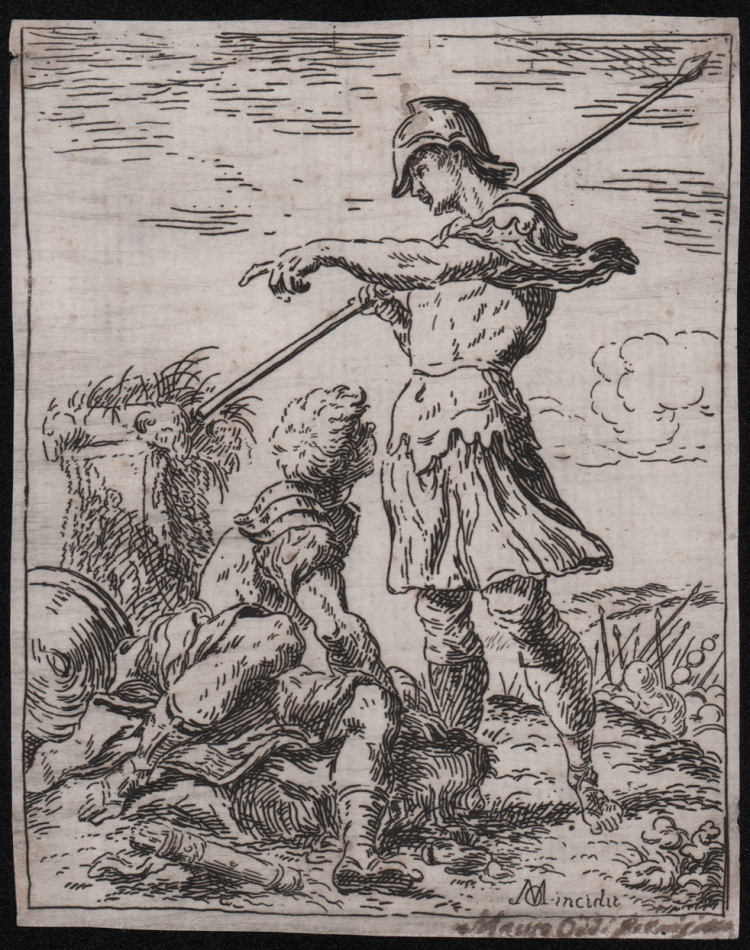
Reverse copy of the etching by Antonio Balestra.
https://www.antiquarius.it/en/xviii-century-italian-school/15965-two-soldiers.html
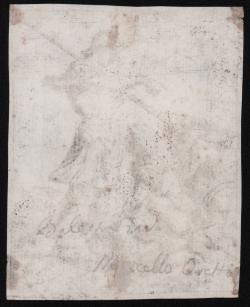
The print, previously attributed to Mauro Oddi (our copy bears an old manuscript inscription attributing it to Oddi), is now correctly ascribed to Marcello Oretti.
Oretti (1714-1787), son of a doctor of philosophy and medicine, the erudite Bolognese devoted his entire life to historical-artistic studies; having learned the "principles of drawing" from Ludovico Mattioli and Donato Creti, he also devoted himself to painting and engraving. In the city of Verona, in particular, he joined the Muselli family. As his own copperplate work, Oretti recalls a sacred scene "with a holy bishop, Our Lord and the souls in purgatory", which is not found today. Also known are the reproductions of the Martyrdom of Saint George by Paolo Veronese («delineauit et incidit MO») and of a Rest on the Flight into Egypt by Giambettino Cignaroli ("MO incidit Veronæ"). Establishing the chronology of these prints is not at all easy, since Oretti stayed on the banks of the Adige several times between at least 1741 and 1775. Strictly speaking, they should be dated to his youth, around the first end. As for the engravings after Balestra, there is nothing to stop us from believing so—one might even think of them as a tribute to the master while he was still alive. (cfr. Paolo Delorenzi, «Piacevoli carte» intagliate per «spasso». Antonio Balestra peintre-graveur, p. 125).
A fine impression, printed on contemporary laid paper, trimmed to the platemark, in good condition. A very rare work.
Bibliografia
Paolo Delorenzi, «Piacevoli carte» intagliate per «spasso». Antonio Balestra peintre-graveur, in “Antonio Balestra. Nel segno della Grazia”, catalogo della mostra (Verona, Museo di Castelvecchio, 19 novembre 2016 - 19 febbraio 2017), a cura di A. Tomezzoli, Verona 2016, pp. 115-127.
|
He was born in Bologna on December 27, 1714, to Francesco Antonio, a professor of medicine at the University of Bologna from 1697 until his death (1746), and his wife Camilla Fabri, niece of Marcello Malpighi.
He was educated in Jesuit schools, later continuing his studies in philosophy and the most popular foreign languages of the time: French and German. Despite this, his manuscripts—none of which were published during his lifetime—reveal a rough command of Italian, which may explain why he doesn't merit an entry in Giovanni Fantuzzi's Notizie degli scrittori bolognesi, but only a fleeting incidental mention.
He had two older brothers, Sicinio, a notary by profession (his son Riniero was also a notary), and Giuseppe, a career soldier, and at least one sister, Gentile, who married Giacomo Arnoaldi, a law professor at the University of Bologna from 1744 until his death. The family, a long-established minor Bolognese nobility, had seen its fortunes gradually decline throughout the 16th and 17th centuries. Only in 1722 was the family trust, established in 1492, added to that of Ercole Rigosa, the last member of another ancient and noble Bolognese family now in extinction. This trust, along with a commitment for the three Oretti brothers to adopt his surname, was granted. Thus, in public documents, Marcello appears to have been unemployed, living off modest income from land and real estate. However, he does not appear to have married or fathered children, which allowed him, despite his modest means, to travel. There are no documented trips outside Italy, but, especially in the second half of the 1770s, he visited the country, from Lombardy to his beloved Veneto, Romagna, Tuscany, the entire Papal States, and even Naples. He also amassed a notable library specializing in art history and devoted himself to collecting archaeological artifacts (his collection is described by Luigi Lanzi in his 1782 notebook: Florence, Library of the Uffizi Gallery, ms. 36/I, fol. 98v), coins, graphic works, and paintings, as well as naturalistic specimens, minerals (gems, semi-precious stones, marbles, fossils), and shells.
All of these collections are described by Oretti himself in some of his approximately 60 autograph manuscripts preserved in the Biblioteca comunale dell'Archiginnasio in Bologna (where the manuscripts cited below are located, unless otherwise specified; for the collections, see mss. B 402-B 405), which they acquired in 1872, included in the purchase of the vast collection of Prince Filippo Hercolani (1736-1810), who had acquired them shortly after Oretti's death. Scattered individual volumes are available in other Italian libraries, such as the Estense Library in Modena.
|
|
He was born in Bologna on December 27, 1714, to Francesco Antonio, a professor of medicine at the University of Bologna from 1697 until his death (1746), and his wife Camilla Fabri, niece of Marcello Malpighi.
He was educated in Jesuit schools, later continuing his studies in philosophy and the most popular foreign languages of the time: French and German. Despite this, his manuscripts—none of which were published during his lifetime—reveal a rough command of Italian, which may explain why he doesn't merit an entry in Giovanni Fantuzzi's Notizie degli scrittori bolognesi, but only a fleeting incidental mention.
He had two older brothers, Sicinio, a notary by profession (his son Riniero was also a notary), and Giuseppe, a career soldier, and at least one sister, Gentile, who married Giacomo Arnoaldi, a law professor at the University of Bologna from 1744 until his death. The family, a long-established minor Bolognese nobility, had seen its fortunes gradually decline throughout the 16th and 17th centuries. Only in 1722 was the family trust, established in 1492, added to that of Ercole Rigosa, the last member of another ancient and noble Bolognese family now in extinction. This trust, along with a commitment for the three Oretti brothers to adopt his surname, was granted. Thus, in public documents, Marcello appears to have been unemployed, living off modest income from land and real estate. However, he does not appear to have married or fathered children, which allowed him, despite his modest means, to travel. There are no documented trips outside Italy, but, especially in the second half of the 1770s, he visited the country, from Lombardy to his beloved Veneto, Romagna, Tuscany, the entire Papal States, and even Naples. He also amassed a notable library specializing in art history and devoted himself to collecting archaeological artifacts (his collection is described by Luigi Lanzi in his 1782 notebook: Florence, Library of the Uffizi Gallery, ms. 36/I, fol. 98v), coins, graphic works, and paintings, as well as naturalistic specimens, minerals (gems, semi-precious stones, marbles, fossils), and shells.
All of these collections are described by Oretti himself in some of his approximately 60 autograph manuscripts preserved in the Biblioteca comunale dell'Archiginnasio in Bologna (where the manuscripts cited below are located, unless otherwise specified; for the collections, see mss. B 402-B 405), which they acquired in 1872, included in the purchase of the vast collection of Prince Filippo Hercolani (1736-1810), who had acquired them shortly after Oretti's death. Scattered individual volumes are available in other Italian libraries, such as the Estense Library in Modena.
|