
| Reference: | S52061 |
| Author | Pietro FABRIS |
| Year: | 1780 ca. |
| Measures: | 145 x 205 mm |
| Reference: | S52061 |
| Author | Pietro FABRIS |
| Year: | 1780 ca. |
| Measures: | 145 x 205 mm |
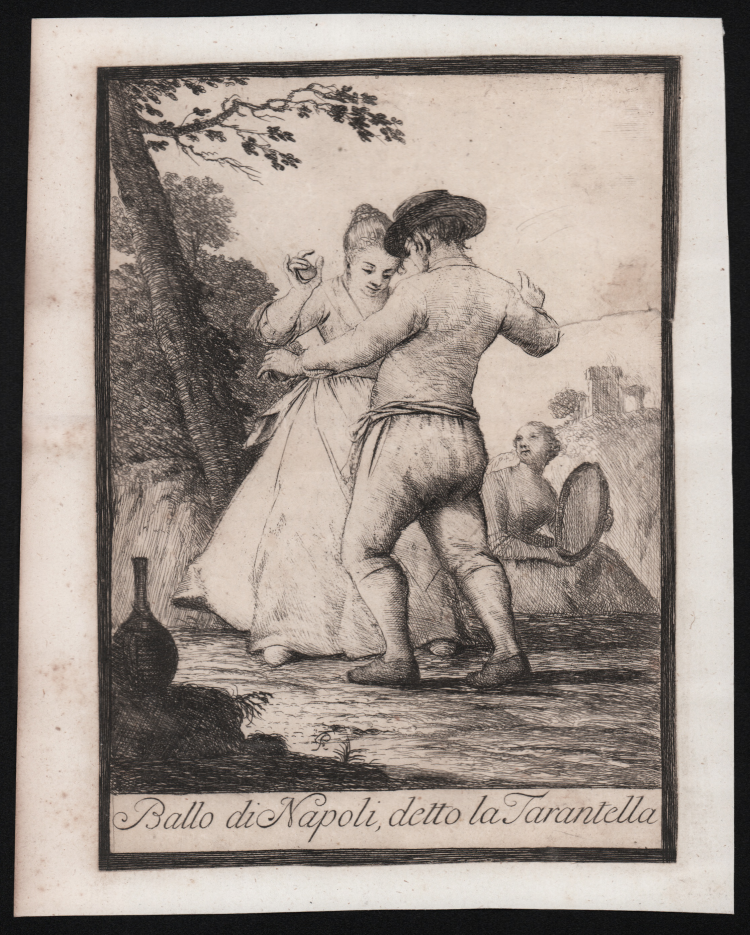
Etching, circa 1780, signed with the monogram PF at the bottom centre.
It depicts the famous folk dance of the Tarantella, typical of southern Italy, which has traditionally become characteristic of the Neapolitan people. According to its etymology, it seems to originate from Taranto, or perhaps its name derives from the tarantula, whose bite, according to popular belief, produces a kind of Bacchic frenzy that excites people to dance. The tarantella has been known since the 14th century. It is similar to the saltarello, with which it is confused in certain regions.
Pietro Fabris, active in Naples between 1756 and 1792, was probably of English origin. More detailed and specific biographical data are lacking; even his nationality is attested only by the fact that he himself describes himself in many paintings, next to his signature, as an “English painter”. Fabris's activity took place entirely in Naples, with the probable interruption of a few stays in London, and he was fully integrated into the cultural scene there. His vast known artistic production includes numerous oil paintings on canvas, gouaches and drawings, inspired by Neapolitan views and landscapes and popular scenes, festivals and customs of southern Italy.
A beautiful example, printed on contemporary laid paper, trimmed to the copperplate and mounted on antique paper support, traces of paper folds, otherwise in good condition. Rare.
Pietro FABRIS (Attivo a Napoli 1759 - 79)
|
Italian painter and engraver. He worked in Naples for most of his life, but frequently added the phrase ‘English painter’ to his signature. His genre scenes and landscapes, of which the earliest are four large canvases of Scenes of Popular Life (1756–7; Naples, priv. col.), illustrate events at the royal court as well as picturesque scenes of Neapolitan life with pedlars, fishermen, picnickers and dancers; they were popular with those making the Grand Tour. Two paintings representing the Departure of Charles III of Bourbon for Spain (Aranjuez, Pal. Real) were presumably painted in 1759, when this event occurred. In 1768 Fabris exhibited in London at the Free Society and accompanied the British envoy, Sir William Hamilton, to Sicily; he included a portrait of this enthusiastic patron in one of two genre scenes showing the Drawing-room in Lord Fortrose’s Apartment in Naples (1770; Edinburgh, N.P.G.). He exhibited again in London in 1772 at the Society of Artists.
|
Pietro FABRIS (Attivo a Napoli 1759 - 79)
|
Italian painter and engraver. He worked in Naples for most of his life, but frequently added the phrase ‘English painter’ to his signature. His genre scenes and landscapes, of which the earliest are four large canvases of Scenes of Popular Life (1756–7; Naples, priv. col.), illustrate events at the royal court as well as picturesque scenes of Neapolitan life with pedlars, fishermen, picnickers and dancers; they were popular with those making the Grand Tour. Two paintings representing the Departure of Charles III of Bourbon for Spain (Aranjuez, Pal. Real) were presumably painted in 1759, when this event occurred. In 1768 Fabris exhibited in London at the Free Society and accompanied the British envoy, Sir William Hamilton, to Sicily; he included a portrait of this enthusiastic patron in one of two genre scenes showing the Drawing-room in Lord Fortrose’s Apartment in Naples (1770; Edinburgh, N.P.G.). He exhibited again in London in 1772 at the Society of Artists.
|